• The Green Fuse

    by

    God is alive.
    Magic is afoot.
    — Buffy Saint-Marie

    Several years ago for a few weeks, I lived in the middle of the Green Mountain National Forest in Vermont. One day I decided to hike into the mountains several miles from the campus where I attended graduate school. The day dripped humidity, but when the breeze slid across me I felt cool. I drove the six miles from campus to the top of Middlebury Gap where the Long Trail, a path that snakes along the tops of the Appalachian Mountains from Georgia to Canada, crosses the highway. As I applied insect repellent, and situated the water bottle and lunch supplies in my back pack, cars and lumber company trucks rumbled past where I had parked on the side of the road. Finally, with all my preparations complete, I waited for a gap in the flow of traffic, crossed the road and entered the forest. Fifteen yards into the trees, the road disappeared. Another twenty yards into the forest and I came across a National Forest Service sign that read: “Now entering a Primitive Wilderness Area.” I laughed to myself. My mind conditioned by the graduate classes I had sat through for the last three weeks to split differences in meaning from one word in a poem to the next dryly provided, “That means on this side of the sign I’m in civilization.” The trees on either side of the sign stood mute to my humor.

    Below the sign, inside a covered box , a registration book lay filled with the names and the cities of hikers ranging from Maine to California, who had passed into the woods before me. The book requested that I sign-in, like a hotel, in case of an emergency and the park rangers needed to help someone locate me. I dutifully signed in putting the day’s date next to my name as I wondered if the group who had signed in two days before me were still on the trail heading south toward Georgia. My planned four to five hour hike seemed like a lark.

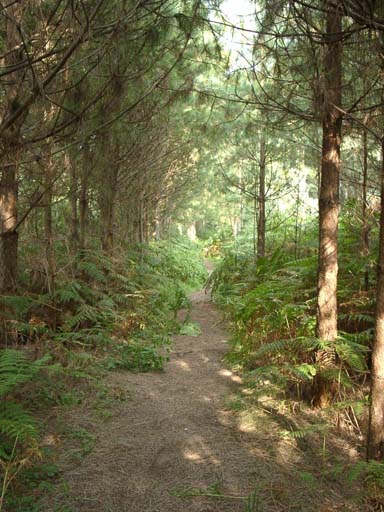
    When I first left the mid-June heat of Texas for the green of Vermont, I was amazed with the lush variety of greens that blanketed the rounded mountains. But the green that I encountered as I left the road overwhelmed me. Fern and day lillies burst forth from the forest floor. Moss grew thick across fallen trees and rocks. The Blue Spruce and pine trees threw a dark green canopy over my head blocking the sky. The sunlight that managed to pierce through the tree tops stabbed down in white columns similar to the light I once saw pour down through a window of the Vatican, bathing a priest saying mass to the left of the main alter with an angelic glow.

    As I walked up the trail, using the roots of the trees that crawled across the path like steps, a faint breeze would peer from around the trunk of a pine and touch me lightly on the forehead like a benediction before disappearing into the woods on the other side of the trail. The hike proved not overly difficult, but my lungs raised on the flat terrain of the Texas Coastal Plain forced me to rest after an hour of the steady climb from the road to the top of Bread Loaf mountain. I sat down on the large root of a pine that climbed forty feet above my head.

    Between sips from the water bottle, I nibbled on the trail mix I had bought down at the Ripton General Store earlier that morning. The nuts tasted stale, but the gooey sweetness of the raisins and the dried date pieces quickly formed the mix into a satisfying mouthful. I leaned back against the tree’s trunk, letting the rustle of the leaves and the infinite green of the forest wash out all thoughts of the semiotic deconstruction of Virginia Wolf’s essays and the level of Dante’s Purgatorio which we had reached that week in class from my mind. The immediacy of the forest surrounded me; the beauty of a birch bending its white trunk through the thick green firs and the chatter of the jay and grey squirrel wove an ineffable web about me as effortlessly as the spider weaves her threads about an errant moth. Fifteen minutes later after luxuriating in the forest’s calm, I put the water bottle and the rest of the trail mix back into my pack. I stood up, brushed the moss from my pants and continued up the trail.

    Shortly the path became steeper forcing me to watch the ground a few feet in front of me in order not to trip over a root or a fallen tree. Not that I was missing that much by looking at the ground for I could only see about ten yards up and down the trail before it would bend out of view. I walked on for an hour in this manner, stopping momentarily to pick up a piece of slate that caught my eye or to look at an odd mushroom growing out of a tree stump. Every once in awhile, I would hear the quick flutter of rain on the forest canopy, followed by water dripping off of the leaves. But it never turned into a real rain, just enough to increase the rich humus smell of the forest floor.

    As I walked, I thought about the first people who had come into this country. How odd it must have been: no trails, no General Stores down the road, no roads. Just miles of green surrounded by still more green miles.

    “I placed a jar in Tennessee,” I thought, then laughed suddenly understanding Steven’s poem more than I ever had sitting in Dr. Malof’s undergraduate poetry class. But I defined nothing in the forest, it was its own definition.

    Finally I came to a bridge, two planks laid across cut telephone poles, that spanned a small brook. I squatted on the edge of one plank and stared into the running water. The sound of the water over rock whispered softly like a seductive spell. After several minutes I looked up, somehow everything was different. The forest had become imminent. The lush green of the forest had become palpitant in the air, which itself seemed to be thicker than before. I sat down on the plank and looked up through the trees trying to see beyond the green canopy to sky. But the forest held dominion. I felt like a protozoa, surrounded by an amoeba, slowly being absorbed. The forest was alive and I had been devoured.

    I suddenly felt an urge to tear off all of my clothes and run laughing through the forest, leaving the trail and its traces of civilization behind. I stood up confused. I was lost. I knew where I was, the trail only led two ways: farther in or back to the road. But I, my self, was becoming lost in the overpowering green of the forest. A line of David Wagonner’s poem Lost ran through my head, “The trees know where they are.” Yes, they knew where they were. They also knew that I did not belong. An exhilaration mixed with fear rippled through me like wind through leaves. I turned and walked quickly down the path I had just climbed. Before I could think about it, I was stumbling down the trail. Leaping from rock to tree root, almost falling , just catching myself before another leap sent me farther down the path.

    Twenty yards from the entrance sign that I had so glibly passed several hours before, I fell. I landed belly down, sprawled across a bed of moss and pine needles like a supplicant before a saint’s shrine. I rolled over on my back and began laughing hysterically between gasps of air. Several minutes later I struggled the last short steps out of the forest. I sat quietly in my truck recollecting myself before driving slowly back down the mountain.

    I had left that morning with the intention of taking in a bit of nature. Instead I had been taken in and spit back out by nature. Philosophers speak about the numinous, the glimpse of God you catch on the edges of your peripheral vision. But the blinding face of God does not simply burn out your eyes as I had imagined as a child in Sunday school; it ignites your mind with infinity. The forest is alive. Not just the individual life of each tree, fern, moss or bird, but a life that encompasses all of the life in the forest, including the life of the individual man that enters into the forest’s domain.

    (Spring 1993)

  • from "Primogenitive Folly" (57)

    by

    The echos’ cacophony perplexes;
    each false note harmonizes with discord,
    a seeming pattern like rain on puddles.
    A bending of self around the shifting
    context of the time we find ourselves in.
    The barrage persists all day and all night;
    the words blast upon my psyche like hail
    pummeling. Flowers bend into the mud.
    I walk along barren ground calling out
    names at random in hopes that someone hears:
    the wind, the storm, the silence devours.
    What words we use to justify ourselves
    are lost beneath the onslaught of the world.

    An old path blends into a mottled ground.
    Birds whip between rain and leaves, singing songs
    beneath the backbeat of the storm. Lightning
    scars what night is visible through the trees.
    No one is near to hear these words I speak;
    nevertheless, I say them anyway.
    The mumbled sounds mingling with falling trees
    somewhere beyond the distant horizon;
    is anyone there? I storm off to look
    ever hopeful that around the next bend,
    over the next hill, I will find the one
    true voice that has lured me on for years:
    a siren singing between the echoes.

    Where we go, there we go; there we grow.

    (August 2001-April 2003)

  • from "Primogenitive Folly" (42)

    by

    I had it all wrong she says as if memory were an idle trifle that could be fiddle-faddled with like some lump of clay until it acquiesced to the shape one wished it to assume but I know that isn’t right I was there and her story can’t be justified by the events as I saw and understood them to occur not saying I got inside the heads of all the others yet I know what I know and I know what she says isn’t so none of it makes sense even if you leave out all the parts she does or reinterprets like trimming puzzle pieces to fit a frame what we all say until the vision refocuses enough to fit her telling but then there are so many knots of time in this chain each one fashioned after its own fashion that untying them all becomes like climbing bare-handed up a piano wire soon slippery with blood and what is left of reconciliation is tangled in ribbons of flesh nearest the heart: truth is a complicated lie

    (August 2001-April 2003)

  • Liminal Transitions: A Love Song

    by

    1

    Casual social chitchat:
    such words work their way
    into my life like dreams,
    wisps of possibility
    never there.

    2

    Patterns in an eddy’s swirl,
    chance hallway meetings:
    Laocoön’s stone snakes slide
    between a meaning only
    I can see.

    3

    A cold front pushing swiftly
    past the river’s trees
    tosses humidity
    like leaves where I stand thinking
    about her.

    4

    Smoke snakes into the night sky
    like a strand of hair
    hanging over your eye
    which I wish to move aside,
    but cannot.

    5

    Crossing borders is often
    difficult: language
    shimmers into language;
    voices speaking to no one,
    just echoes.

    (September 2010)

  • Blue Morning Glory

    by

    Thin tendrils uncurl from dark foliage,
    threading themselves across garden walls.
    How much each allows the other
    to see or stay hidden defines
    the intimacy of this moment
    unfolding like Morning Glories into light.

    My hand floats across your hip,
    navigating your shape from the dark.
    Our skin slides over skin
    searching out the other like a moth
    fluttering over a field, settling
    on the lip of this fresh blossom.

    My heart opens into you endlessly,
    redefining all that I am with your kiss.

    (August 2010)

  • Poetry: A Myopic Vision

    by

    I don’t hear a god talking to me,
    nor see gnostic visions from some hill.

    I hear people speaking one to another,
    their voices weave patterns out of air:

    a quilt to keep our thoughts warm,
    safe, obedient to our structured desires.

    No paranoid delusions of abstract control,
    no hubris that I can see beyond our life:

    the street in front of me is just the street
    that is in front of me, no significance

    beyond a way to be here or not here,
    transcendent only in the sense that today

    becomes today yet again in ongoing temporal
    tessellations like heat waves across the horizon.

    (August 2010)

  • Narcissi

    by

    Just another flower reflected in this pool,
    I wonder whether what I see is what I know.

    Of course this eye through which this vision
    comes to me is more than the corporeal lens

    gazing so obsessively across the surface sheen
    of this darkly-wooded pond I am complicit with.

    Too Simple? Too Platonic? My roots are entertwined
    with all the various flora surrounding me.

    So yes, I am who I am and what I see,
    and what I see is determined solely by me;

    yet, from this mulch we grow and return
    so all that I am is as much as you,

    each of us just a reflection and refraction of the other,
    just another flower bent over the surface of the pool.

    (July 2010)

  • Three Poems (sometimes they arrive quickly)

    by

    Utterance

    The words slip
    from my lips
    as if they actually mean
    something
    of import;

    yet

    everyone daily speaks
    and each dreams
    the world we live,
    so why do I
    feel so privileged?

    Parenthood

    So much anger and resentment,
    so much attention to perceived slights,

    so much importance attached to extremes
    of adolescent self-absorption,

    so much of what we do is determined
    by an other, as if we can maintain a whole

    outside of ourselves: the universe expands
    into a space without prior existence.

    Say It Three Times And It Is So

    and so I repeat myself
    and myself I repeat so
    I repeat so and myself

    myself so and I repeat
    and I so repeat myself
    myself I repeat and so

    so I myself and repeat
    repeat and myself so I
    myself and I so repeat

    (July 2010)

  • Losing My Grip

    by

    My hands ache along the fingers, no strength
    To grasp the rock face even to maintain
    My position, much less move to the next
    Fissure, the next slight breach in the mass which
    Looms above me in perpetuity.

    I am so tired of even the pretense:
    The daily happy chatter over lunch,
    The concerned anguish around work travails;
    Not that love does not surpass all of this,
    Yet I wonder some days if there’s not more.

    Desire drives me into a discontent
    With the days offering, disguising true
    Happiness behind the glamour and shine
    Of the spectacle, the omnipresent
    Crush of the other’s clichéd narrative.

    Not that my sad tale is any better,
    Albeit a more familiar story
    To me than the ones which rub against mine;
    But even so, I fear the textured rock
    Between the cracks in the conversations

    That flow in a seemingly endless rush;
    Beneath the whisper of my voice talking
    Telling myself again not to let go,
    To let the blood soften the fractured rock
    Beneath the tips of my aching fingers.

    (July 2010)

  • Notes from Heart of Texas Writing Project Advanced Institute on the Reading/Writing Connection

    “Such a move suggests the fluid nature of structure. Structure may be perceived as a kind of textual space (Nystrand, 1986) created by both readers and writers, not simply a “characteristic of a text that exists apart from the people involved in producing and comprehending them” (Shallert, 1987, p.73). (p11)

    One of the things I would like my students to leave my class with in regards to writing is that essays are not formulaic, but that does not mean they do not have a structure. The structure is part of the meaning and as a reader one should look at how the writer put the piece together, what was being attempted when this part of an essay comes before another, or refers back to something that had come previously. As well as to become aware of what they bring to a text as a reader, and how that can play into the creation of a meaning that might possibly go beyond what the writer had in mind; and that it is ok to be an active participant in the creation of meaning. As a part of this process I hope the students come to see their own essays as a creative act where they are an agent in the creation of the work, not simply filling in the blanks of pattern handed to them by the teacher, society, or some other authority. That it is ok to take a risk and say what they wish to say, or to discover what they wish to say as they are saying it. That structure can be and often is an organic outgrowth of the thinking of the student.

    Next school year I want to open up the writing and reading more in my class while at the same time laying in a bit more control and direction. Inside of this paradox lives what I am taking from this week. I want to specifically use the texts, poetry and essays I present in class in a conscious interconnected manner to try to teach the students to look at a text as a writer. Off the top of my head I think I can use essays as a macro focus and poetry as a micro focus for what a writer is doing inside of the text. Part of the overarching connection will be Andrea Lundsford’s phrase “everything is an argument” and have the students look at what purpose is being served by what the writer did, either in a structural or stylistic manner. I want them to think beyond: “oh that was just to keep the reader’s interest,” which I don’t think is ever the case. I want them to be able to explain why they think the writer did what she did. And explain why they did what they did in their own writing beyond they wanted a grade. What was the purpose? The reason for using a technique, story, sentence, or structure and how that reason helped create a meaning.

  • Parallax

    by

    Striding home for lunch at sixteen
    a line of poetry repeating in my head;
    the brisk November sky had nothing
    on the power of the word unfolding
    in my life at that precise instant.

    All I wanted to do was be home with pen
    and paper to write it down, just get it.
    The brown grass of the neighbor’s yard
    took forever to cross; then the street,
    it’s fresh coat of tar and asphalt became
    a Mississippi barring an undiscovered
    world from my nascent explorations.

    Dad, not yet diagnosed, sat smoking
    in the driveway. “Fine, fine,”
    I muttered in reply, waving off
    his promise of lunch waiting inside.

    And what was the line that drove me
    with such harried import from school
    across vacant lots, past my father
    with such adolescent disregard?

    That I cannot tell you thirty six years later:
    for nothing, not even a phrase remains
    from that line from that day, nothing;
    nothing but the urgent walk home
    through the brisk-blue November air.

    (June 2010)

  • Ephemera

    by

    The dazzle of morning light dances
    across the surf of the pulsating bay.
    Enthralled, yet blinded, by the beauty
    of it all, we stand stunned listening
    to the staccato gossip of the gulls
    and the incessant tumble of the waves.
    Until all that we are and desire
    dissolves in the ephemeral effluent
    that flows quiet freely in the everyday
    chatter of friends, like DNA fragments
    combining and recombining in endless strands
    of meaning manifesting momentarily
    second by second across this sacred life,
    this surface shimmer, we call home.

    (May 2010)

  • turn and look around

    by

    like a ballerina en point
    a turn of my head
    divides the circle

    in a second hand’s staccato arc
    to scope out the destination
    before the body follows

    like daniel boone
    through the cumberland gap
    mentally surveying the landscape

    the breach if you will
    in the comfortable thought
    the continual march of the horizon

    (November 2006)