“So many of us use when at our craft/of transmuting our life into words.//The essence is always lost.”
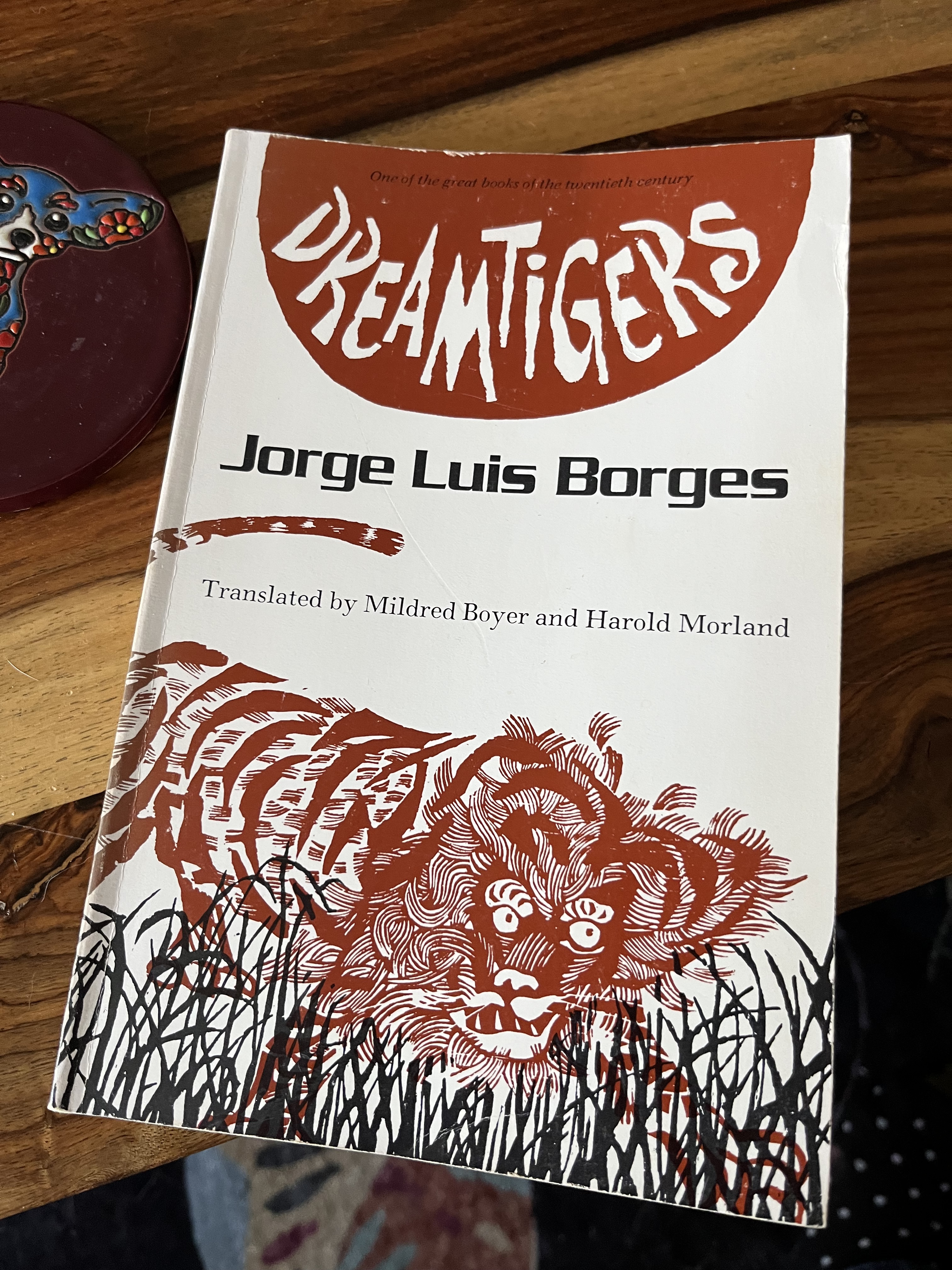
I have read three other books by Borges over the years: Labyrinths, The Book of Sand, and Ficciones. They have all been thought provoking and strange. I first heard of Borges as a fictional character in Umberto Eco’s “The Name of the Rose,” which makes sense as I finished “Dreamtigers” this afternoon. In “Dreamtigers” one of the themes Borges causes the reader to think about is identity. Specifically who is the real “Borges” (and us by extension) the one created by us that we present to the world as us, or the one that created the presentation. “Dreamtigers” is divided into two sections. The first comprised of parable-like reflections revolving around themes of memory, identity, creativity, and mirrors. The second section made up of poems, which touch upon similar themes and images. One of the ideas that have lingered with me after finishing the book is the thought that our unique experience of life which each of us possess and create though our life…vanishes as we die. “Events far-reaching envoy to people all space, whose end is nonetheless tolled when one man dies, may cause us wonder. But something, or an infinite number of things, dies in every death, unless the universe is possessed of a memory, as the theosophists have supposed.” I know that this is obvious, but also profound. Nietzsche said that in the end we only experience ourselves. And Borges extends this with the thought that this individual experience dies with the life of the person. Unless as he says, the universe possess a memory. And even then, that memory is changed and erased by the future which remembers us in their own individual experiences. “There is not a single thing on earth that oblivion does not erase or memory change, and when no one knows into what images he himself will be transmuted by the future.”
 subtext