I hold this votive out;
Its small flicker, a sign,
A symbol, of what I offer:
Not much light, nor warmth
Within the glow of my palm;
Yet, still a hope for both
From my hand to yours.
(January 2011)
I hold this votive out;
Its small flicker, a sign,
A symbol, of what I offer:
Not much light, nor warmth
Within the glow of my palm;
Yet, still a hope for both
From my hand to yours.
(January 2011)
A Review
When even the clichés cringe at the clichés
They are forced to co-habit with, who cringe
At the inevitable next step, the slow tread
Moving toward the gallows, when someone
Should have screamed out in anguish, someone
Surely could see how innocent of ideas
It all was, and stopped it before too many
Well-meaning people were arrayed in formation
To make elemental claims to authenticity
Until they are forced to believe the words
They mouth otherwise the vacuity would collapse
Upon itself like a black hole devouring space.
Yet the obvious stayed silent, the parade passed,
The emperor’s tailor danced in delight.
(January 2011)
by
To C.D.
As if the mosaic of my emotions
could be summarized in simple
platitudes others would want to hear – –
like the greeting, “How are you?”
if answered truthfully, the full
force of existential anxiety
would annihilate the listener
with its dark pathos, nothing
remaining but a shadow’s smudge.
“How does it make you feel?”
is best left unanswered, or deflected
by a fine, an OK, or an easy joke;
best not go too far beyond the surface,
too easy to become entangled
in the causalities of my emotional
Sargasso Sea, too easy to drown
flailing about on the sea bed,
stretching for air just out of reach.

(January 2011)
by
(pastoral)?
devastation crumbles
formed sand washed
drips delicately
grain by grain
a cascade a flower blooming
in reverse
a low grumbling
mutters of discontent
thunder across dry hills
or laughter followed by a hacking cough
rough-cut saws through wet wood
buildings silently mark the space
a division of here from there
blind reflective glass
shadowless clouds
intermingle with passersby
patterned by the false
symmetry of rain on glass
(cityscape)?
where reality
and metaphor blend
where meanings made manifest
i speak with you
(August 2001- April 2003)
by
Just another jerk,
taking pride in his work.
Timbuck Three
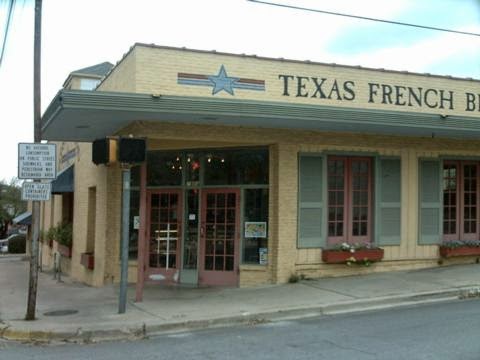
The alarm goes off at 3:30. The Dunkin’ Donut commercial jingles through my head, “Time to make the doughnuts,” despite the fact that we don’t make doughnuts at the bakery. Some Arabic folk song ululates on the public radio station. “Who the hell listens to this stuff at this time in the morning?” People like you, asshole. Get out of bed. An hour later I start up the Toyota and begin the thirty minute drive into town. Another Saturday morning slinging croissants at Texas French Bread.
Walking into the bakery, I wave to Lori, one of our delivery drivers, who stands in front of the bread slicer bagging the night’s production for her route. She and the other drivers have already been here for an hour, and except for her, they’ve gone on their first runs. I don’t bother to say anything because of the noise from the slicer. I need to remind John, the maintenance man, again, that the machine is about to break down. At the time clock, a note from Leslie, the manager of the drivers, is attached to my time card.
Kelly, old buddy of mine, I’ve been hearing some disconcerting rumors about what David is going to do to the delivery routes. See what you can find out and let me know.
I fold the note place it in my pocket. I’ll think about the meaning of this later. Now I need to get the store open for the hungry hordes of consumers. It’s cold and raining; today will be busy. Bakery items provide some strange comfort; the body must call for high carbohydrates and sugar whenever the sky turns gloomy.
Upstairs, I turn the espresso machine on. It takes thirty minutes to warm up, and if I forget, inevitably, the first customer of the day will want one. Back in the office I check the special orders and read any messages the night manager has left for me. Taped to the front of the special order book is a note from Oscar, the first person scheduled to come in after me at six. He sprained his ankle playing basketball last night and won’t be coming in this morning. I grimace and look up at the schedule. Who can I wake up? The choices are slim.
The first try: No one answers. Smart.
Second call: A chipper voiced answering machine.
Third call: “Oh. God. No. Sorry. No. I just got into bed. We went to see the Butt-Hole Surfers. Jees, What time is it?”
“That’s fine.” He probably did too many drugs to be able to function even if he had come in.
Fourth call: “Well, if you can’t get anybody else I’ll come.”
“I’ve already tried everybody else.”
Pause.
“Oh.”
Pause.
“O.K. I’ll be there soon. Bye.”
Back to the special orders. Nothing out of the ordinary. The Law School wants a hundred assorted croissants. Some lady wants six dozen cocktail croissants. Another wants a 12×18 inch carrot cake shaped like a dog biscuit with “Forty Fucking Fabulous Years” written on it in pink icing. I bet the dessert bakers loved that one. I post the orders on the doorway leading down into the bakery.
“O.K. Let’s get this show boat on the road,” I say out loud. That first sleepy-eyed customer will be standing outside at six o’clock when I unlock the door. They could stay in bed, after all it is Saturday, it’s not like they have to be at. work. Forty minutes later, at ten till six, with every thing ready for the days onslaught, I pour myself a cup of coffee, and wander downstairs and out the back door to smoke a quick cigarette. Lori is still standing next to the bread slicer, she nods as I pass by.
Leslie drives up. I wait. She steps out of the van, stabs a cigarette into her mouth and angrily lights it. “So, did you get my note?” I nod. “It really pisses me off. I come in and the first thing I hear is that David is going to reschedule the entire delivery routes. He has no fucking idea what we do, and he thinks that he can do this without even asking us.”
“Who told you this?”
“Jesse Duran said as I walked in here at four, ‘So, did you hear that the night shift is going to start slicing and bagging the bread?’ What the hell does that mean? We do that. Is David trying to cut our hours? The night shift can barely do their job. How the hell are they going to start doing ours too?”
“David comes in at ten, I’ll ask him then.”
She stomps her cigarette out as Nathan, the person I woke up, walks across the parking lot. He nods and walks inside. A car drives up. I check my watch: Six o’clock. I walk up to the front door, unlock it, step inside and pour two cups of coffee. Jason and his wife, Mary, walk in smiling at the coffee waiting for them. I slide over to the counter. “An onion bagel, cream cheese. A sesame bagel, strawberry cream cheese. Do you want an Oatmeal muffin today?” They collect their breakfast and sit down. The bakery is open.
Erin bounces in at seven, even when she pulls it back her dark Pre-Raphaelite hair forms a halo around her head. “Good morning, everyone.” Jason and Mary wave to her.
At eight, Rita slouches through the front door, pours a cup of coffee and slinks into the back room silently. Everything is normal. The Law School picked up their order and the dog biscuit cake sits on the walk-in shelf. People stream in, papers tucked under their arms, demanding coffee and baked goods; no one is too obnoxious.
“Do you have any doughnuts?”
“No, ma’m. Sorry.” Look in front of you.
“What isn’t fattening?”
Nothing, this is a bakery. “How about a muffin?”
I help forty customers in thirty minutes. “Good morning.” I stuff their bags, hand it across the counter, place their coffee order. “You can pay at the register.” A human assembly line shuffles by me; I turn to the next person. “Hi, can I help you?” The record is stuck.
The day goes on. At nine-thirty, Jonathan, our sandwich maker, arrives. He is wearing a hot pink beret to cover the razor cuts he caused when shaving his head a week ago. “Greetings and salutations to all.”
“Hi, Jonathan.”
At eleven we begin to run out of croissants. We are not running out of customers. I walk down into the bakery and tell Ke that we need at least four more trays. He nods. Kenny, the purchaser, walks in, pulls an envelope off of his clip board. “This came for you. Judy has read it.” Judy owns the bakery, and does not like to hear complaints no matter how invalid.
“Yeah, and. . .”
“Just read it.”
Dear Texas French Bread,
Friday morning I came into your store on Red River.(I wince). At the register was a rude asshole. I did not get his name but he was wearing a pink hat. Cool out this jerk.
Good-bye,
(unsigned)
Kenny laughs. I sigh and trudge back up the ramp to find Jonathan. Jonathan is talking to Peit, a Belgian mechanic who comes in every day. “Yeah, I thought about shaving my pubic hair too.” Customers at a nearby table look up from their newspapers and stare.
“Jonathan, can I talk to you a minute.”
He smiles obliviously following me into the office. I hand him the note.
He reads it. “Whoa, who do you think they mean?”
I point to his hat. His eyes get wide letting the insight in. “I know that you don’t mean to be rude, but some of our customers aren’t aware of your oddities.” Or want to be aware of them as far as that goes. “So why don’t we watch ourselves a little bit?” He looks at the floor. He seems genuinely hurt that someone would think he was a rude asshole. “Can I have the note?”
“Sure.”
“I want to make a T-shirt transfer. Wouldn’t that be great?” He grabs the letter out of my hand and dances back to his station. I think about my last class of seventh-grade students. Kenny walks up behind me.
“So, what was Judy’s reaction?”
“She was pissed off.”
“Does she want him fired?”
“No, she’s pissed at the person who wrote the letter. She can’t believe that they didn’t sign it.”
Twelve o’clock: an hour to go before I’m out of this place for two days. I think I can make it without anything else occurring. Judy calls. “Where’s David?”
“I’m not sure. Let me go see if he’s in yet.”
I look downstairs. The drivers and David are out in the parking lot. Leslie, Lori, and Chris are all talking at once. David looks contrite. “He can’t come to the phone right now, Judy. I’ll have him call you.” I hang up the phone; Skip, the dishwasher, is looking nervous next to me. Skip is paranoid and taking medication. Somedays he becomes paranoid about taking his medication. I sense today is one of those days. “Kelly, I’m having a problem today.” I nod, looking him in the eye. He sweats, and looks at his hands, then back to me. “You see, I’m having this problem reconciling the conflict.”
“You mean with David and the drivers?”
He looks out the window and contemplates the drama. Leslie is waving her arms at David as if she were a crazed symphony conductor and he an incompetent flutist. “No. No. They’re fine. I’m having this problem reconciling the conflict between good and evil.”
Don’t we all.
(Summer 1990)

to W. Walt Rinehart, 2 months
If I had time
I would speak
of light’s manner
upon leaves. Yet,
language has not
mastered time
for me:
no memory
past the present.
Light is green
upon a darker green
that shifts, not again,
but now
where once
has never been.
The wind and
light are leaves.
No cause to think,
simply watch
what-is:
light
among
leaves.
(July 1986)
by
for K.C.
a wine cork
tied with thread
to an arcing twig
stripped bare of bark
twirls nonchalantly
above the mantle
(june 2006)
In a class on the Essay at Bread Loaf, Shirley Brice-Heath said that reading and writing are leisure activities. She said this in explanation of why so many writer’s in the 19th century, or any other time period, were upper middle class and/or wealthy. It takes time to read and time to write, one can’t be working all hours on the factory floor if one is going to read and write. Over time I have hacked away at the “stuff” I teach that takes up the time of the classroom; I have abandoned entire beloved lesson plans and units because they ate into the time my students have to read and write. My students live busy complex lives. They work at their jobs, often more than one, they have many classes in addition to mine and some of them have babies that they have to take care of as well. So I schedule huge blocks of time to read and write in class everyday. It is not a “Read-in” Friday, or “let’s write an in-class essay today”, but every day we are reading and writing together and alone. It is what is expected in my class. Over time the students come to expect the time they have to reading and write and become irritable when they don’t get that time because of scheduled and unscheduled administrative dictates. The time to read and write is important, because it is time the students don’t get.
(begun as a quick write during a presentation by Amber Futch at a Heart of Texas Writing Project conference December 2010)
by
A mashup of lines from Whitman, Neruda, Carson, Michaels and Lee
Why didn’t you
Feed on the specters of books?
Why didn’t you
Know he exists?
Why didn’t you
Do more than be vexed into love?
Why didn’t you
Negotiate the fog of your life?
Greet the stranger with no handkerchief,
Spend more time practicing the piano,
Or learning to read
The damp degenerate afternoon?
Why didn’t you
Filter them all from yourself,
And stop at the edge of the lake
With the trees?
(December 11, 2010)
How little we can know
Within the span of our lives:
Friends, lovers, conversation,
Everything else falls away.
(Fall 2010)
by
An Ongoing Reformation
Like frost throwing fractals
Across a windowpane,
I shape my life,
Without thought:
A random re-gathering
Of my sundry parts.
Cognitive Dissonance
I live in a world of shadows
Hiding within my thoughts, trapped
Perhaps by the cave wall’s proximity.
Sudden influxes of light blind
With their sharp stabs of insight
Sending me deeper into dark’s solace.
Safer to sit here weaving the tatters
Of my misconceptions, a shroud
Of warmth against some other life.
(November 2010)

The wine-glistened lips meet in our kiss.
I run my tongue along the glass
Pursuing each drop, each phoneme
For another shade of meaning
To unfold in this taste I desire.
A fine distillation: each nuance,
Each gesture, each half-smile
Condensed to feed my addiction;
Words mean only what we bring.
Do we share the same dreams?
I drink her words in, savor the sounds
Roll them around, feel their fit,
And wonder how much more can there be?
What exactly was it she said to me?
(November 2010)
by
Lisa listened and wrote back
the minutia of our lives exchanged
like kisses on her frontsep at night
words flowed easily
like rivers meeting up
coming to a confluence
creating a greater force together
in the coupling of our seperate voices
we traded books, and stories, and letters
always letters, mailing and recieving
one every few days, immediately
starting another – – never not
connected by pen on the page
the words written as if whispered
in the dark in bed, rather than miles
and weeks, and cities apart
(November 2010)

