We keep saying that Johnny can’t read because he’s deprived, because he’s hungry, because he’s discriminated against. We say that Johnny can’t read because his daddy is not in the home. Well, Johnny learns to play basketball without daddy. We do best what we do most, and for many of our children that is playing ball. One of the reasons Johnny does not read well is that Johnny doesn’t practice reading (Reverend Jesse Jackson quoted in Raspberry, 1976 as cited in Thurlow 1984 p.267)
I used to feel that I had to explain the way I teach to people. Sometimes I still feel that way. Fellow teachers in the copy room will ask by way of making conversation, “So, what book are your students reading now?” I used to try to explain how all my students were reading different books; so I really couldn’t tell them off the top of my head why my students were reading. Then because of the way they would look at me, I would feel like I was an incompetent teacher. I could see the thoughts running through their heads: he doesn’t know what they are doing in his class; or worse, he doesn’t do anything in his class. So I felt the need to explain in detail how all of my students chose the books they read, that those books then became the “text” book from which they worked out the reading skills required by the TEKS, that I really did keep track of every book the kids were reading, all 150, and yes, I could tell if they were actually reading the book without giving them a scantron test. And best of all, the students read two books each six weeks. Eventually I just settled on saying, “No, we aren’t reading anything together right now.” Which was true in a way.
We read together all the time, just not the same book. One day a couple of months into the first year I moved to high school after teaching for 15 years in the middle school, my students were reading their books silently. Some were sitting at their desks, others were lying on bean bags, and about four of them were encamped in the hall on the floor. I sat in the doorway on the floor, so I could see both the kids in the hall and the ones in my room. I was reading whatever I was reading at the time. The students knew if they had a question that I would see them and come to them, or they would just come over to where I was reading and talk quietly to me. A history teacher on conference period walked down the hall, saw my students reading in the hall, saw me reading in the doorway and said, “I wish I could just sit and read during class and do nothing.” She walked on, my students erupted, indignation flowing from them like lava roiling across Pompeii. It took me several minutes and a cooling smart-assed comment directed by me toward the history teacher to return my students to a more stable state of being. They were pissed because she assumed we were doing nothing, because they were reading silently to themselves. Reading is one of the two main purposes in my class, the other is writing. They were doing something. For some of them it was one of the hardest things they had ever done in English class: read a book.
At that point in the year, and still around the end of the first six weeks every year, a student, sometimes more than one, will end their first book talk with me by confessing that the book they had just finished was the first book they had read since middle school or the first book they had ever finished. They tell me this with pride. Not that they had managed to pull the wool over their former teacher’s eyes, but with pride that they had finished a book, and they liked it. There is something wrong with that picture. Seniors in high school, all seniors in high school, should have finished a book, and what’s more, one that they enjoyed reading. I am not blaming the students for this lack, but the way we teach reading.
It all seems so simple, in a head-slapping-duh simplicity. In order to read better one must read; it is an activity that improves with the doing. For years I have been instinctively following this guideline in my classroom without any documented research to prove what I was doing had any validity. It just made sense to me. Yet, the teacher down the hall had the same gut feeling that what she was doing was just as correct. For years I had followed the same kind of teaching. I had built elaborate units with interconnected writing assignments and projects; however, it did not seem right to me to say my students were reading when what they were doing was listening to me read to them and mechanically constructing essays that I had come up with for them to formulaically follow.
Most of the “reading” time in my class, now, is spent in Sustained Silent Reading, where the students read from self-selected texts. I have been frowned upon for wasting time in class instead of teaching. So being fairly pig-headed about most things, a few years ago, I did a bit of reading on the effects of reading silently in class from self-selected texts for a literature review for a doctoral class on the teaching of reading. I found quite a lot to show that my gut feeling was not just my nervousness about not doing what everyone else was doing down the hall. It was the right thing to do.
Bibliography for Lit Review
Armbruster, Bonnie B., Wilkinson, Ian, A.G. Silent Reading, Oral Reading, and Learning From Text, The Reading teacher vol. 45, no. 2 October 1991.
Cunningham, Ann E., and Stanovich, Keith E., What Reading Does for the Mind, American Educator, Spring/Summer 1998 pp.1-8.
Fisher, Douglas. Setting the “opportunity to read” Standard: Resuscitation the SSR program in an Urban High School, Journal of Adolescent and Adult Literacy, 48:2 October 2004 pp. 138-150.
Hunt, Lyman C., The Effect of Self-Selection, interest, and motivation upon independent, instructional, and Frustrational Levels, The Reading Teacher, Vol. 50, No.4 December 1996/January 1997 pp.278-282.
Parr, Judy M. and Maguiness, Colleen. Removing the silent form SSR:Voluntary reading as Social Practice, Journal of Adolescent and Adult Literacy 48:2, October 2005 pp.98-107.
McCallum, R. Steve, Sharp, Shannon, Bell, Sherry Mee, and George, Thomas. Silent Versus Oral Reading Comprehension and Efficiency, Psychology in the Schools, Vol.41 (2), 2004.
Methe, Scott A., and Hintze, John M., Evaluating Teacher Modeling as a Strategy to Increase Student Reading Behavior, School Psychology Review, 2003, volume 32, No. 4 pp. 617-623.
Olen, S.I.I., Machet, M.P Research Project to Determine the Effect of Free Voluntary Reading on Comprehension, South African Journal of Library & Information Science, 02568861, Jun97, Vol. 65, Issue 2.
Swalm, James E., A Comparison of Oral Reading, silent Reading and Listening comprehension, Education p.111-115.
Thurlow, Martha, Graden, Janet, Ysseldyke, James E., Algozzine, Robert. Student Reading During Reading Class: The Lost Activity in Reading Instruction, Journal of Educational Research, May/June 1984 (Vol. 77 (no.5) pp267-272.
(August 2011)
Just another jerk,
taking pride in his work.
Timbuck Three
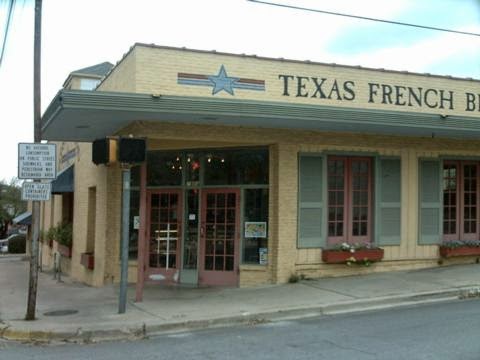
The alarm goes off at 3:30. The Dunkin’ Donut commercial jingles through my head, “Time to make the doughnuts,” despite the fact that we don’t make doughnuts at the bakery. Some Arabic folk song ululates on the public radio station. “Who the hell listens to this stuff at this time in the morning?” People like you, asshole. Get out of bed. An hour later I start up the Toyota and begin the thirty minute drive into town. Another Saturday morning slinging croissants at Texas French Bread.
Walking into the bakery, I wave to Lori, one of our delivery drivers, who stands in front of the bread slicer bagging the night’s production for her route. She and the other drivers have already been here for an hour, and except for her, they’ve gone on their first runs. I don’t bother to say anything because of the noise from the slicer. I need to remind John, the maintenance man, again, that the machine is about to break down. At the time clock, a note from Leslie, the manager of the drivers, is attached to my time card.
Kelly, old buddy of mine, I’ve been hearing some disconcerting rumors about what David is going to do to the delivery routes. See what you can find out and let me know.
I fold the note place it in my pocket. I’ll think about the meaning of this later. Now I need to get the store open for the hungry hordes of consumers. It’s cold and raining; today will be busy. Bakery items provide some strange comfort; the body must call for high carbohydrates and sugar whenever the sky turns gloomy.
Upstairs, I turn the espresso machine on. It takes thirty minutes to warm up, and if I forget, inevitably, the first customer of the day will want one. Back in the office I check the special orders and read any messages the night manager has left for me. Taped to the front of the special order book is a note from Oscar, the first person scheduled to come in after me at six. He sprained his ankle playing basketball last night and won’t be coming in this morning. I grimace and look up at the schedule. Who can I wake up? The choices are slim.
The first try: No one answers. Smart.
Second call: A chipper voiced answering machine.
Third call: “Oh. God. No. Sorry. No. I just got into bed. We went to see the Butt-Hole Surfers. Jees, What time is it?”
“That’s fine.” He probably did too many drugs to be able to function even if he had come in.
Fourth call: “Well, if you can’t get anybody else I’ll come.”
“I’ve already tried everybody else.”
Pause.
“Oh.”
Pause.
“O.K. I’ll be there soon. Bye.”
Back to the special orders. Nothing out of the ordinary. The Law School wants a hundred assorted croissants. Some lady wants six dozen cocktail croissants. Another wants a 12×18 inch carrot cake shaped like a dog biscuit with “Forty Fucking Fabulous Years” written on it in pink icing. I bet the dessert bakers loved that one. I post the orders on the doorway leading down into the bakery.
“O.K. Let’s get this show boat on the road,” I say out loud. That first sleepy-eyed customer will be standing outside at six o’clock when I unlock the door. They could stay in bed, after all it is Saturday, it’s not like they have to be at. work. Forty minutes later, at ten till six, with every thing ready for the days onslaught, I pour myself a cup of coffee, and wander downstairs and out the back door to smoke a quick cigarette. Lori is still standing next to the bread slicer, she nods as I pass by.
Leslie drives up. I wait. She steps out of the van, stabs a cigarette into her mouth and angrily lights it. “So, did you get my note?” I nod. “It really pisses me off. I come in and the first thing I hear is that David is going to reschedule the entire delivery routes. He has no fucking idea what we do, and he thinks that he can do this without even asking us.”
“Who told you this?”
“Jesse Duran said as I walked in here at four, ‘So, did you hear that the night shift is going to start slicing and bagging the bread?’ What the hell does that mean? We do that. Is David trying to cut our hours? The night shift can barely do their job. How the hell are they going to start doing ours too?”
“David comes in at ten, I’ll ask him then.”
She stomps her cigarette out as Nathan, the person I woke up, walks across the parking lot. He nods and walks inside. A car drives up. I check my watch: Six o’clock. I walk up to the front door, unlock it, step inside and pour two cups of coffee. Jason and his wife, Mary, walk in smiling at the coffee waiting for them. I slide over to the counter. “An onion bagel, cream cheese. A sesame bagel, strawberry cream cheese. Do you want an Oatmeal muffin today?” They collect their breakfast and sit down. The bakery is open.
Erin bounces in at seven, even when she pulls it back her dark Pre-Raphaelite hair forms a halo around her head. “Good morning, everyone.” Jason and Mary wave to her.
At eight, Rita slouches through the front door, pours a cup of coffee and slinks into the back room silently. Everything is normal. The Law School picked up their order and the dog biscuit cake sits on the walk-in shelf. People stream in, papers tucked under their arms, demanding coffee and baked goods; no one is too obnoxious.
“Do you have any doughnuts?”
“No, ma’m. Sorry.” Look in front of you.
“What isn’t fattening?”
Nothing, this is a bakery. “How about a muffin?”
I help forty customers in thirty minutes. “Good morning.” I stuff their bags, hand it across the counter, place their coffee order. “You can pay at the register.” A human assembly line shuffles by me; I turn to the next person. “Hi, can I help you?” The record is stuck.
The day goes on. At nine-thirty, Jonathan, our sandwich maker, arrives. He is wearing a hot pink beret to cover the razor cuts he caused when shaving his head a week ago. “Greetings and salutations to all.”
“Hi, Jonathan.”
At eleven we begin to run out of croissants. We are not running out of customers. I walk down into the bakery and tell Ke that we need at least four more trays. He nods. Kenny, the purchaser, walks in, pulls an envelope off of his clip board. “This came for you. Judy has read it.” Judy owns the bakery, and does not like to hear complaints no matter how invalid.
“Yeah, and. . .”
“Just read it.”
Dear Texas French Bread,
Friday morning I came into your store on Red River.(I wince). At the register was a rude asshole. I did not get his name but he was wearing a pink hat. Cool out this jerk.
Good-bye,
(unsigned)
Kenny laughs. I sigh and trudge back up the ramp to find Jonathan. Jonathan is talking to Peit, a Belgian mechanic who comes in every day. “Yeah, I thought about shaving my pubic hair too.” Customers at a nearby table look up from their newspapers and stare.
“Jonathan, can I talk to you a minute.”
He smiles obliviously following me into the office. I hand him the note.
He reads it. “Whoa, who do you think they mean?”
I point to his hat. His eyes get wide letting the insight in. “I know that you don’t mean to be rude, but some of our customers aren’t aware of your oddities.” Or want to be aware of them as far as that goes. “So why don’t we watch ourselves a little bit?” He looks at the floor. He seems genuinely hurt that someone would think he was a rude asshole. “Can I have the note?”
“Sure.”
“I want to make a T-shirt transfer. Wouldn’t that be great?” He grabs the letter out of my hand and dances back to his station. I think about my last class of seventh-grade students. Kenny walks up behind me.
“So, what was Judy’s reaction?”
“She was pissed off.”
“Does she want him fired?”
“No, she’s pissed at the person who wrote the letter. She can’t believe that they didn’t sign it.”
Twelve o’clock: an hour to go before I’m out of this place for two days. I think I can make it without anything else occurring. Judy calls. “Where’s David?”
“I’m not sure. Let me go see if he’s in yet.”
I look downstairs. The drivers and David are out in the parking lot. Leslie, Lori, and Chris are all talking at once. David looks contrite. “He can’t come to the phone right now, Judy. I’ll have him call you.” I hang up the phone; Skip, the dishwasher, is looking nervous next to me. Skip is paranoid and taking medication. Somedays he becomes paranoid about taking his medication. I sense today is one of those days. “Kelly, I’m having a problem today.” I nod, looking him in the eye. He sweats, and looks at his hands, then back to me. “You see, I’m having this problem reconciling the conflict.”
“You mean with David and the drivers?”
He looks out the window and contemplates the drama. Leslie is waving her arms at David as if she were a crazed symphony conductor and he an incompetent flutist. “No. No. They’re fine. I’m having this problem reconciling the conflict between good and evil.”
Don’t we all.
(Summer 1990)
God is alive.
Magic is afoot.
— Buffy Saint-Marie
Several years ago for a few weeks, I lived in the middle of the Green Mountain National Forest in Vermont. One day I decided to hike into the mountains several miles from the campus where I attended graduate school. The day dripped humidity, but when the breeze slid across me I felt cool. I drove the six miles from campus to the top of Middlebury Gap where the Long Trail, a path that snakes along the tops of the Appalachian Mountains from Georgia to Canada, crosses the highway. As I applied insect repellent, and situated the water bottle and lunch supplies in my back pack, cars and lumber company trucks rumbled past where I had parked on the side of the road. Finally, with all my preparations complete, I waited for a gap in the flow of traffic, crossed the road and entered the forest. Fifteen yards into the trees, the road disappeared. Another twenty yards into the forest and I came across a National Forest Service sign that read: “Now entering a Primitive Wilderness Area.” I laughed to myself. My mind conditioned by the graduate classes I had sat through for the last three weeks to split differences in meaning from one word in a poem to the next dryly provided, “That means on this side of the sign I’m in civilization.” The trees on either side of the sign stood mute to my humor.
Below the sign, inside a covered box , a registration book lay filled with the names and the cities of hikers ranging from Maine to California, who had passed into the woods before me. The book requested that I sign-in, like a hotel, in case of an emergency and the park rangers needed to help someone locate me. I dutifully signed in putting the day’s date next to my name as I wondered if the group who had signed in two days before me were still on the trail heading south toward Georgia. My planned four to five hour hike seemed like a lark.
When I first left the mid-June heat of Texas for the green of Vermont, I was amazed with the lush variety of greens that blanketed the rounded mountains. But the green that I encountered as I left the road overwhelmed me. Fern and day lillies burst forth from the forest floor. Moss grew thick across fallen trees and rocks. The Blue Spruce and pine trees threw a dark green canopy over my head blocking the sky. The sunlight that managed to pierce through the tree tops stabbed down in white columns similar to the light I once saw pour down through a window of the Vatican, bathing a priest saying mass to the left of the main alter with an angelic glow.
As I walked up the trail, using the roots of the trees that crawled across the path like steps, a faint breeze would peer from around the trunk of a pine and touch me lightly on the forehead like a benediction before disappearing into the woods on the other side of the trail. The hike proved not overly difficult, but my lungs raised on the flat terrain of the Texas Coastal Plain forced me to rest after an hour of the steady climb from the road to the top of Bread Loaf mountain. I sat down on the large root of a pine that climbed forty feet above my head.
Between sips from the water bottle, I nibbled on the trail mix I had bought down at the Ripton General Store earlier that morning. The nuts tasted stale, but the gooey sweetness of the raisins and the dried date pieces quickly formed the mix into a satisfying mouthful. I leaned back against the tree’s trunk, letting the rustle of the leaves and the infinite green of the forest wash out all thoughts of the semiotic deconstruction of Virginia Wolf’s essays and the level of Dante’s Purgatorio which we had reached that week in class from my mind. The immediacy of the forest surrounded me; the beauty of a birch bending its white trunk through the thick green firs and the chatter of the jay and grey squirrel wove an ineffable web about me as effortlessly as the spider weaves her threads about an errant moth. Fifteen minutes later after luxuriating in the forest’s calm, I put the water bottle and the rest of the trail mix back into my pack. I stood up, brushed the moss from my pants and continued up the trail.
Shortly the path became steeper forcing me to watch the ground a few feet in front of me in order not to trip over a root or a fallen tree. Not that I was missing that much by looking at the ground for I could only see about ten yards up and down the trail before it would bend out of view. I walked on for an hour in this manner, stopping momentarily to pick up a piece of slate that caught my eye or to look at an odd mushroom growing out of a tree stump. Every once in awhile, I would hear the quick flutter of rain on the forest canopy, followed by water dripping off of the leaves. But it never turned into a real rain, just enough to increase the rich humus smell of the forest floor.
As I walked, I thought about the first people who had come into this country. How odd it must have been: no trails, no General Stores down the road, no roads. Just miles of green surrounded by still more green miles.
“I placed a jar in Tennessee,” I thought, then laughed suddenly understanding Steven’s poem more than I ever had sitting in Dr. Malof’s undergraduate poetry class. But I defined nothing in the forest, it was its own definition.
Finally I came to a bridge, two planks laid across cut telephone poles, that spanned a small brook. I squatted on the edge of one plank and stared into the running water. The sound of the water over rock whispered softly like a seductive spell. After several minutes I looked up, somehow everything was different. The forest had become imminent. The lush green of the forest had become palpitant in the air, which itself seemed to be thicker than before. I sat down on the plank and looked up through the trees trying to see beyond the green canopy to sky. But the forest held dominion. I felt like a protozoa, surrounded by an amoeba, slowly being absorbed. The forest was alive and I had been devoured.
I suddenly felt an urge to tear off all of my clothes and run laughing through the forest, leaving the trail and its traces of civilization behind. I stood up confused. I was lost. I knew where I was, the trail only led two ways: farther in or back to the road. But I, my self, was becoming lost in the overpowering green of the forest. A line of David Wagonner’s poem Lost ran through my head, “The trees know where they are.” Yes, they knew where they were. They also knew that I did not belong. An exhilaration mixed with fear rippled through me like wind through leaves. I turned and walked quickly down the path I had just climbed. Before I could think about it, I was stumbling down the trail. Leaping from rock to tree root, almost falling , just catching myself before another leap sent me farther down the path.
Twenty yards from the entrance sign that I had so glibly passed several hours before, I fell. I landed belly down, sprawled across a bed of moss and pine needles like a supplicant before a saint’s shrine. I rolled over on my back and began laughing hysterically between gasps of air. Several minutes later I struggled the last short steps out of the forest. I sat quietly in my truck recollecting myself before driving slowly back down the mountain.
I had left that morning with the intention of taking in a bit of nature. Instead I had been taken in and spit back out by nature. Philosophers speak about the numinous, the glimpse of God you catch on the edges of your peripheral vision. But the blinding face of God does not simply burn out your eyes as I had imagined as a child in Sunday school; it ignites your mind with infinity. The forest is alive. Not just the individual life of each tree, fern, moss or bird, but a life that encompasses all of the life in the forest, including the life of the individual man that enters into the forest’s domain.
(Spring 1993)
Today a fellow teacher asked, “When did you know that you were smart?” My honest, yet glib answer was, “I don’t think I am smart.” Yes, that was a deflection. My second answer, “I’m not smart, everyone else is stupid” was just a smart-ass answer.
I do think that I am smart. Yet I think that somewhere along the line I missed something. I never felt that I was all that smart. I’m not sure even now if I am all that smart. Yes, I was in the excelerated classes in middle and high school. Yes, I was in the Junior and National Honor societies. I made A’s and B’s without trying through out public school. In college I received my B.A. again without trying that hard and doing the usual amount of drinking and partying, and skipping classes; and sometimes more than the usual amount.
When I look back at various events in my life, I think wow that was really a weird gecky thing (translation: smart). I had what I realize now was my first philosophical encounter with language in third grade. I thought, “Nothing has to be something or it wouldn’t have a name.” I read the Hobbit and the Lord of the Rings for the first time in 3rd and 4th grade. I didn’t think that was unusual, my older sisters had already read it, and they were what I had to compare myself to, the norm I had at hand. It befuddled me in elementary that others were not as interested in the books I was interested in, or that they took longer to do the assignments in math or social studies. I never thought of myself as smart however.
By sixth grade I met two of my oldest friends, Nathan and Jimmy. Finally some people who had read the same books as me, who were interested in, what I now realize were odd, obscure, games and were willing to spend hours and hours playing them while we talked about the books we were reading. We would embark on projects and have a blast creating sets for the skits or plays we were doing for class. But this was all normal. Normal, not smart. Smart was something else, something beyond what I was able to do.
As a nineteen year old undergraduate, I worked as a dishwasher at Clarksville Wine Shop. I listened to the customers, and the waiters (graduate students) talk about various subjects from wine to art, to music, to politics; and I came to an early cynical idea: pretension is half of the game. With being able to back it all up the other half, thus negating the pretension. I started working on being able to back up what I had to say; being able to do more than just bullshit. I have always read a lot. When some author refers to some other text, and that text keeps coming up, I go and read it. I don’t read someone else’s ideas about that writer, I go read the source. I guess my Lutheran upbringing comes out there: don’t rely on the priests to tell you what the book means, read it yourself. I’ve noticed that most people do not make their own decisions about ideas, they tend to read what others say the ideas mean. When I read “Thus Spoke Zarathustra,” for the first time, I was surprised that the infamous quote, “God is Dead.” comes rather early in the work and is not really that important in the work as a whole. Yet that is the line that I would say the majority of people know from Neitsche, if they know any line at all. I read and study because I don’t understand much of life; and for the most part, that simply leads me into deeper confusions and cause for further reading.
Others always seem to know what they are doing, what all the answers are. I don’t understand the world. I am not that smart.
I have not come to mean
I mean I mean
Or if not I do not know
If not I know or know
This which If they did go
Not only now but as much so
As if when they did which
If not when they did which they know
Which if they go this as they go
They will go which if they did know
Not which if they which if they do go
As much as if they go
I do not think a change.
-Gertrude Stein
What meaning I have is questionable; I have not come to mean anything, rather I have become someone who makes meaning out of what is at hand, a bricoluer, if you will, rather than someone who knows what anything means. Someone who takes what is there and makes what she wills of it. My father, after he retired, opened a furniture repair shop in the garage at home. He had three children from 8 to 17 and he could not afford to retire even on social security, so he took what he had in his repertoire and made money. People would bring him their broken furniture, or their “antiques,” furniture they wanted to keep for some reason. Dad would fix it. He would find pieces of wood reproduce the original and fix it. I remember him staring at a piece of copper sheeting for an hour, getting up walking around the yard, cursing, sitting down and staring at the copper again, cursing some more, before finally cutting out a pattern for something he was trying to make in less than a minute. He was my Axe Handle.
Much of what I write now, as far as essays go, are rambles, I start, then follow where the trail leads. Of course that does not mean a direction as much as a trail, impling a wake like a boat across a lake; I arrive somewhere, so in retrospect it appears as if I have followed a path, rather than cut my way through the tangle of my thinking. The turns of the trail are determined as much by what I do not talk about as much as what I do. I think of Mark Strand’s poem where he says, “I move to keep things whole.” He keeps the air apart in his bodily presence, so he moves allowing the reunification of air. I write to make things whole; I move through the bits of words I have been reading trying to get out of the way. I am not being coy. I look over the “texts” I have been reading, write down a few quotes, out of the slew of underlining I made while reading the books, then start to write. I would imagine that if I could pick different quotes from the same authors, I would come up with a different essay. Of course the quotes I pick are determined by what I am thinking at the time of the choosing, which is influenced as well by the quotes I pick as I am picking them thereby changing what I am thinking. Finally I create a story line that attempts to shape it all into a sense of meaning, or at least a sense of what I think I mean at the time.
I wonder if I am shaped more by the writing than I shape what I write when I write.