Category: essay


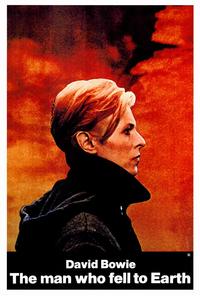
  • David Bowie meant a lot to me as a teenage boy growing up in South Texas. He was cool, but not by any means the stereotype model of a male I was offered in Victoria. I was an introverted bookish boy who liked to write. Sports and, the measure of a man in my high school, football, held no interest at all for me.  I was accused of being gay, because I liked Bowie, wore Bowie t-shirts, had Ziggy written across the back of my school class shirt. Plastered on my bedroom wall was a full size poster for the Man Who Fell to Earth a friend had given me one year. Bowie’s androgyny was what I wanted, not the testosterone driven cowboys of my hometown. Bowie made it all right to be different. To not follow the norm. I listened to Hunky Dory and Ziggy Stardust repeatedly when my sister brought them home from college one summer when I was still in middle school. The first album I ever bought with the first check I ever wrote from my first bank account with the money from my first job flipping burgers at Wendy’s was David Live. It took two and a half hours of work then to pay for the double live album. I soon had all of the rest of his recordings. I was lucky enough to see him perform three times: on my 18thbirthday in Houston during the Heroes/Low tour, in Dallas for Serious Moonlight, and finally in Austin for Glass Spiders. I have only been affected by the death of a celebrity the way I am today once, and that was when John Lennon died. Patti Smith will be the same, may she live forever. However, Bowie and his music helped me early on to define my identity, and with his passing I realize that those early efforts of mine to become me would not have occurred as easily if it were not for David Bowie.  On the long commute to work this morning I listened to the entire Diamond Dogs album. In Rock and Roll With Me, Bowie wrote: “I found a door which lets me out.” I found a door to myself through David Bowie.
  • The difficulty with writing is that you must sit down and write. There are so many other things to do with your life besides write: shop for dinner, watch TV, wash the dog, change the cat box. All things which must be done, and do not require you to think about yourself. When you write, you must think about what you are writing. Word by word. You must sort out the jumble in your head and write something down. It is all very linear.  As soon as you write something, then thirty other possibilities open up.
    Like now for instance, I read recently how in quantum physics (or mechanics), at any given moment there are millions of possibilities that could happen in any number of infinite combinations, but only one of those events will happen in the space/time in which you are a part. It’s called the singularity. It is as if, I imagine, you came to the fork in Frost’s poem and as soon as you stepped down one of the paths, the other vanished, if not physically, then ceased to exist as a metaphorical possibility.
    Now to put this back on the trail I started down earlier, as each sentence comes to its moment of singularity, it opens up whole new infinite sets of numbers of directions to depart from.  As soon as one singularity is reached, it vanishes and the writer is confronted with the next choice. This becomes even more complex, as I go back and re-read what I have written. Unlike and like the moment of collapse into a singularity in physics where the infinite other space/times disappear, in writing one can always go back and try a different universe without a sigh of regret. All the other possible universes can still be accessed through the power of revision. But of course as soon as you change one thing, then the story you were on vanishes as another emerges.
    A couple of weeks ago I ran across a writing exercise, at UTTpoetry, that was intriguing enough that I tried it. I was given two sentences from a 19th century novel completely unknown to me. I had never heard of the book, never heard of the writer. In the novel, the two sentences appeared one after the other.  The writing task was to insert my own sentence between the two given sentences, maintaining whatever narrative flow I saw between the two. Once that step was accomplished, I had to insert another sentence between the first and now new second sentence, and then another between the new second sentence and the third sentence, which was formerly the second sentence. The third step was to repeat this process, inserting two new sentences between each of the sentences in the text. Then again, and again, until I had 17 sentences total.
    What was interesting, at least to me, was how the narrative grew and became transformed with each new set of insertions. With the first round, I was pretty pleased, I had made a simple connection between the two sentences which changed what I had at first thought of as the meaning. This transformation continued with each new set of sentences. By the end the narrative which was there on the page, resembled very little, except for the first and last sentence, what I had been given at the start.  
    It was amazing to me, not only how the story I imagined from the given sentences had diverged so farby the end of the exercise, but how each time a sentence was added it changed the meaning, the original intent vanished, and was replaced by new opportunities, and this constant state of flux was caused simply by the choice of direction I decided to take as I wrote a new middle sentence between each of the sentences.

    Which brings me back to the beginning, what makes writing so difficult: there is never a set direction to take, as soon as one choice is made a million other possibilities collapse, while at the same time opening up a million more. The writer is always at the point of singularity by herself, possibly even embodying the point of singularity in herself, as she writes. The writer is both an opening and a closure. A door, an empty space between possibility.
    (July 29, 2015)
  • What I like about writing, either poetry or the essay, is that I don’t have to make sense. The writing makes sense on its own. The writing begins to make sense as I write, more as an impressionistic whole, a tone, a leit-motif if you will, which takes over the poem, or the essay. I remember watching a program on PBS about birth. When the millions of sperm finally end their race to the egg, as soon as one sperm comes in contact with the egg, the egg is transformed into an impenetrable barrier that all the loser sperm cannot breach. I see the same transformation happen as I write. I have one sentence down, which makes me think of another, and that second sentence then collapses all the other possible pathways the first sentence could have engendered, while simultaneously opening a myriad of new rabbit holes down which I can fall. Writing like this is exciting. As I progress, re-reading as I go, or rather as I become lost, I start to see that I am not lost. One can never be lost if one does not know where one is going, I guess.  There is not a straight linear progress, but it still has a form, more like the orgasmic organic transformations of the earth as the tectonic plates grind into one another, where the musings, thoughts of the writer reflexively bend back and out, an Escher-like reflowing; connections made where none were seen, imagistic moves, themed turns, poetic leaps down the trail of thought: Art. 
  • On February 1, 2013 I decided I would try to post something on this blog everyday. I thought I would fail, because finding time to write has always been problematic.  I figured I could supplement new poems and musings with older poems, after all I have been consciously writing poetry since I was 15. Luckily I do not have much writing still extant prior to the age of 22.
                With this post I am making my goal a reality. I have posted 492 times since this time last year. Not only did I post at least once every day since last year, I sometimes managed to post multiple times in one day. The self-imposed quota has made me do what pretty much all advice to writers from writers boils down to: write every day. Many days I posted something from one of my longer projects from the past: “My Book of Changes”, “If This is A Comedy, Why Ain’t I Laughing”, “Primogenitive Folly,” “115 Missing Days, or “Sonnet, a Renga.” But the majority of the time what I posted were new poems. Even when I posted one of my older works, I still wrote everyday.
                I make no claims to the quality of my poems. But as Charles Bernstein wrote, if you call something a poem, then it is a poem. It might be a bad poem, but it is still a poem. I think I am writing some of the best poetry I have ever written. Yes, that is an arrogant statement, and easily mocked. I don’t have a problem with that; I write poetry.  I like what I write. I want others to read it. Like it, don’t like it; get it, don’t get it: It doesn’t change what I write or think about. I put thought and conscious effort into each poem. I try to write with skill and craft in each line I lay onto the page. I enjoy the hurdles of self-imposed structures, coupled with random chance and whim.
                Ultimately, writing everyday has given me a space to think about the world and my place within the life I have managed to carve out. It has made me more attentive to my thoughts and normally roiling emotions. If nothing else, this has been a positive influence, forcing me to examine the vicissitudes of my condition with a more contemplative eye.
                I will continue to post as I write. I am currently working on a project with my sister Donna Neal, the visual artist, based upon the tarot pack. So, the poems should still come on a fairly regular basis for a while. I am not going to worry too much if I miss a day or two along the way however.  I hope some of you have enjoyed the flood over the last year, and will continue to read what I write.

    (January 31, 2014)
  • it’s always and never just about dying
    to write out the life I find myself in
    as if by happenstance I arrived here
    rather than a chain of simple choices
    and long obsessions which dragged me along
    unwittingly devoid of any will
    beyond the briefest yes and no response
    to uninspired trivial decisions
    come work at Wendy’s the bakery this school
    I did and there I was and here I am
    adrift like a leaf upon a slow creek
    hung up momentarily on a root
    or twirled backwards into my own eddies
    lost in my handwriting upon this page
    (September 23, 2013)

  •        I write essays about what I am thinking about. Topics tend to unfold around my obsessions. Several years ago I wrote about the anger, which exploded in me as I encountered the cognitive dissonance of being a working teacher and being a doc student in curriculum and instruction.  Everything, which could be wrong was being done in the schools, anything, which could be a glimmer of hope was being snuffed out faster than cockroaches in a Raid commercial. A friend of mine, a fine essayist, said she wrote from anger. She would, she said, drill down through the layers of her emotion to find a deep anger in her topics and that anger would be the driving force behind her essays.  I find anger to be too volatile, although I often become angry about my topics. I think anything you think about in an authentic manner becomes emotional. After all we are emotional animals who invest part of ourselves into what we are thinking about, but that does not necessarily mean that the writing becomes emotional rants. 
           The essay is a way: a way of thinking, a way of discovering what it is you are thinking, a way of testing ideas, rather than a test of what you know about ideas. Montaigne called the essay a wandering along the way.  Virginia Woolf said it was the mind tracking itself. I like the essay because of its freedom, the flow of thoughts running along the page. I like the discovery, the unfolding of the topic as I write. The way the structure eventually reveals itself as the thoughts progress. In a class on the Essay I took when I was in grad school at Bread Loaf with Shirley Brice Heath, we defined the essay as conversation with oneself. It is a multi-vocalic conversation, almost a call-and-response as you move through the ideas you are exploring. The writer questions, doubts and explains to herself the subject in the process of writing about the subject. It is a process of writing where the process of thinking is reflected in the written product, where the enjoyment of reading the essay replicates the enjoyment of writing the essay.
           It is similar in many ways to sitting on the back porch with erudite friends who are having a serious or jovial conversation over a glass of wine.  The essay is convivial and democratic, rather than autocratic. Just as in the free flow of conversation, the participants in the conversation rarely have a pre-planned agenda of where the conversation is going to end, or even a pre-planned topic, the essay starts where it starts and eventually comes to an end. In hindsight the end makes sense when one looks back over the course of the conversation. Almost as if one had planned it all out on the page. Almost.

    (September 21, 2013)

  • In a graduate class with Walt Litz on the Modern Long Poem, he said that there was an occasion which caused Wallace Stevens to write each of his poems, but that did not mean that Stevens wrote occasional poems.  Obviously, there is always some event, phrase, person, occasion which causes a poem to begin in the poet’s mind, but that does not mean that the poem is about that event, phrase, person or occasion. As an undergraduate in English, we were taught “New Criticism” (although, at least, at the University of Texas in the late 70’s, it was never taught as a named form of Criticism). It was frowned upon to bring in biographical information when writing essays about poetry. The text itself was enough to write about, outside information was unnecessary if not unwanted. When I write, there is also some initiating push, which sends me chasing the words to the end.  I rarely, if ever, know where I am going in a poem. One of the thrills of writing is the discovery of the poem as I write it. I don’t sit down and say, “I’m going to write a love poem” or “how about a sonnet today?” I just write and then find the heart of the poem as I fall into the flow of words.  Of course, the poem is my thinking, whether I am conscious of the thinking or not at the time of composing the poem; yet that does not mean my thinking is tied the concrete of my daily encounters with the world. For the most part my daily encounters with the world are sparks which ignite my thinking into the abstract which then cause me to try to recapture the process through the language event of the poem. Occasionally, I find a poem about something more than the occasion through this process, and my world is widened as a result.
    (August 9, 2013)

  • I left at work the green leather notebook I carry around with me to write in when ever I have a moment. I had a vague idea I wanted to play with; so I went to pull it out of my bag, and it wasn’t there. A wave of panic moved through me. There is something wrong, when I have tied so much of my calm into an object. Even now as I write this my shoulders are tense as if someone were wringing my muscles like old rags, beaten on one too many rocks, not many threads left to hold water. I know that I often use writing as a buffer against the world, but when I have invested so much of my identity into an object, it has moved beyond a tool to use to work out my life to a fetishistic icon that has become more important than the writing, the process. Of course, my solution to dealing with the stress of not having my notebook is to sit down immediately and write about it. Somewhere in this wave of words, I can wash out the terror of not having my book, the story I tell myself about myself; of not having my security blanket to wrap myself in and hide from the world.  I know I will find it on my desk tomorrow. Yet, I also have a gnawing fear crawling along my spine like a wharf rat along a ship’s rope that it will not be there; it will be lost. And that fear is causing tremors to move through all of my faults.
    (March 2013)

  • At the beginning of February, I set the arbitrary goal to post something on Subtext each day. I have found over time that if I set goals, or establish a project around which I am writing, I will write more than if I just go through my life writing willy-nilly. Writing is difficult; so it is something that most rational people would not choose to do, because it causes anxiety by the sheer amount of honesty it requires. (or the equally difficult amount of dishonesty, if one is the type of writer who hides even from himself). I am compelled to write by whatever urges drive my life. Writing allows me to explain the world and myself to myself and the world.
    When I go through periods of more sporadic writing, it is as if there is some loss in my life. Normally, these periods don’t last long, because I either read an incredible poem, or book, which makes me want to write, to try to create such beauty on my own. Reading inspires me to write, or I hear some phrase, either from someone else, or from my own thoughts, and that drives me to the page. Writing is cheaper than therapy, and as an introvert, writing is more comfortable as well. The year my mother was dying, my doctor prescribed an anti-depressant to me; I did not write much that year, didn’t feel much either.
    It was interesting to try to write a poem a day. I knew I would probably fail at this imposed quota simply because the requirements of my life would get in the way. I figured I could just use poems I have written in the past, and had not posted yet, on days when my resolve faltered. And I did that a few times, posting a poem I wrote Lisa for Valentine’s Day in 1993 when we had no money, and a couple of others from a series I wrote in 2005-2006.  For the most part, the 29 posts in February were all new, which was cool. I was fascinated and almost disturbed by my obsessive drive each day to write something, anything; just so I could get something out to post. I wrote a fairly eclectic range of styles/types of poems, even if I still orbited my usual themes and obsessions. But that is to be expected, I write about what I think about, and they are only about me in as much as my thoughts are a part of me.
    I have for the last several years wondered if poetry was fiction or non-fiction. According to an old acquaintance, the American Library Association classifies poetry as non-fiction. But I can’t see that when I think about poems like The Rime of the Ancient Mariner, or The Changing Light at Sandover. Poetry crosses back and forth between the two categorizations, being simultaneously fiction and non-fiction. Living, like werewolves, on the border line of both countries, between the living and the dead, the real and the imaginary, or perhaps as Wallace Stevens said about everything: poems are always moving toward the real, creating and changing the real as they are read and absorbed into the current (the confluence of great rivers?) and ever-changing location of culture. (Had to put in a Bhabha reference).
    (February 2013)

  • It seems odd to write about what I do when I can’t write while I’m in a fairly prolific time with my writing. I think my key to not getting bogged down in a fallow period is that I keep a notebook with me at all times.
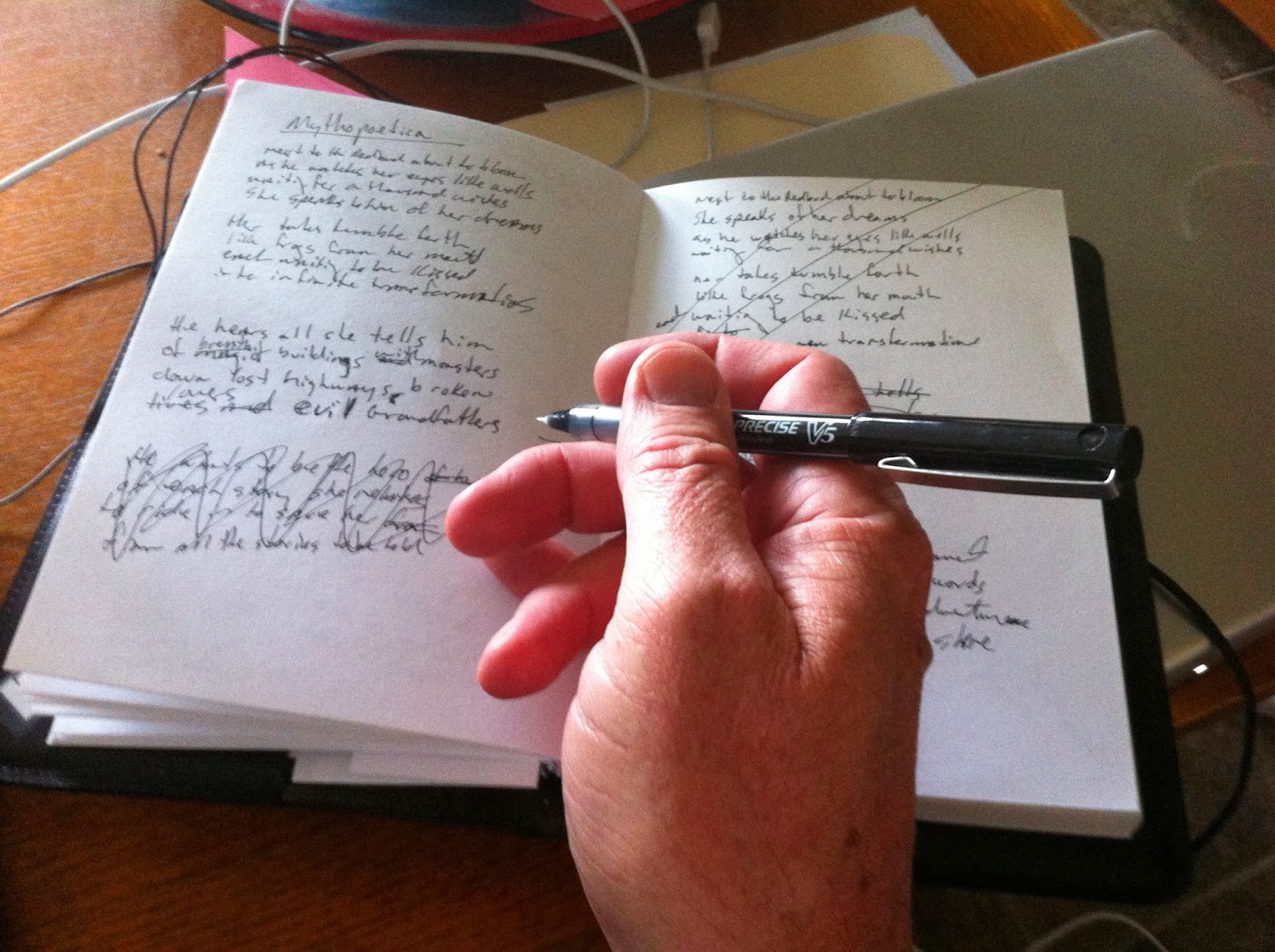
    Since I was 15, I have carried with me some form of writer’s notebook. In high school I carried around a paper brad binder, then graduated to a three-ring binder where I kept neatly re-copied “finished” poems, not then realizing to what extent all the drafts could be mined later for the raw ore of writing. Of course, then, there wasn’t much of a revision process at all. Without ever having heard or thought about it, Ginsberg’s first-thought-best-thought became first-thought-only-thought in my composing process. So there wasn’t much to mine from the slag of my thinking. As I went off to college, I moved my notebook into a five-subject spiral. Ostensibly, the spiral was for notes for my classes, but never having learned how to take notes, I tended to work on ideas for stories and poems in the back of my college classes while half-heartedly listening to the lectures on Texas politics during the nineteen thirties, or the arcana of macro-economics. After graduate school, I settled into using a hard covered book-sized artist sketchpad as my notebook.  I like not having pre-printed lines to worry about and the texture of the paper appealed to me as well. The aesthetic of the writing experience became important as I relaxed into the process of writing, more than obsessing over the end product as I had as a beginning writer.
    It is the focus on the process of writing, which I believe allows me to avoid the trap of not writing. When I am not working directly on a poem, or feel as if I don’t have something I am playing with, I will flip back through my notebook, reading through drafts of now “finished” poems, or bits of words that never progressed beyond the first contact with the page. Often in these lost bits, or leftover bits of language I find new starting points for new poems, or at least, places to grow larger leftover bits that I might be able to use later, or not.  They give me something to play with while my mind searches for the poem I will write.
    Last summer, instead of cleaning out my closet as I was tasked, I found old notebooks from up to twenty years ago. I sat on the floor of the closet reading through old scraps of my thoughts. I was surprised by how much I found that I could use in the present. Some were happy accidents, others were directions I was not ready to go in when I first wrote them, or didn’t recognize as a true direction. But my point here is that if I hadn’t of gone through the old notebooks I wouldn’t have discovered something to write about in the present. 
    What I also discovered from the old notebooks was that I am writing more in the last few years than I ever did twenty years ago.  I write the beginning and ending dates of each notebook in the inside cover as I begin and finish a book. It used to take me up to two years to finish off the space of the sketchpad. For the last three years I have run through the same sized book in six months.  I credit a large part of that to making the time to sit and work through my current book on a daily basis. In other words, when I can’t write, I do exactly what I do when I am writing well: I sit down and write. Sometimes I write on a specific poem I have been working on, other times I just flip through and re-read what I have written.  It is the time I make myself do this that is what makes the writing occur. I don’t wait to be inspired, or when I think I can find the time. I just do it. I sit down and I write. Or at least pretend to write. I don’t worry if what I am writing is worth a damn, I just write trusting that I will be able to find something, if not now, later, worth thinking about. I trust that the poems will come, that I will write something, that the muse will eventually talk back.

  • Her love is heavenly, when her arms enfold me,
    I hear a tender rhapsody; but in reality she doesn’t even know me.
    Just my imagination once again runnin’ way with me.
    Tell you it was just my imagination runnin’ away with me.
    no, no, no, no, no, no, no, can’t forget her”—The Temptations
    Lately much of what I have been writing about has involved dream in some form or another. In the early nineties when I was taking a graduate poetry workshop in Vermont, the instructor Carol Oles, as a possible assignment, wanted us to write about a dream we had. I said in class that I couldn’t remember my dreams, which was an obfuscation; because I could remember many of them, I just felt that most of them at the time were inappropriate, or too embarrassing to write about.  Yet, I did write about dreams quite a bit that semester. Carol commented on that about half-way through the summer, “For someone who can’t remember his dreams, you seem to write about them a lot.”  I didn’t say anything.  What I thought however was I don’t write about dreams, because I often have a hard time differentiating between waking and dreaming.  I didn’t say anything, because I felt if I did I would come off as a flake, some new age whacko, a stoner, another white westerner pretending to have some kind of eastern religious insight, or just another writer who never got over their adolescent fascination with Poe: a dream inside a dream, sigh. But it was true: I often had a hard time separating dream from reality, still do. 
    Not that I don’t know when I am awake and interacting with the world. I guess most of my confusion occurs when I am thinking about events or conversations I have been a part of in the past. The past being defined as any time that is not the one I am currently in.  The event could have taken place an hour ago as easily as years ago. Did he really mean what he said in the way that he said it? How should I interpret that look? Did I say that or only think it?  Most of the time, I really don’t have too much of a problem with this; just when I start thinking too much. My training and natural proclivity toward analyzing text and language tends to throw me back into conversations or interactions I have been in, where I immediately begin to parse meaning out of air. I go through as many possible interpretations as I can come up with, often forgetting if what I think could or might have been said or done, actually was said or done.
    Yet, to return to where I thought I was going with this bit of chatter, lately I have been writing about dreams, both the kind I wake up from in the morning, wisps of their world still hanging about me as I head downstairs to make coffee; and, the more delusional kind, where I think something is happening because my imagination makes meaning out of situations and conversations where no meaning exist. “Just my imagination, running away with me.” La-la-la-la. Of course I am as aware as one can be that it is just a delusion, or a dream that I am writing into, but I am interested at present to see what rises out of the mist of dreams. Writing about the world I am enmeshed in creates and changes that world. I am better able to see, and discover, the world I enter each day by writing it, and myself, into being. Or at least that is my current dream.

    (January 2013)

  • during a Heart of Texas Writing Project Workshop on
     “Teachers Living a Writing Life”
    All of the following arose out of questions/”assignments” in the workshop:

    Why do I write?  ( 1}. Because I have to. 2}. to make sense of my world, 3}. to keep the world away, 4}. Keat’s Truth and Beauty, of course).  As if a question like this can be answered like an advertisement hook to be read on a billboard as one drives down I-35 at 75 mph.  I started writing poetry fervently as a sophomore in high school about the time my father was diagnosed with terminal cancer.  So in an easy psychological pass, I wrote because I was afraid; because I loved my dad; because I was a raging bag of anger, fear, love and confusion. I wrote, much like now, to make sense of all the troubles of the world I floundered about in, and to hold onto the seconds of ecstatic beauty I would stumble upon whenever I would look out long enough from my introverted, introspective, self-involved mind to see something other than myself.
    I write whenever I can.  I rarely have long swaths of time to write, especially in the last 20 years as I started teaching and raising my children.  I learned to write in short bursts, whenever I could.  Faculty meetings were always a good time. I used writing like I often use books, to block out the ugliness of the world. I have trained myself to write in the cracks of my life, the moments, always brief, which open up during the day.  In the morning as I’m waiting for the coffee to brew, I will sit and work out an image or thought.  Sometimes I write in my head, working out a line of a poem as I am lost in the repetition of the elliptical machine at the gym. Last year as I drove home eight hours after dropping my son off for his last year of college in Arkansas, I wrote an entire sonnet in my head, counting off the syllables with my thumb on the steering wheel and trying to memorize each line at 75 miles an hour. Finally I stopped for gas and wrote it all down in my ever-present green notebook. But most of the time I make time within the pulse of my day.  I carry my notebook with me wherever I go, to the copy room at work, to Kohl’s as my daughter is looking at clothes.  I don’t always write, but I have it with me in case I can write. I write obsessively. I have phrases that haunt me, rolling around in my head for years.  When I am clueless about what to write, I will write these driftwood-like phrases down hoping that this time they might generate something and will finally leave me alone. I will read and re-read my notebook, looking over bits of chaff left from other moments of writing, sometimes I find a newer direction from these obscure signs to a brighter prospect.
    Now as I sit here in this meeting with a larger block of time and the assignment to write, I find it difficult to come up with something to write about.  I have trained myself to write in small openings, to reflect upon snippets of words, to follow a trend or contour of thought in vague directions and to trust that something will unfold.  Now when told to write, I find it problematic. At the beginning of this block of time, I opened up my notebook and tried to work on and expand upon a couple of lines I wrote a few days ago. But it all seemed artificial and forced, so I moved back to the computer and started writing about how I write again. I think part of my problem today is that I feel compelled by the “writing workshop” to write: actually put words into my notebook, or type furiously on the laptop, like now; but writing is not just the physical act of writing, it is the thinking, the time to let “the mind track itself,” as Virginia Wolff said about the essay. Often my most enjoyable moments I have while writing come as I am just drifting among the wisps of thought that emanate from a line I have written.  If I try to force the next line, it usually turns trite or maudlin, or clichéd.  It is easy to go down the well-trodden path (like just then as I conjured up Frost instead of finding my own cow trail to wander along). I guess my writing ritual, to fold back into an earlier conversation this morning, is to allow myself to attend to my thoughts as if they mattered, but to also allow my thinking to go where it goes without too much direction from me.  Yes, that sounds gooey and undisciplined, but also meditative. I try not to think too much about meaning or direction. I fiddle with sounds of the words, or I count syllables, or words, or lines, or focus with connecting a free associative image to another in a way that flows and seems to make sense in more than a surrealistic manner, without obsessing too much on the sense it seems to be making.  I use the mechanics of the craft as a Mandela of a sort to take my conscious mind off the event horizon of the poem. I try to allow for the poem to occur without me, or my ego, getting in the way. Of course, that is all difficult and most of the time a complete lie as far as how I go about writing; but, it is something I attempt and when the work is going well, it is what is happening. 
    (October 2012)