I’ve told this story before—
with a different point,
a different ending,
a different resolution.
Most of my stories don’t end.
They trail off into the dark
of another day’s words,
some other recollection.
(August 29, 2026)
I’ve told this story before—
with a different point,
a different ending,
a different resolution.
Most of my stories don’t end.
They trail off into the dark
of another day’s words,
some other recollection.
(August 29, 2026)
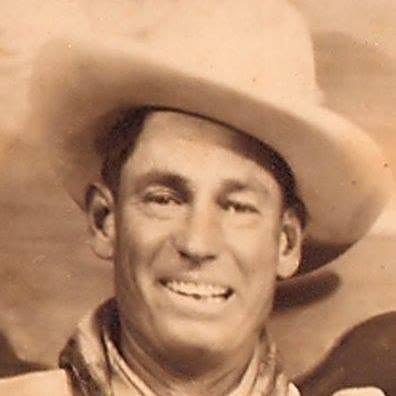
I did not know him
as the child I was
anymore than the man
I have become—
He was a shadow
sifted in story
his deep voice laced
with decades of smoke
before dying
into mom’s revisions
I still don’t know
what I was afraid of
(Father’s Day: June 21, 2026)

Memory is all that we are,
and all that we are is what
we remember. These days
I often forget why I enter
a room as I enter. I’m forced
to wait on the blurred past
with its dead possibilities
to catch up to my present.
We sit comfortably couched
about the room. We confess
our stories again, shifting
scenes to allow for shapes
which differ, to be polite,
from others in other rooms.
(December 28, 2025)
memory agitates into vision media res: the precise moment of peak self-revulsion, the inaction, the cowardice, the lie inherent in regret— when nothing more could have been done, nor anything now retroactively applied which can act as balm to the shame carried for decades through the day in those quiet moments on the way to work, waiting for the light to turn green, or some phrase, or song on the radio which tumbles memory’s cascade through the spongey canyons to again reconfigure itself into this contiguous present as some other story without static cause
(December 25, 2025)

The wind gusts in bursts
rushing leaves down the street
in a spasm of seasonal ritual,
as if a pattern’s repetition
creates a meaning separate
from our own simple noticing.
I have a hard time hearing
these voices of the world
through the constant clatter,
through the daily dazzle
and flash of the spectacle
playing in the wind’s
petulant laughter.
My screams are too loud.
To maintain my illusion
of safety, of purpose,
I whisper stories to myself.
I know stories are stories
and how they move through
each other like incestuous ghosts,
or confluent rivers, shaping
one another as they change.
I know change is incremental,
so I listen closely to my heart.
I notice a difference, but
am unsure what is different—
my notice, or the angle
of the wind through the trees.
(November 13, 2025)

This is how this story goes, or at least what I can remember from how Dad told it. I have probably told this story as many, if not more, times than my dad. Uncle Les had gone off to college in the late 1800’s. Every now and then a letter from him would arrive that first semester, and then they didn’t. My Grandfather Noel, Les’ brother, saddled up his horse and rode off to check on things. When he arrived, Les’ dorm room appeared as if Les had just walked out and would return any minute. He had been missing for several months. Then years later, around 1906, when my dad was three years old, a man came riding up to the “dirt” farm Noel struggled to eek a living from out near Liberty Hill. The man had two large saddle bags draped over his horse, two bandoliers criss-crossing his chest, and two large pistols hanging from his hips. The man was Uncle Les. After he dismounted, he walked into the house and hung his pistols from a peg on the wall. Les never touched those guns again. “Leave those guns alone, Ralph They’re nothing but trouble,” my Grandmother Pearl told the excited three year old. Les took his saddle bags out to the barn where he slept for the next 7 years as he worked for his brother on the farm for room and board. After seven years, Les took the almost forgotten saddle bags and bought a ranch out west. Even as children, we saw the holes in Dad’s story: Where did Les get the money for his ranch? Noel only paid him with food and a place to sleep. Where had Les been all those years after disappearing from his college? What had he been doing? After being gone for so long, why did he wait for seven years before he bought his ranch? What was in those two saddle bags? Was any of what Dad said over the years about Les true in any way? How much have I filled in the holes of my memory with conjecture?
(September 7, 2025)

He didn’t know how to act, and had no script to follow. She knew her part without book, and said all her lines with ease. This was, she pointed out, not her first time in this role. It was, he thought, a true love story, not just another chance for her to reprise a stock character. Repeatedly, she set the scene, hitting her mark, an easy cue to follow. Scene after scene, he vaguely wandered the stage, wishing he knew what to say; wishing he knew what to do; unable to act on his desires. She was confused. What was his motivation? Why wouldn’t he act? Why did he not respond correctly? Eventually, the farce ended as it began, without preamble, or resolution. Some one laughed in the wings, followed by a slow clap. Then, like a ghost, she left the stage, leaving him to ponder their performance alone, as the lights slowly faded past memory.
(September 5, 2025)

“You should understand
the way it was
back then,
because it is the same
even now.”
from Storyteller by Leslie Marmon Silko
Today I finished (for RFB) Storyteller by Leslie Marmon Silko. It reminded me of Way to Rainy Mountain by N. Scott Momaday in the way it blended personal narratives, with native-American stories, and history. The three aspects being, in reality, inseparable. In the case of Storyteller, the stories, poetry, photographs orbit around each other to create the idea of “story” as what defines us in our lives: the past, present, mythic all combine to create the culture we live in as well as the individual person who lives inside of the culture. It is a fairly subtle nuanced book. Silko does not spell it all out in the way Thomas King does in “The Truth About Stories,” a book I finished a few weeks ago. King also blends personal narrative, with myth, and history. Instead, Silko, lays out the parts of her collection in a type of collage, where the various parts generate a collective power creating a larger whole from the smaller parts.
Here are just some lines I underlined as I read:
“But sometimes what we call “memory” and what we call “imagination” are not so easily distinguished.”
“The story was the important thing and little changes here and there were really part of the story. There were even stories about the different versions of stories and how they imagined these differing versions came to be.”
“We were all laughing now, and we felt good saying things like this. “Anybody can act violently—-there is nothing to it; but not every person is able to destroy his enemy with words.”
“even silence was alive in his stories”
“the memory
spilling out
into the world”
“So they pause and from their distance
outside of time
They wait.”
“laugh if you want to
but as I tell the story
it will begin to happen.”
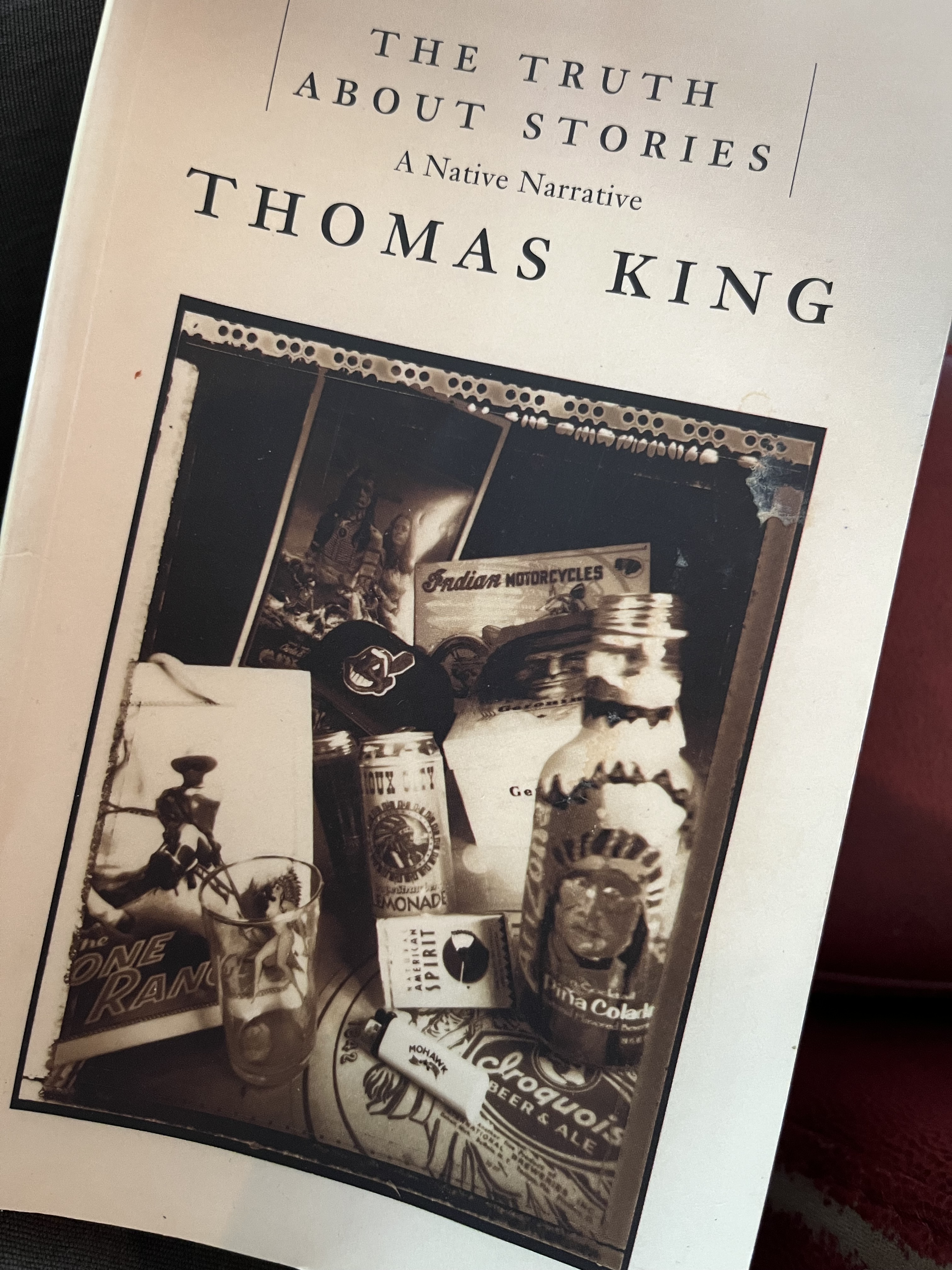
This is the second, maybe third, time I have read this book. It is that good. Oscar Wilde wrote that a book that isn’t worth reading twice is not worth reading once. The Truth about stories is worth reading once, maybe even three times. “The truth about stories is that is all that we are.” King repeats throughout the book as he tells stories within stories, mixing personal narrative with native “myth” and historical facts to illustrate, expand and deepen each section/chapter of his book. His themes are identity, how we become who we think we are, how we can change who we think we are; How others come to define us through the stories they tell about ourselves and themselves; and that we can change our world by changing the stories we tell each other. King is an indigenous Canadian. He focuses early on in the book about how one is an Indian, and how a large part of that definition is provided by the non-indigenous, from how one is supposed to dress to be seen as authentic, to convoluted arcane laws developed by the government in their attempts to control and eventually eliminate the Indian. He has a wonderful light touch in his writing style that makes an otherwise grim tale less horrific without sounding paternalistic. King begins each chapter with the story of the world carried on the back of a turtle, which is carried on another turtle ad infinitum. I assume to point out that there is never a sole basis for the story we live within. He ends each chapter in a similar way connecting the end to one of the stories from that chapter. Here is one of them: “Take it. It’s yours. Do with it what you will. Tell it to your children. Turn it into a play. Forget it. But don’t say in the years to come that you would have lived your life differently if only you had heard this story. You’ve heard it now.”
“If you haven’t read hundreds of books, you are functionally illiterate, and you will be incompetent, because your personal experiences alone aren’t broad enough to sustain you.”
—General John Mattis
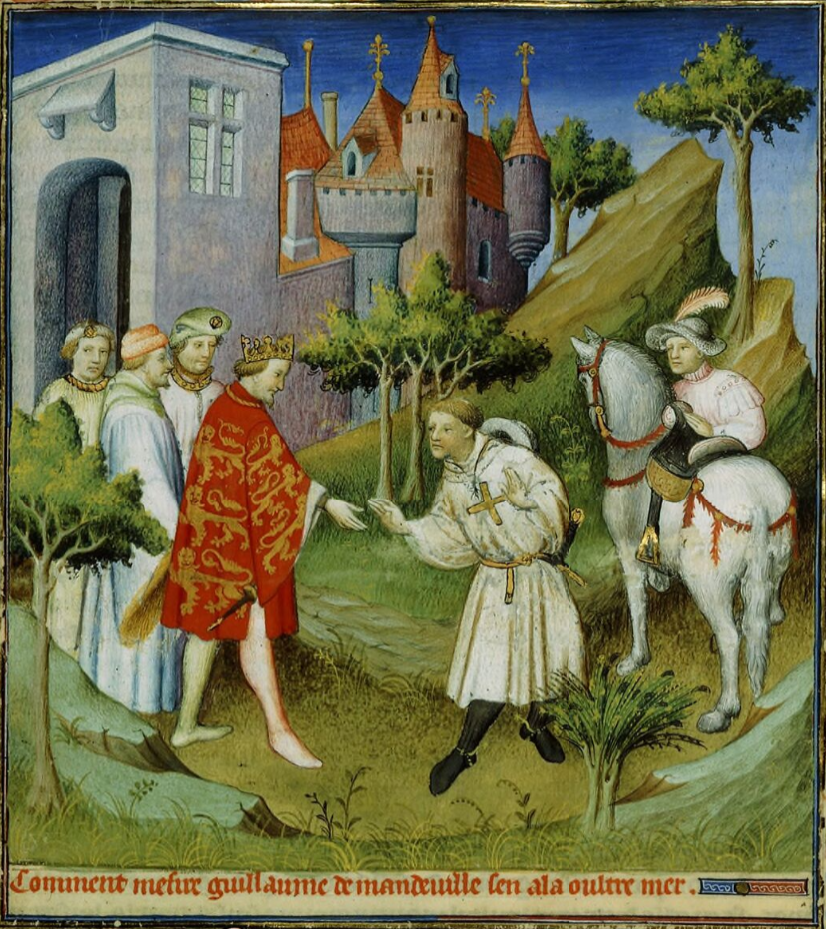
Some days the distance across the room is problematic. Like now, I am reminded of a book by something I just read, but cannot see from where I sit if it is on the shelf. Prester John would know, but he lives somewhere else far far away surrounded by pagans and others I can only imagine. But for today, I am lost in thought. Prester John and his mighty Christian armies could lead the way, if only I could find him somewhere nearby. Perhaps tomorrow, or the day after, I’ll remember to look in that book over there. For now, I am tired, and it is almost time for dinner, and I have such a long walk home through the village square before dark.
(April 17, 2025)

Ghosts move through the house, sitting on the kitchen table, on the arms of overstuffed chairs, looking at the blurbs on the backs of books left casually on side tables as if they still knew how to read. They have something more to say, but they have lost their ability to speak. I loan them my mouth. Their words almost fit what I say. They speak in the footnotes as unacknowledged experts to cite variations and caveats. Although no one has time to read their comments, their soft attention to others’ details reshape the shadows until memory begins to cling to their faces like stone veils, or muscles to bone. They no longer belong to the story they once were, anymore than I know the end of mine.
(April 16, 2025)

At which closed door
does it no longer matter
if it remains a closed door?
Does a story I’ve never heard,
because never told, become
more than my own
through implied genetic hints
and stale romantic longings?
Hundreds, perhaps thousands,
of years, and miles of oceans between
allow one to co-opt, create, and project
a nameless European hero (with a face like mine?)
to pillage and fuck their way into a future
through the tangled heath and ruins of time.
(April 3, 2025)
tells a story
to entertain
to make belief
an allowance
to comfort
and hide
from whatever
needs be
feared
(March 31, 2025)

At least 25 years ago, I read The Road Home by Jim Harrison. I read it again for the second time slowly over the last month. The Road Home was the first novel by Harrison I read. I had read his short book of poetry “After Ikkyu,” which is still one of my favorite books of poetry. I have since read pretty much everything he wrote. The Road Home is the sequel to Dalva, which I read after The Road Home. The Road Home had an enormous emotional impact as I finished it the first time, and now again 25 years later. It wrestles with themes of history, family, place (as in location), nature, art, and love, and how all of these interact in one’s life for good and ill. Harrison’s prose style (poetry too) creates the illusion of someone talking directly to you, going on short and longish tangents and asides as the story is told. All the while adding nothing that is not necessary as the story unfolds. Here are some quotes from The Road Home:
“The mind by itself must discipline itself to open wide enough to allow the soul to clap its hands and sing.”
“..as if we were all undertakers for our past.”
“If it all was based so resolutely on chance it seemed by far the best course to seize what chances were offered.”
“Obsessions don’t seem extraordinary if it’s just the way you are.”
“I wondered at the time and still do why they allow people to teach who don’t read.”


