I re-read Randall Jarrell’s The Bat Poet late this afternoon (It is short, 36 pages so don’t be too impressed). I first read The Bat Poet as part of The Hill Country Writing Project (the precursor to the Heart of Texas Writing Project) in 1987. It is such a lovely book about becoming a writer. Lots of analogies between the narrative of the bat and the stages newbie writer’s go through on their journey to being a poet—1) seeing a world different than your peers; 2) finding a mentor (text); 3) writing your first poems 4) mimicking others’ voices 5) finding your voice in your identity; 6) returning to your community with your vision: a mini-hero’s journey! I love the scene between the bat and the mockingbird (the accomplished poet no one understands) when the bat reads a poem he wrote about the owl to the mockingbird. The mockingbird explains the technical aspects of the poem he liked, befuddling the bat who just wrote the poem like the owl was oblivious to the academic names for what he was doing. The illustrations by Maurice Sendak for the book are a bonus.
I believe I was 34. I had three children under the age of 3. I had taught 150+ 13-14 year old students each year for the last five years. It was my first time to be on a jury. The defense attorneys should not have let me on the jury. If they were doing their job of defending him, they should not have let several of us on the jury: the older church going Christian grandmother; the trainer for the local University’s swim team (18-22 year old young women). Looking back, I figure his lawyers thought we would be sympathetic to the youth minister because we understood the dreams and desires of adolescent young girls. We understood how they trusted us, and even loved us. We understood the accusations which could be thrown because of childish misunderstandings. Fortunately we did understand, and came to the verdict that the youth minister of the Baptist church near Dallas had broken the promise of in loco parentis, the legal responsibility of a person or organization to take on some of the functions and responsibilities of a parent. That part of that promise that was to not mentally and sexually abuse a thirteen year old girl.
It was a civil trial. Both the former youth minister and the Church were being sued. The statute of limitations for a criminal trial had expired. The young woman was now 21 years old. The prosecutors told us that the evidence for a civil trial was not the same as a criminal trial. It was not beyond a reasonable doubt, but that the preponderance of evidence that lead to a guilty verdict. The preponderance of evidence dropped on us in thick slabs of revulsion for eight hours each of the days the trial lasted. We were asked to determine what percentage of responsibility for the sexual abuse of the young woman lay with the church, or the youth minister.
The trial, they said, would last about 4 days. In the end it went on for two weeks. We heard testimony from the ministers of the church, the deacons, the church women volunteers, the other young members of the church; all those who also went on church trips, attended youth activities organized by the youth ministry, went to pool parties sponsored by the church where the children played games in the pool with the youth minister; who remembered how he and she sat on the edge of the group around the fire at the beach while others sang songs of joy. We heard from the therapist she went to for years after the youth minister’s rape of the young woman. We heard from the young woman. We were given access to her detailed adolescent diary. The same questions were asked of each witness. The answers that were given were so monotonously repetitive that by the end of the second week, I could have answered for each of the witnesses who were called.
We did not hear from the former youth minister. He was a minister of a church in Ohio at this point. He could not be forced to attend a civil trial in Texas. He had moved on from his days as a mere Christian minister to the young souls in his charge in suburban Dallas. God had called him to a new ministry. He was the head of his own church, a respected man. He could not even be impelled to make any monetary restitution that we decided to lay upon him. He was free, forgiven by society, if not by God.
The deliberations in the small room in which we sat were not about whether the events happened; it was beyond debate that the youth minister did what he was accused of doing, but instead circled around how much the church should have known, or did know about the abuse. We were charged with what percentage of guilt lay with each of the defendants, and how much the total monetary fine should be for the actions of the youth minister, who ultimately would not have to pay anything for what he had done to the young woman. What was the price of rape? How much should an institution be held accountable for the actions of an individual member of an organization? Ultimately, we came to a consensus that he was responsible for 80% of the verdict. It was strange sitting in the room, listening to other men arguing for smaller responsibilities to be laid upon the church (because they knew the minister would pay nothing), for a lesser amount of money to be charged to the church, who should have known, who in much of the testimony showed that they did know, about the actions of the youth minister. Too many of the men on the jury seemed to me to be searching for a way to make it all just go away; after all, she let it happen. She let it happen. She was thirteen. He was mid-twenties.
The second decision we were charged to make was the monetary amount that was to be rewarded to the young woman. Here attorneys were asking for 20 million dollars. The foreman of our jury thought that was an absurd amount of money, finally reluctantly acquiescing to 10 million dollars, eight of which the former youth minister would never pay. The other two million being the responsibility of the church.
I remember walking to the bus which would take me to where my car was parked so that I could drive home back to my family with our small children, and then back to my classroom the next day with my wildly wonderful thirteen year old students, thinking that we had all failed her somehow. That justice was bought off cheaply. That we were all responsible for what happened to her. The trial sat in my mind darkly for the rest of the thirty years I worked in education.
“If you haven’t read hundreds of books, you are functionally illiterate, and you will be incompetent, because your personal experiences alone aren’t broad enough to sustain you.”
—General John Mattis
Some days the distance across the room is problematic. Like now, I am reminded of a book by something I just read, but cannot see from where I sit if it is on the shelf. Prester John would know, but he lives somewhere else far far away surrounded by pagans and others I can only imagine. But for today, I am lost in thought. Prester John and his mighty Christian armies could lead the way, if only I could find him somewhere nearby. Perhaps tomorrow, or the day after, I’ll remember to look in that book over there. For now, I am tired, and it is almost time for dinner, and I have such a long walk home through the village square before dark.
As I was heading toward bed last night, I thought of Galway Kinnell’s “The Book of Nightmares.” It has been years since I last read it. I figured it was the universe telling me I needed to read it again, So I pulled it off the shelf.
I first ran across “The Book of Nightmares” in the University Coop basement, where they would put out the required texts for the numerous classes being offered that semester at UT. I often would troll through the offerings, buying books for classes I was not taking. One semester, Kurt Heinzelman, a prof at UT, was teaching a graduate class on the Modern Long Poem. In addition to Eliot’s Four Quartets, Ted Hughes,” Crow, and various others, was Kinnell’s Book of Nightmares. I bought them all. Kinnell’s book fell into heavy rotation in my reading play lists. A few years later, I found a cassette tape of Kinnell reading The Book of Nightmares, which I listened to constantly in my old Honda as I drove around Austin.
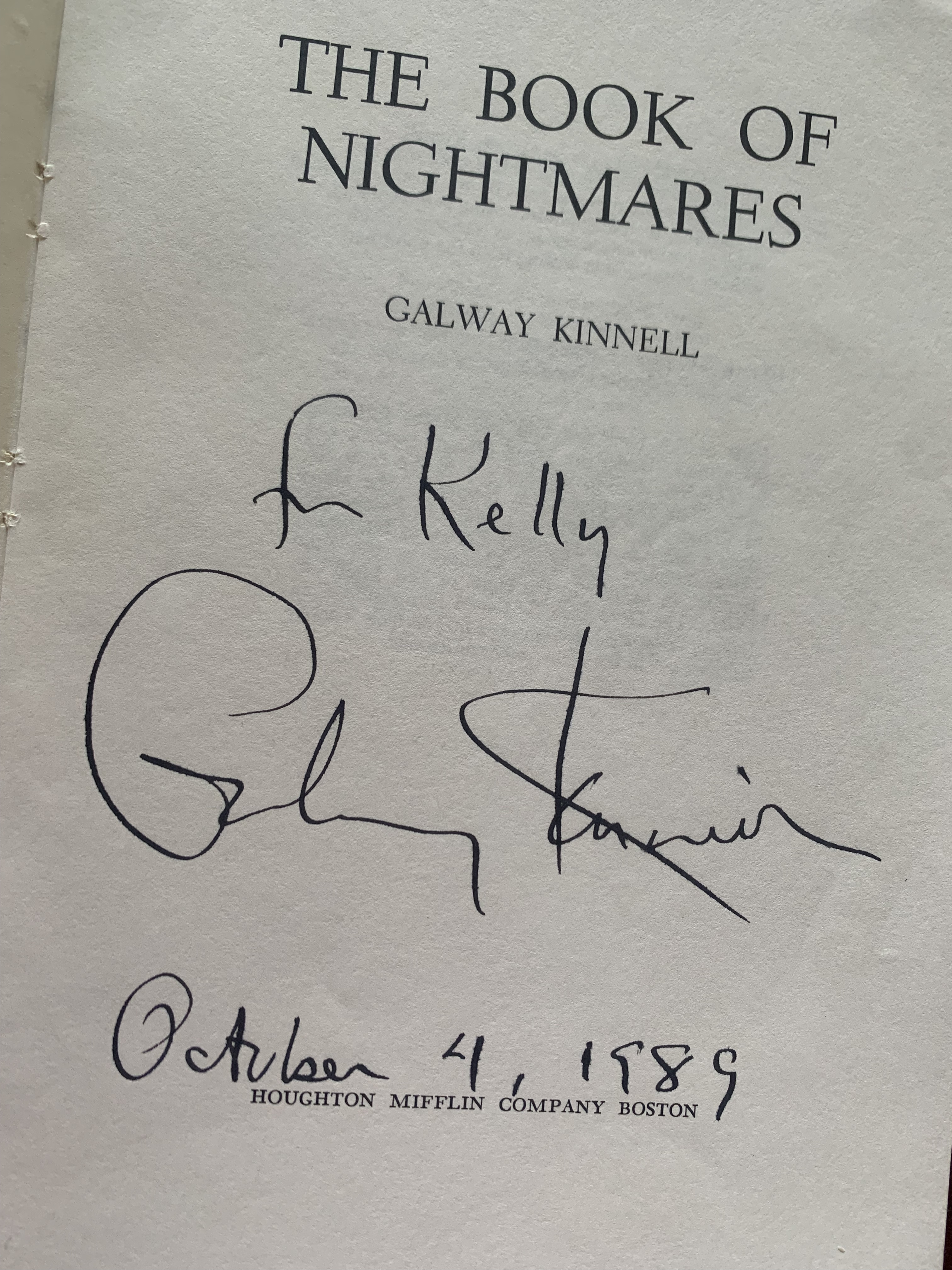
After years of reading and re-reading “Nightmares,” as well as his other books, Kinnell came to Texas State to do a reading in 1989. Lisa, Donna and I drove down to see him. After the reading there was a reception where the attendees could talk with Kinnell. I was too introverted to attempt a meeting, even though I had brought my old copy of Book of Nightmares for him to sign, if by some miracle I was able to summon enough gall to speak to the poet. Donna and Lisa went off to find the restroom and left me sitting on a bench awaiting their return. While I waited a man came over and sat down on the bench next to me. It was Galway Kinnell. I figured I had to talk to him, since there he was. We made forgettable small talk about Vermont, and he graciously signed my copy of Nightmares.
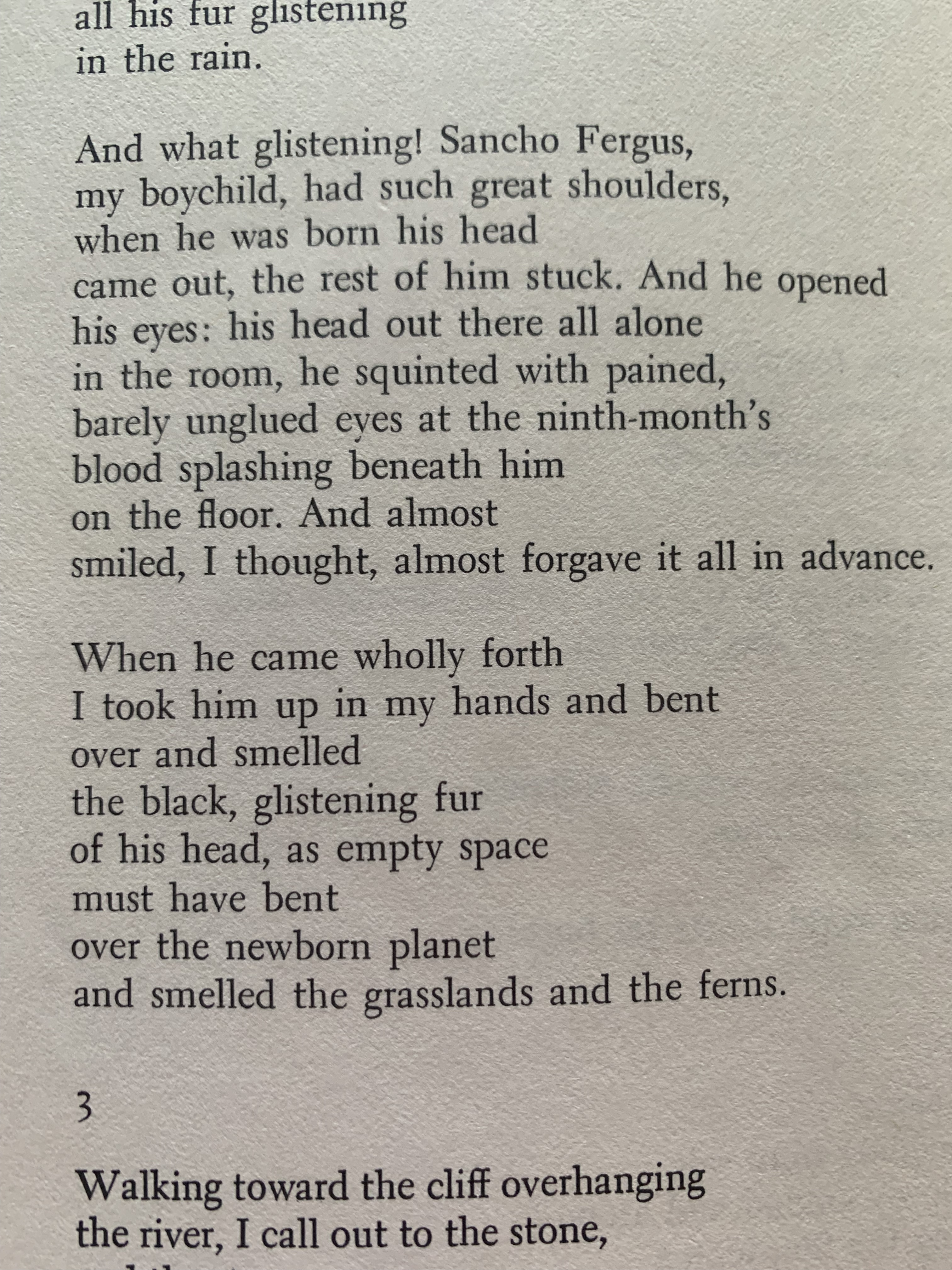
Last night after I pulled it off the shelf again, after years of not thinking about it, I read it again from start to finish. It is still an amazing poetic achievement. Reading it, I immediately fell into the slow rhythms, and stunning imagery. Themes of universal birth and death, creation and time mixed in with the personal reflections on the birth of his own children are just a part of the overall power of the book. I was lucky to have run across it that day in the Coop basement, it has been a true companion in my literate life.
Each day that summer as I walked home from concentrated classes at the University (Early Modern Philosophy: Descartes, Kant, Hegel, Hume, Berkeley all in six weeks), I would wave to an old woman who sat on the porch of her disheveled house drinking coffee, I assumed. Each day for a couple of seconds, we would affirm each other’s existence in the other’s life. One day she called out to me, she wanted my help with something. I hesitated — for I had places to go, people to meet all afternoon. I was afraid she would take more time than I had to give. After I negotiated her neglected front lawn, she held out an old alarm clock, “It’s broken,” she said, “I don’t know what the time is anymore.” I took the clock from her crumpled hands, turned the key a few times, and it started to tick loudly. She thanked me, and I went on my way. The next day and the day after that for the rest of the summer, I never saw her again. Although, now and then, for the last forty years, I think of her, her clock, and the time she took that day.











 subtext