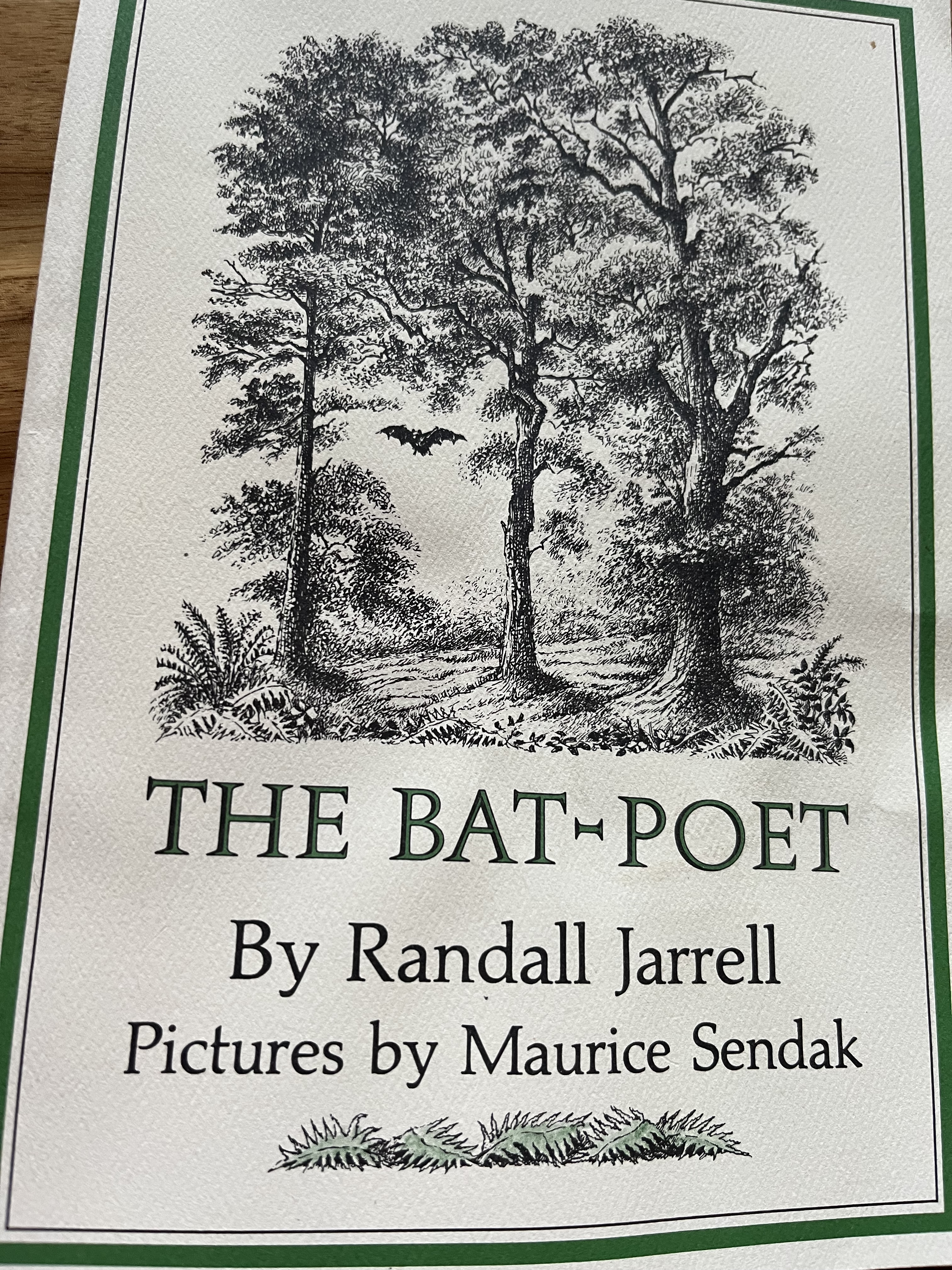
I re-read Randall Jarrell’s The Bat Poet late this afternoon (It is short, 36 pages so don’t be too impressed). I first read The Bat Poet as part of The Hill Country Writing Project (the precursor to the Heart of Texas Writing Project) in 1987. It is such a lovely book about becoming a writer. Lots of analogies between the narrative of the bat and the stages newbie writer’s go through on their journey to being a poet—1) seeing a world different than your peers; 2) finding a mentor (text); 3) writing your first poems 4) mimicking others’ voices 5) finding your voice in your identity; 6) returning to your community with your vision: a mini-hero’s journey! I love the scene between the bat and the mockingbird (the accomplished poet no one understands) when the bat reads a poem he wrote about the owl to the mockingbird. The mockingbird explains the technical aspects of the poem he liked, befuddling the bat who just wrote the poem like the owl was oblivious to the academic names for what he was doing. The illustrations by Maurice Sendak for the book are a bonus.
It has been several decades, at least, since I read Eliot’s Four Quartets from beginning to end in one sitting. But since the poem came up in a conversation a couple of days ago, and Lisa has gone out of town, I read them out loud to myself in one go. It is an amazing work of art: time, faith, God, identity, sense of place, abstract while being incredibly precise in concrete details which fold back into the abstract. The usual allusions to everything in world literature and religion, but so subtle and fast it becomes as if you are reading about Jonah, Arjuna, Charles the 2nd, and many others for the first time. And such a magisterial voice and a musicality which lifts the reader to intellectual heights before they realize what is happening. When, 30 years ago, I read The Quartets for a class on the Modern long poem, Walt Litz, my prof, described it as “philosophical poetry, not philosophy as poetry.” If you haven’t read it, and want something deep, but not as daunting and dark as The Wasteland, then you should read it. It made me think about the first time I heard Beethoven’s Ninth, or Handel’s Messiah all the way through. And if you have read it, then it might be time to look again. I remember reading once that different poets often speak to you differently at different times of your life. The Four Quartets speak differently now than they once did. “My words echo/ thus in your mind.”
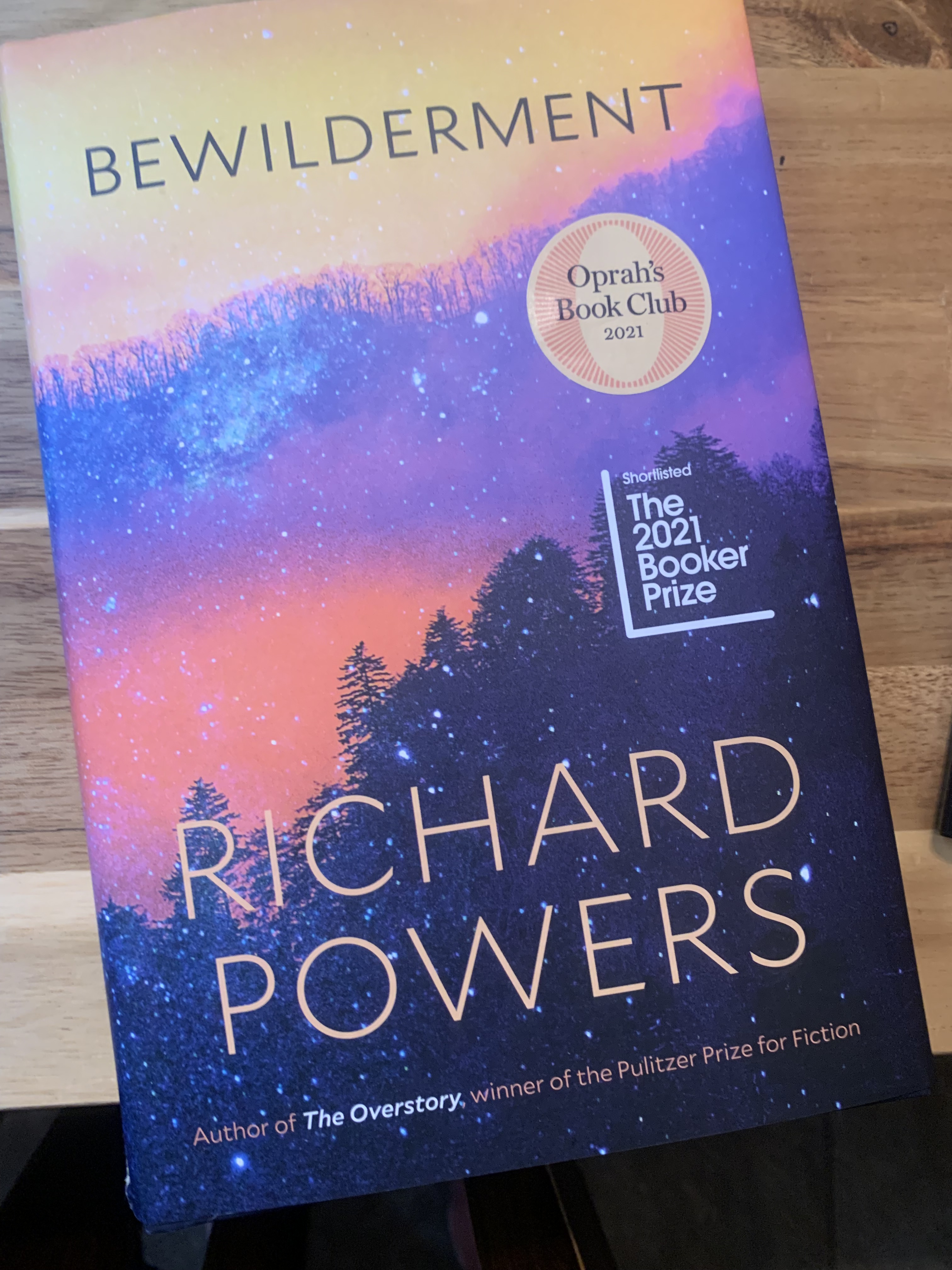
I finished “Bewilderment” by Richard Powers last night. It was a lovely disturbing and heart-rending novel. Awhile back RFB read The Overstory by Powers, it too was lovely and disturbing, but not quite as sad. Where The Overstory was about trees and the destruction of nature and our connection to it, Bewilderment is about the destruction of life as we know it and ourselves. If you have read “Flowers for Algernon” you will recognize the strong allusions and parallels to that classic novel. (If you haven’t read Algernon—what is wrong with you?) In addition to the end of life on the planet, Bewilderment is also about the relationship between a father and son after the loss of the wife/mother. If you haven’t read The Overstory, you should read it. Bewilderment is also great, and a bit shorter.
I finished Prophet Song by Paul Lynch over the last couple of days for my book group (RFB). It is hard to put down, even when you want to look away. An intense, disturbing read. Great lit! Ireland turns toward fascism and civil war. The story follows Eilish and her family as she struggles to keep her family intact and survive. I was paranoid inside of the first 30 pages, and stayed that way to the end 275 pages later. I was always expecting the worst. So many echoes of our current political situations, as well as genocide around the world. I imagine it will stay with me for quiet a long while. Read it. Seriously.