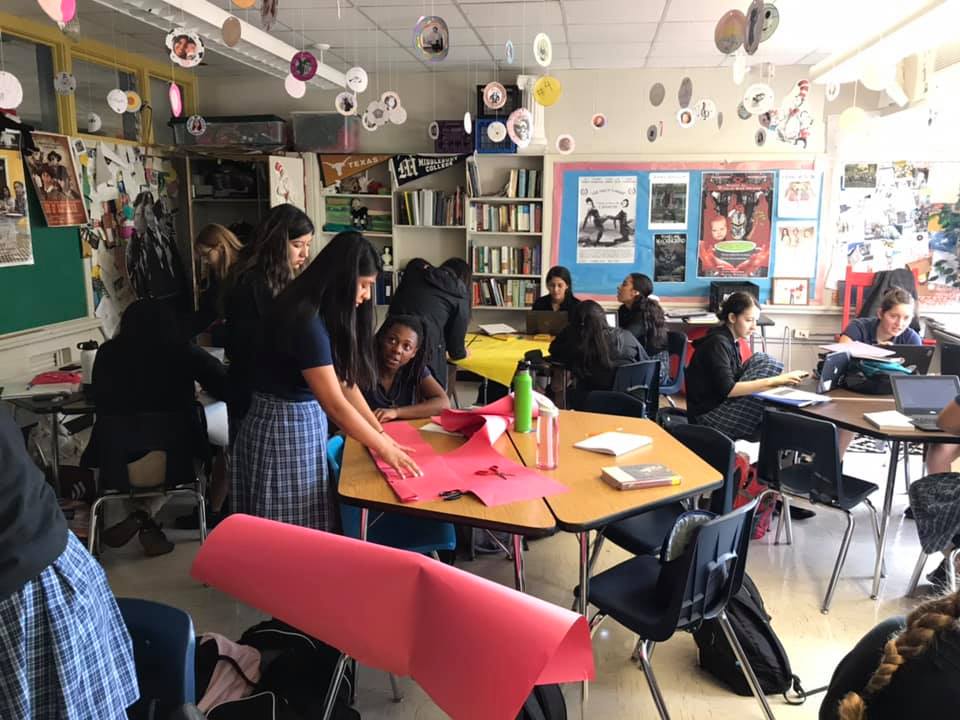
I had a dream/nightmare this morning. I was returning to a teaching job at a high school where I taught English Literature and Composition 14 years ago. The dream began at an English Department meeting where we were being introduced to a newly purchased curriculum that emphasized teaching the students how to spell. The curriculum came with “can’t fail lessons” and lots of pre-made, easy to grade, worksheets. I was arguing against the program, of course. I tried to explain the benefits of teaching reading and writing through a workshop system, of course. No one was listening to me, or the presentation from the district, of course. Instead, the other teachers spent the time complaining about their students and the administration, of course. Richard, my friend, tried to calm me down, but I took it as he was just patronizing me to get me to shut up. The meeting broke up. I wandered the halls looking for my classroom. I realized that no one had shown me where I was supposed to teach. The halls were crowded. It seemed to be lunch, since no one was in any of the classrooms, instead they were milling about in the common areas. Teachers rushed about, overwhelmed. Students gossiped, politely ignoring me as I walked around the building, lost. I never should have come back to teaching, I thought. I should quit now, I thought. But I can’t quit. I need the money: If I quit, I won’t have any income, I thought. I kept walking around the building in a growing panic. I didn’t know where to go. I woke up, as I remembered that I was retired, that I had a pension, that I wasn’t teaching anymore. That I did not have to teach anymore. It was over. It was over.
“My life could have turned out differently, but it didn’t.”
–Jim Harrison
“I live with my contradictions intact”
–David Ignatow
“I’ve got to lose this skin I’m imprisoned in”
–The Clash
“Didn’t nobody seem to know me, babe, everybody pass me by”
–Robert Johnson
It is easy to trace the twisted path which led me to where I am; however, it is a bit more difficult to see where I am going next.
An obnoxious student asked me last week, in regards to this assignment, what my “rock” was. In my usual evasive fashion, I responded, “You are” meaning all of them, my students were my rock. However, even though I enjoy teaching most of the time, when I think of why I do what I do, or rather who I am, I don’t think about teaching. I have several roles I have taken on over the years: husband, father, friend, teacher, student, doctoral student, writer, poet, fool. I don’t think I am a Prufrock, yet, sometimes I feel as if I am no more than a sad man walking along the beach with my trousers rolled. Having a meaning or purpose, it is often said, leads to a happy (ier) life. With that in mind I guess, I would say that teaching gives me some of my purpose, and poetry gives it meaning, or helps me to create a meaning, to create sense out of chaotic universe.
Recently a friend wrote that she had a hard time calling herself a writer, even though I know she writes and writes well. A few years ago, a woman at the first meeting of a poetry group said she did not feel as if she could call herself a poet. I had just said as part of my introduction of myself that I had considered myself a poet since I was fifteen. She seemed shocked that I would have the audacity to call myself a poet. This inability to call oneself what one does came up again in another conversation between teachers. One man said that it felt somehow pretentious to call oneself a poet or a writer. I asked the group how was it any more pretentious to say you were a poet than to say you were a teacher. To me it seemed more pretentious to lay claim to that title, to say, “I am a teacher.” I mean Jesus was a teacher. Who the hell am I? But I have over time become used to being called arrogant, so I guess that is why I have an easy time saying: I am both: a teacher and a poet. I don’t claim to be very good at either one, but I am both. Charles Bernstein said that if one says it is a poem, then it is a poem. No claims to quality, but it is a poem. I am a poet. I sit down with the intention of writing a poem. I think about each line, the rhythm, the sounds of the words in relation to the other words, the phrasing, where I can cut and reduce, where something else needs to be added. I use poetry as a way of making sense of myself and the world I find myself in. As I have said elsewhere, poetry (both reading and writing it) helps keep the horrors of the world away and a way to find beauty everywhere and in everyone. I have consciously written poetry since I was fifteen; with luck, I will continue to do so the rest of my life. I am a poet.
Of course, I am also a teacher. If some magical seer had appeared to me when I was a 17-year-old senior, and told me that I would be a teacher for more than 30 years, I would have laughed out loud just before dying in horror. Yet, here I am working at one of the best high schools in Texas as the senior APLit teacher. Sartre famously wrote about a waiter at a Parisian café. The waiter, according to Sartre, is only a waiter when he is performing as a waiter. So, following that train of thought, I am only a teacher when I am at work talking to my students. I rarely think about being a teacher. It is still, after more than 30 years, difficult to think about me being a teacher. I suppose my life as a teacher would be inauthentic since I don’t think about why I do this beyond making enough to feed my children, pay the mortgage, and send them off to college. Yet, in some small way I like to believe that what I do matters, even though I know it probably doesn’t.
Maya Angelou said you remember how people made you feel, not what you learned. I think that is why when my former students run into me at HEB, or they come back to visit, they remember my class fondly. A few weeks ago, I was having a beer with a friend when I man in his thirties approached and asked if I was Mr. Neal, as if he were a process server for some lawsuit. It was odd to say the least. When I answered yes, he told me that he had been in my class when he was an eighth-grade student at Pflugerville Middle School. He said he heard my voice, and knew it was me. He remembered “The Road Not Taken.” (I used to have my students memorize poems). He said the first few lines. He said that had been his best English class, which I found embarrassing and kind of sad—his best English class was as an eighth grader.
I am not retelling this event as an attempt at self-aggrandizement, but to show how one’s self-identity is often much different than how the world sees you. I am always uncomfortable when people try to define me to me. I find their descriptions to be too pat, too much mired in the cliché, too many wrong associations. I am a teacher, and I feel in some small way I am helping create a better world with my students; yet, I never really know what it is I am doing.
In a faculty meeting, several times, I have stated I don’t have any idea what my students are taking away from my class. In an age of standardized testing, to say I don’t know what my students learn in my class is tantamount to heresy. I don’t mean I don’t know what it is I am doing in class; I just don’t know what it is they are learning. And I certainly don’t see them as the number they receive on standardize tests. I have had students tell me years after being in my class what they remember. It is always surprising to me what they found valuable, because it is never really what the objectives were in the class.
When people ask what it is I teach, they mean what books are we reading. They seem confused when I talk about my students. My students are what (who) I teach. Books, poems, essays, are just the ephemera of my class. The tools that are employed in the teaching. About 15 years ago, I would respond glibly to my fellow teachers when I was asked what I was teaching that six weeks with “Nothing.” My students read what they wanted to read, and for the most part wrote what they wanted to write. I ran my class as a reading/writing workshop. The district where I worked claimed that ELA did workshop k-12, yet I was the only teacher in my high school who did. So it often took several weeks to teach the students how to read on their own, to have the stamina to read for 20 minutes without interruption. So, one day after the students were fairly proficient at the process, I was sitting on the floor in the doorway to my class. I was monitoring the students who read in the hall, and the ones who stayed in my classroom. A history teacher walked by and said snarkily, “I wish I could not teach, and sit around all day and just read.” My students were on the verge of rising up against her, when I mumbled (they had learned to understand my mumbling at that point as well)—I mumbled in response to her, “One would have to know how to read first.’ She walked on, not hearing what it was I had said, and the students laughed as they settled back into their books. I developed a reputation with the faculty pretty much as a smart-ass. Not that they were wrong, but I interpreted what they saw as smart-assness, as more of a way not to scream expletives at them. I refused to accept their definition of what it meant to be a teacher. I created my own definition. Even if some of that definition was simply a defiant rebellion against my fellow teachers.
I do think a lot about what I am doing both as a teacher and writer. So, I imagine I am attempting to be authentic in what I am doing. I question whether my praxis (my beliefs correspond with my actions) is authentic..not just me going with the flow because that is the easy way to go about life. As I said earlier, I am never sure if what I do is effective or worth doing at all. I will fluctuate between thinking I am a decent teacher, or writer, to thinking I am a fraud, fooling everyone, even myself.
And that is the point I think of life: to try to be brutally honest with oneself, to never settle back and assume you know what it is all about, because one can never know. Which is not to say that we should not try to understand our lives, we should always be trying, even if we know we shall never know. Embrace the vast absurdity of the universe with a passionate intensity, not matter how pointless. It is the process and the awareness of the life you are living that makes the life have meaning and be worth living.
I don’t understand why others don’t grab onto ideas and roll with them in the same way I do. What do they not get? What do they see in the soap opera trivia of day to day life? What do they find so fascinating?
I wonder why I still won’t let go of the control of my classes more? I tell people that my students, our students, are smarter than we allow them to be. Yet i don’t allow them to be as smart as they are either. Why?
I spend much of my time thinking, dwelling over ideas and events, trying to figure out how they make sense with each other. I try to make meaning, a meaning (and that is perhaps my downfall), out of the chaos of the world.
I turned in my last test for Ed. Psych earlier today. So now, except for reading ten more adolescent novels, I am through with grad school for the summer. Perhaps for good. While I love the readings and the class discussions, for the most part, I am still caught up in the question I had after my first semester: Why am I doing this? Every semester since I have started this, I go through this same questioning: why am I doing this? Perhaps my inability to come up with an answer is reason enough not to finish. The tests and papers, where I have to perform in order to prove myself, create stress because I am such an over achiever and obsess over my “failures” if I make a B. Then when I make my A, I wonder if I really deserved the grade and criticize the work I did do. What kind of sick psychology is in play there? I feel as if I am missing my children’s adolescence by spending my time reading the reams of articles required for each class. ( I was stunned when someone in class last week admitted to not having read one of the two articles we were supposed to read. This in a relatively light reading load.) It was interesting taking two classes this summer, because it seemed as if I had lots of time because I was not working full time teaching high school. Yet I had more than one classmate looked shocked that I was taking two classes in one summer session. I am acquiring debt at an alarming rate, just as my oldest child is beginning to apply to colleges, none of which are cheap, and all of which I will do whatever I can to help him go to if he gets accepted, which it looks like he will based on their student demographics. I don’t see a lot of benefits to finishing, other than I hate quitting anything. I like the idea of being able to say I am working on a Ph.D., and the idea that I will get one if I continue, but is that just my egotistic vanity that is at stake; my insecurity in my intellectual ability trying to justify itself with yet another piece of paper? One of the four truths of Buddhism is that suffering is caused by desire: perhaps I should rethink my desires? OM.







 subtext