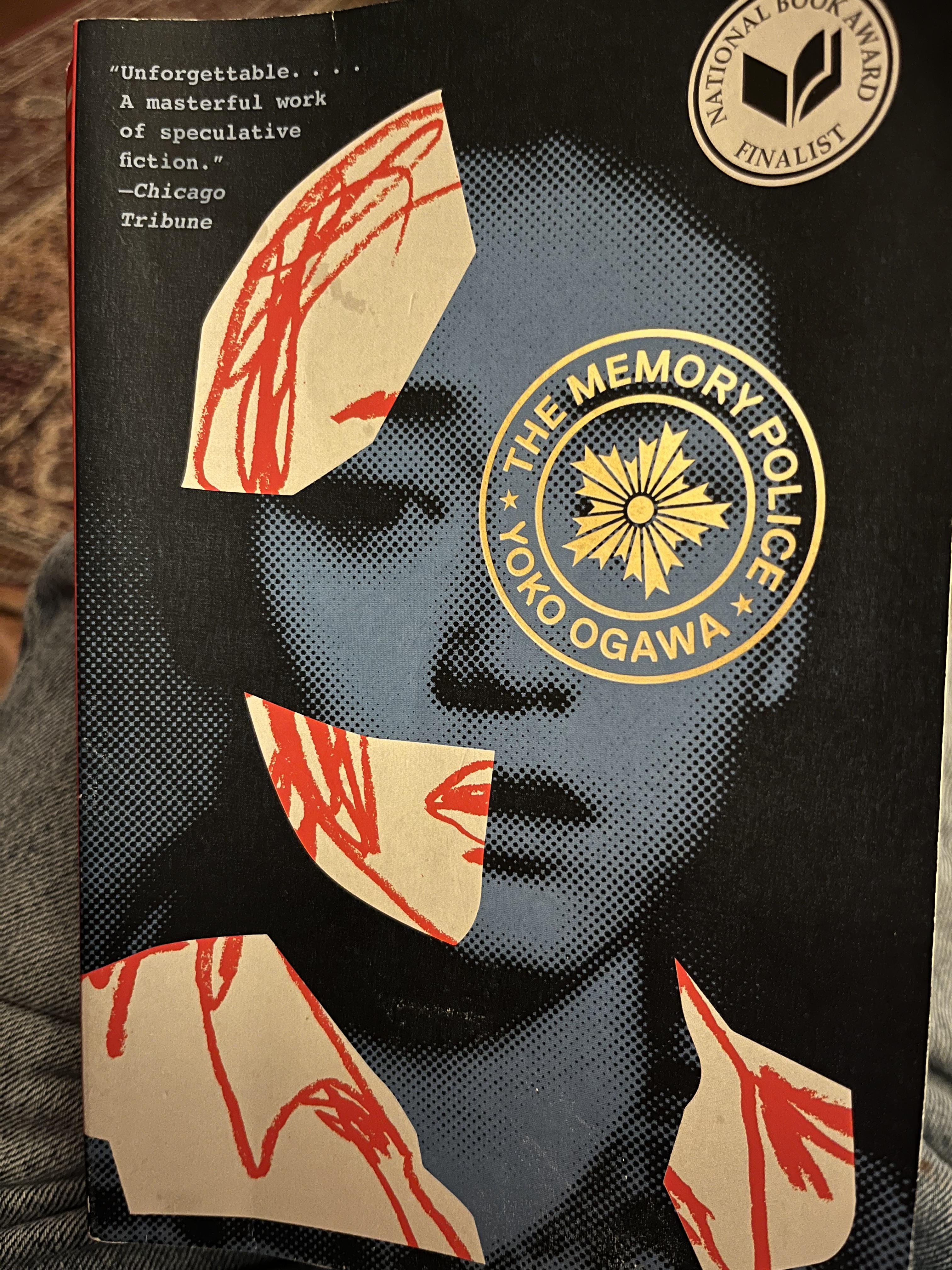
I finished the Memory Police last night, but couldn’t summon enough energy to write a response. It was curious. It was interesting. It was ART!! Were there great lines and thoughts? Yes. Did it make sense? Not at first glance, which this response is. The novel (as the blurb on the back states) takes place on an unknown island where objects keep disappearing. Disappearing completely, even from the memory of most of the people on the island. Those who can still remember are taken away to some unknown place, for some unknown fate by the Gestapo-like Memory Police. The last sentence of the blurb says “The Memory Police is a stunning novel about the trauma of loss.” I guess that is true, but only on one level. I would say it is more about the control of a community’s narrative; How history can be erased, and how we all just go along. How writing extends and saves individual memory for the next generations, who lose and save and create their own memories. How small seemingly unimportant objects can embody massive recollections.
Random Thoughts/Questions: None of the characters have names. There is a narrator, the novelist; the old man, who used to be the ferryman before the ferry disappeared, and R, who does not forget. The novelist is writing a novel, which sporadically we (the reader) get to read.Is the old man an allusion to Charon? Are the people who forget dead? The narrator is writing a novel, but loses her voice and can’t remember how to write. R, who used to proofread the narrator’s novels, keeps encouraging her to write, almost like editors who finish novelists books posthumously. Does “R” stand for reader? which is us, as we try to create meaning out of other’s incomplete memories?
Quotes:
“When I was a child, the whole place seemed… a lot fuller, a lot more real. But as things got thinner, more full of holes, our hearts got thinner, too, diluted somehow, I suppose that kept things in balance… And even when the balance begins to collapse, something remains.”
“I have the feeling my voice may come back one day if I study the letters imprinted on the used ribbon.”
“I’d imagine you’d be uncomfortable, with your heart full of so many forgotten things.”
“Memories don’t just pile up—- they also change over time. And sometimes they fade of their own accord.”
“Each one of us hides them away in secret. So, since out adversary is invisible, we are forced to use out intuition. It is extremely delicate work. In order to unmask these invisible secrets, to analyze and sort and dispose of them, we must work in secret, to protect ourselves.”
“Memories are a lot tougher than you might think. Just like the hearts that hold them”
“When you lost your voice, you lost the ability to make sense of yourself.”
Poems of witness. Too bad they must continue to be written. These were written by a 27 year old woman in the dying Soviet Union’s gulags. Carved into soap with a matchstick, then washed away after being memorized.
And then they’ll torch the cattle, houses with napalm,
measure the children with wheels of a tank,
level walls to the ground.
But maybe they won’t touch the crazed old women—
and don’t keep bringing up the schoolbook: the condemned
know the histories—
time’s worn thin above the place of execution, begins to leak.
God grant you don’t learn what the wife of salt will see:
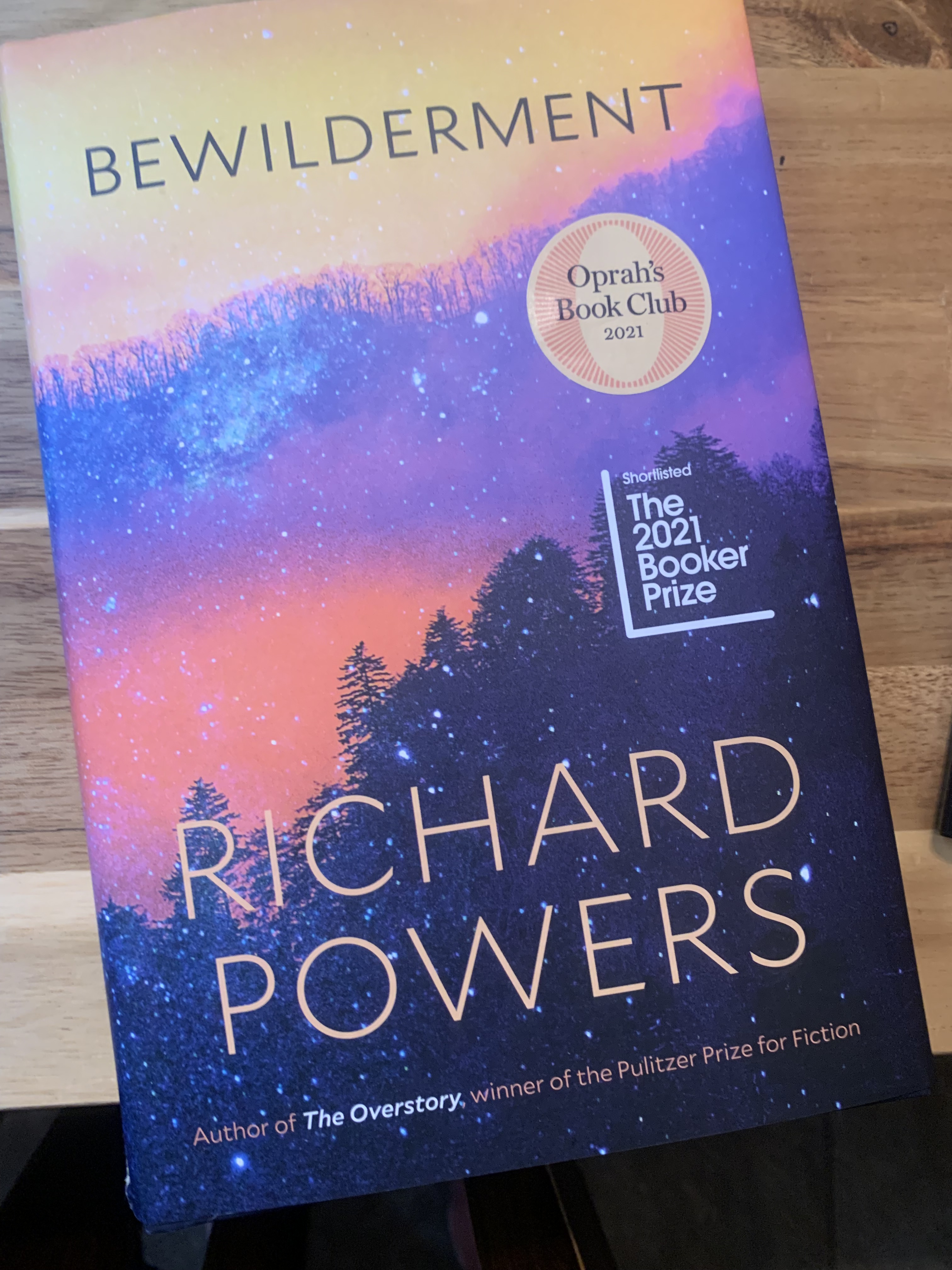
I finished “Bewilderment” by Richard Powers last night. It was a lovely disturbing and heart-rending novel. Awhile back RFB read The Overstory by Powers, it too was lovely and disturbing, but not quite as sad. Where The Overstory was about trees and the destruction of nature and our connection to it, Bewilderment is about the destruction of life as we know it and ourselves. If you have read “Flowers for Algernon” you will recognize the strong allusions and parallels to that classic novel. (If you haven’t read Algernon—what is wrong with you?) In addition to the end of life on the planet, Bewilderment is also about the relationship between a father and son after the loss of the wife/mother. If you haven’t read The Overstory, you should read it. Bewilderment is also great, and a bit shorter.
As if leading a ritual, the dogs wake me from dream. Their wet noses snuffle in my ear, scenting for traces of consciousness. I slowly collect myself, then escape down the stairs alone. Their task complete, the dogs curl into the warm shapes I leave behind in the tangled sheets. I’m cold, so I wrap myself in one of the brightly colored Mexican blankets Lisa bought more than twenty years ago along the border. Behind me on the counter, the coffee pot begins to gurgle and spurt. I watch through the sliding glass door as the leaves fall from the cottonwood and sycamore out back. Chasing squirrels most of the day, the dogs have worn two paths through the grass, each ending in the same place on the far side of the cypress at the bottom of the yard. These paths breathe cliche, no less so because mundane. The squirrels, out early, leap from tree to tree, dropping to the ground unmolested to collect acorns they buried, somehow remembering where they are months after the fact.