Category: essay

  • I believe I was 34. I had three children under the age of 3. I had taught 150+ 13-14 year old students each year for the last five years. It was my first time to be on a jury. The defense attorneys should not have let me on the jury. If they were doing their job of defending him, they  should not have let several of us on the jury: the older church going Christian grandmother; the trainer for the local University’s swim team (18-22 year old young women). Looking back, I figure his lawyers thought we would be sympathetic to the youth minister because we understood the dreams and desires of adolescent young girls. We understood how they trusted us, and even loved us. We understood the accusations which could be thrown because of childish misunderstandings. Fortunately we did understand, and came to the verdict that the youth minister of the Baptist church near Dallas had broken the promise of in loco parentis, the legal responsibility of a person or organization to take on some of the functions and responsibilities of a parent. That part of that promise that was to not mentally and sexually abuse a thirteen year old girl. 

    It was a civil trial. Both the former youth minister and the Church were being sued.  The statute of limitations for a criminal trial had expired. The young woman was now 21 years old. The prosecutors told us that the evidence for a civil trial was not the same as a criminal trial. It was not beyond a reasonable doubt, but that the preponderance of evidence that lead to a guilty verdict. The preponderance of evidence dropped on us in thick slabs of revulsion for eight hours each of the days the trial lasted. We were asked to determine what percentage of responsibility for the sexual abuse of the young woman lay with the church, or the youth minister.

    The trial, they said, would last about 4 days. In the end it went on for two weeks. We heard testimony from the ministers of the church, the deacons, the church women volunteers, the other young members of the church; all those who also went on church trips, attended youth activities organized by the youth ministry, went to pool parties sponsored by the church where the children played games in the pool with the youth minister;  who remembered how he and she sat on the edge of the group around the fire at the beach while others sang songs of joy. We heard from the therapist she went to for years after the youth minister’s rape of the young woman. We heard from the young woman. We were given access to her detailed adolescent diary. The same questions were asked of each witness. The answers that were given were so monotonously repetitive that by the end of the second week,  I could have answered for each of the witnesses who were called.

    We did not hear from the former youth minister. He was a minister of a church in Ohio at this point. He could not be forced to attend a civil trial in Texas. He had moved on from his days as a mere Christian minister to the young souls in his charge in suburban Dallas. God had called him to a new ministry. He was the head of his own church, a respected man. He could not even be impelled to make any monetary restitution that we decided to lay upon him. He was free, forgiven by society, if not by God. 

    The deliberations in the small room in which we sat were not about whether the events happened; it was beyond debate that the youth minister did what he was accused of doing, but instead circled around how much the church should have known,  or did know about the abuse. We were charged with what percentage of guilt lay with each of the defendants, and how much the total monetary fine should be for the actions of the youth minister, who ultimately would not have to pay anything for what he had done to the young woman. What was the price of rape? How much should an institution be held accountable for the actions of an individual member of an organization? Ultimately, we came to a consensus that he was responsible for 80% of the verdict. It was strange sitting in the room, listening to other men arguing for smaller responsibilities  to be laid upon the church (because they knew the minister would pay nothing), for a lesser amount of money to be charged to the church, who should have known, who in much of the testimony showed that they did know, about the actions of the youth minister. Too many of the men on the jury seemed to me to be searching for a way to make it all just go away; after all, she let it happen.  She let it happen. She was thirteen. He was mid-twenties. 

    The second decision we were charged to make was the monetary amount that was to be rewarded to the young woman. Here attorneys were asking for 20 million dollars. The foreman of our jury thought that was an absurd amount of money, finally reluctantly acquiescing to 10 million dollars, eight of which the former youth minister would never pay. The other two million being the responsibility of the church. 

    I remember walking to the bus which would take me to where my car was parked so that I could drive home back to my family with our small children, and then back to my classroom the next day with my wildly wonderful thirteen year old students, thinking that we had all failed her somehow. That justice was bought off cheaply. That we were all responsible for what happened to her. The trial sat in my mind darkly for the rest of the thirty years I worked in education. 
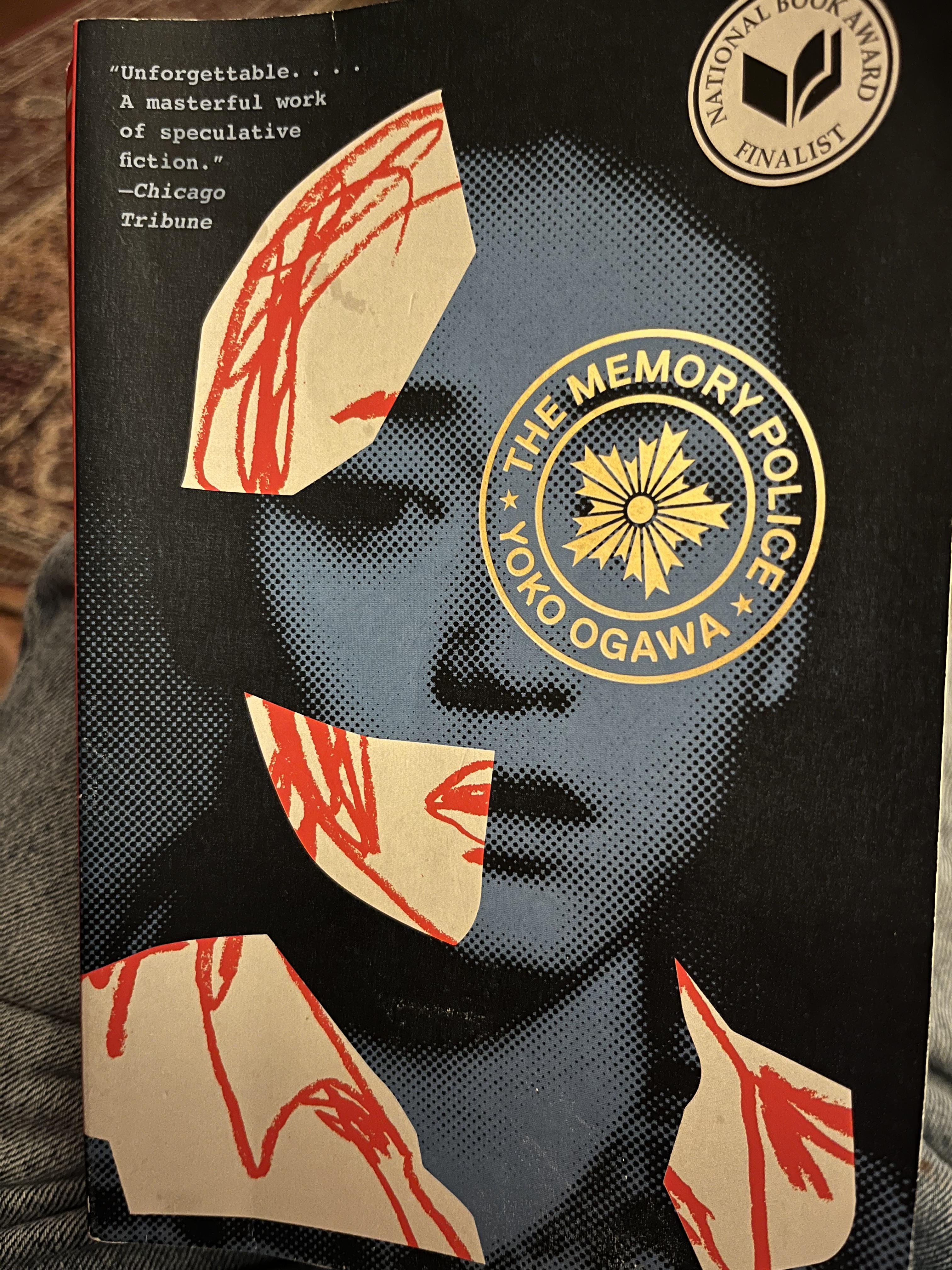
  • I finished the Memory Police last night, but couldn’t summon enough energy to write a response. It was curious. It was interesting. It was ART!! Were there great lines and thoughts? Yes. Did it make sense? Not at first glance, which this response is. The novel (as the blurb on the back states) takes place on an unknown island where objects keep disappearing. Disappearing completely, even from the memory of most of the people on the island. Those who can still remember are taken away to some unknown place, for some unknown fate by the Gestapo-like Memory Police.  The last sentence of the blurb says “The Memory Police is a stunning novel about the trauma of loss.” I guess that is true, but only on one level. I would say it is more about the control of a community’s narrative; How history can be erased, and how we all just go along. How writing extends and saves individual memory for the next generations, who lose and save and create their own memories. How small seemingly unimportant objects can embody massive recollections. 

    Random Thoughts/Questions: None of the characters have names. There is a narrator, the novelist; the old man, who used to be the ferryman before the ferry disappeared, and R, who does not forget. The novelist is writing a novel, which sporadically we (the reader) get to read.Is the old man an allusion to Charon? Are the people who forget dead? The narrator is writing a novel, but loses her voice and can’t remember how to write. R, who used to proofread the narrator’s novels, keeps encouraging her to write, almost like editors who finish novelists books posthumously. Does “R” stand for reader? which is us, as we try to create meaning out of other’s incomplete memories?

    Quotes:

    “When I was a child, the whole place seemed… a lot fuller, a lot more real. But as things got thinner, more full of holes, our hearts got thinner, too, diluted somehow, I suppose that kept things in balance… And even when the balance begins to collapse, something remains.”

    “I have the feeling my voice may come back one day if I study the letters imprinted on the used ribbon.”

    “I’d imagine you’d be uncomfortable, with your heart full of so many forgotten things.”

    “Memories don’t just pile up—- they also change over time. And sometimes they fade of their own accord.”

    “Each one of us hides them away in secret. So, since out adversary is invisible, we are forced to use out intuition. It is extremely delicate work. In order to unmask these invisible secrets, to analyze and sort and dispose of them, we must work in secret, to protect ourselves.”

    “Memories are a lot tougher than you might think. Just like the hearts that hold them”

    “When you lost your voice, you lost the ability to make sense of yourself.”


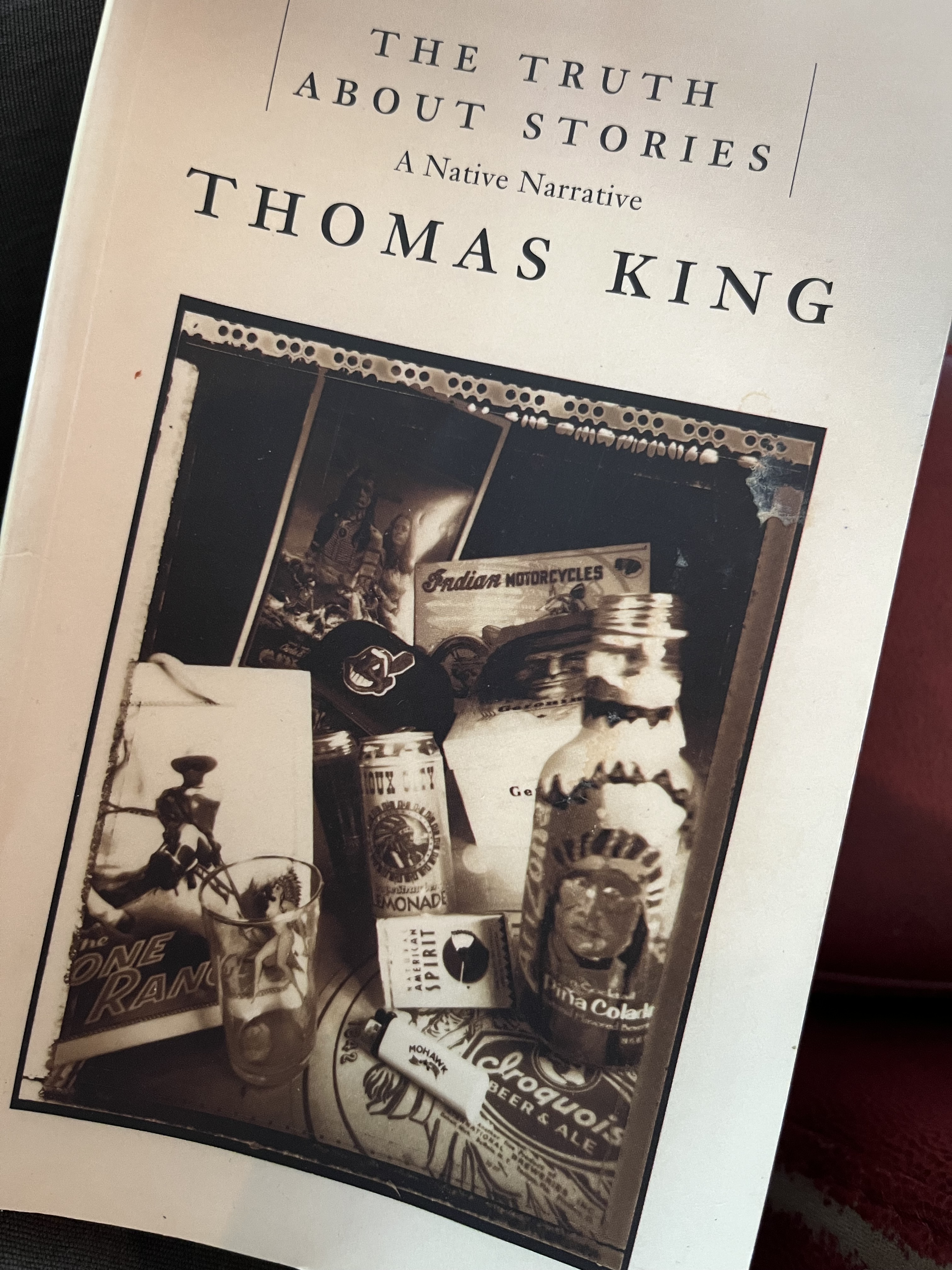
  • This is the second, maybe third, time I have read this book. It is that good. Oscar Wilde wrote that a book that isn’t worth reading twice is not worth reading once. The Truth about stories is worth reading once, maybe even three times. “The truth about stories is that is all that we are.” King repeats throughout the book as he tells stories within stories, mixing personal narrative with native “myth” and historical facts to illustrate, expand and deepen each section/chapter of his book. His themes are identity, how we become who we think we are, how we can change who we think we are; How others come to define us through the stories they tell about ourselves and themselves; and that we can change our world by changing the stories we tell each other. King is an indigenous Canadian. He focuses  early on in the book about how one is an Indian, and how a large part of that definition is provided by the non-indigenous, from how one is supposed to dress to be seen as authentic, to convoluted arcane laws developed by the government in their attempts to control and eventually eliminate the Indian. He has a wonderful light touch in his writing style that makes an otherwise grim tale less horrific without sounding paternalistic. King begins each chapter with the story of the world carried on the back of a turtle, which is carried on another turtle ad infinitum. I assume to point out that there is never a sole basis for the story we live within. He ends each chapter in a similar way connecting the end to one of the stories from that chapter. Here is one of them: “Take it. It’s yours. Do with it what you will. Tell it to your children. Turn it into a play. Forget it. But don’t say in the years to come that you would have lived your life differently if only you had heard this story. You’ve heard it now.”

  • The thing is you won’t live long

    anyway

    the thing is to see where you are

    While you are—

    —George Oppen

    fool, look out the window

    And write

    —George Oppen

    You must go on. I can’t go on. I’ll go on.

    ― Samuel Beckett

    I made the mistake of looking at an old “manuscript” from about 15 years ago. I made it about 10-12 pages in before I ran across a couple of lines that I could call good enough to be poetry. There are about 40 more pages to go. I hesitate to go on. I have always over the decades cycled up and down in my opinion of my writing. I know, every writer has doubts. But that does not make it any less depressing when I am plummeting, nor any more justifiable when I am flying high. I remember Robert Frost saying somewhere that he didn’t write experimental poetry, because experimental poem was another name for failed poem. The poem either worked or it did not. If it did, then it was not an experiment; if it failed, then it wasn’t a poem. The old manuscript was not a poem—which was depressing. Instead it was a series of posturing hoping without hope to somehow adhere from one poem/stanza/blither to another without any real attempt on my part beyond “chance” in some misguided belief that John Cage’s ghost would descend to lead me out of the wilderness of my hubris. I take solace in the belief that I knew it was crap, because I put it away and never really looked at it for the last 15 years. I somehow knew without knowing….I am smarter than I let myself be (to use a mantra I said about my students on myself).* My current plan is to plow through the fallow field, and see if there are some living roots that can be salvaged. It will be a trudge. But then, what else would I be doing.

    *They are smarter than we let them be.

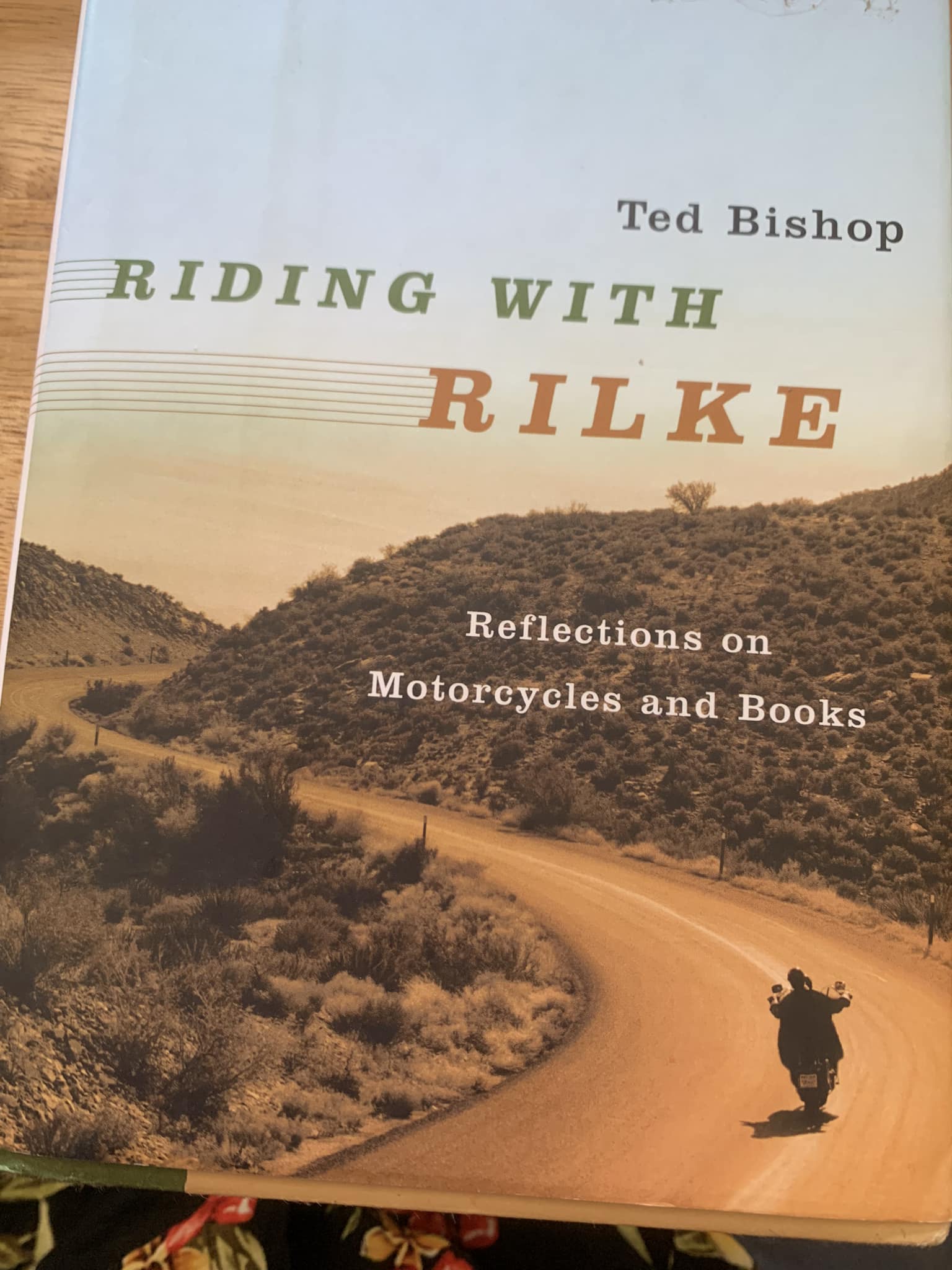
  • I finished “Riding with Rilke, reflections on Motorcycles and Books” by Ted Bishop today. We have recently read “American Rambler” in RFB, which was a book-length essay about a man’s hike from Washington D.C. to New York City, where along the way the author reflected on American history and current politics. So, when I ran across “Riding with Rilke” at Half-Price Books, I was open to another travelogue essay/reflection. 

    “Riding with Rilke” is structured around the author’s solo motorcycle trip from Edmonton to Austin, then back again. Along the way he talks about motorcycles, mainly Ducati and BMW, learning to ride, the landscape, and writers, mainly Modernist. For me, it started off with too much talk about motorcycles and the difference in small design elements make toward the performance and ride of the bike. But then I have no background in this, so it makes sense that I would not be as interested. Once he starts his reflections on books with a section on Virginia Woolf, I shifted gears and began to enjoy the book better. Bishop is a Modernist scholar, and much of his talk on books revolves around doing archival work at the Harry Ransom Center in Austin. 

    Bishop wrote the book when he was recovering from an almost deadly motorcycle accident. Overall, I really enjoyed the book. 

  • I have been writing poetry since I was fifteen. There were proto-moments earlier where I wrote and enjoyed writing, but those were mainly assignments for school. For almost the last 50 years I have considered myself a poet. Over the last few years, I have submitted some of my work to various lit magazines in a sporadic and random manner. I have even had some accepted for publication. And I appreciate their efforts. I am not making any claims toward the quality of my poetry. Some days I think I am writing pretty well, but when I read it again days, weeks, or even years later, I think: my writing is pretty crappy. Lately I have been leaning more toward the crap judgement. I am not looking for any affirmation from others, because I know that doesn’t really mean anything more than my own opinion of my work. Yet, one must have some confidence in one’s ability to create in order to continue, and that confidence has to come from somewhere whether from others comments, or one’s own arrogance. The last few days, weeks, I have asked myself why I continue to write after all this time. Why do I take the time to work over a poem, to shape it into something I think is a poem. Then I post it to social media, and on my own blog. I get a handful of responses indicating that someone, somewhere read it. For a few seconds, I bask in some stranger’s positivity. I do appreciate those who read my work, whether or not they comment. However, I wonder why I bother. Especially since I am currently in a downward spiral as far as my own opinion of what I write. I have gone through this cycle before, and have always shrugged off the doubt eventually and continued on. I normally say I write because I have to write, but I think it is more accurate to say I write because I write. It is simply something I do. I am not sure what I would do if I didn’t write. Drink more than I already do, become more bitter than I already am? Perhaps. I don’t think I will find out, because I have confidence I will continue to write (good or bad), as I have for almost 50 years.

    (June 28, 2024)

  • “to combat the resistances of language you must keep talking”

    –Anne Carson

    I write most everyday. Since the end of last August, I have filled up two 150-page notebooks, completed close to 80 short poems.  I have written, if not so obsessively as now, since I was 15. I write poetry, with the occasional venture into essays like this one. I have trouble with narrative, one event leading into another befuddles me, as does conversation between people.  So I do not write fiction. Yet, I do have an interior running commentary on the narrative I am living, snipes and admonitions on my life as it unfolds. To push back against this cruel eviscerating voice, which adheres tightly within my skin, I write. I write to explain the world to myself, to explain myself to myself, to resist the world, which is lain upon me by the world. I write to resist the temptation to settle into myself without a thought. I am uncomfortable in most social situations. It’s discomforting when others try to define me, or attempt to interpret me from my writing. Yes, I am aware that all writer’s expose their minds in their writing. Even writers of fiction expose themselves through their fictional characters. Nietzsche wrote that in the end we only experience ourselves. Yet, I believe there is also a separation from oneself, a leap into the universal other, which occurs when one writes: a transubstantiation of individuality into a larger third person narrator, who watches and observes with more objective, more just, eye. Of course, I also know this is pure bullshit. I am as clotted with my biases and situation as anyone. But it is through writing, through the transformative nature of writing, where a third space can open, and one can enter along with whomever can follow into a changed world, a different, perhaps better place, if only for the time it takes to read the poem. And to keep from being defined, trapped even in these new spaces, I continue to write, to find a way to exist with myself.

    (February 28, 2017)

  • “My life could have turned out differently, but it didn’t.”

                      –Jim Harrison

    “I live with my contradictions intact”

             –David Ignatow

    “I’ve got to lose this skin I’m imprisoned in”

                      –The Clash 

    “Didn’t nobody seem to know me, babe, everybody pass me by”

                      –Robert Johnson

    It is easy to trace the twisted path which led me to where I am; however, it is a bit more difficult to see where I am going next. 

    An obnoxious student asked me last week, in regards to this assignment, what my “rock” was. In my usual evasive fashion, I responded, “You are” meaning all of them, my students were my rock. However, even though I enjoy teaching most of the time, when I think of why I do what I do, or rather who I am, I don’t think about teaching. I have several roles I have taken on over the years: husband, father, friend, teacher, student, doctoral student, writer, poet, fool. I don’t think I am a Prufrock, yet, sometimes I feel as if I am no more than a sad man walking along the beach with my trousers rolled. Having a meaning or purpose, it is often said, leads to a happy (ier) life. With that in mind I guess, I would say that teaching gives me some of my purpose, and poetry gives it meaning, or helps me to create a meaning, to create sense out of chaotic universe.

    Recently a friend wrote that she had a hard time calling herself a writer, even though I know she writes and writes well. A few years ago, a woman at the first meeting of a poetry group said she did not feel as if she could call herself a poet. I had just said as part of my introduction of myself that I had considered myself a poet since I was fifteen.  She seemed shocked that I would have the audacity to call myself a poet.  This inability to call oneself what one does came up again in another conversation between teachers. One man said that it felt somehow pretentious to call oneself a poet or a writer.  I asked the group how was it any more pretentious to say you were a poet than to say you were a teacher. To me it seemed more pretentious to lay claim to that title, to say, “I am a teacher.” I mean Jesus was a teacher. Who the hell am I? But I have over time become used to being called arrogant, so I guess that is why I have an easy time saying:  I am both: a teacher and a poet.  I don’t claim to be very good at either one, but I am both. Charles Bernstein said that if one says it is a poem, then it is a poem. No claims to quality, but it is a poem.  I am a poet.  I sit down with the intention of writing a poem.  I think about each line, the rhythm, the sounds of the words in relation to the other words, the phrasing, where I can cut and reduce, where something else needs to be added. I use poetry as a way of making sense of myself and the world I find myself in. As I have said elsewhere, poetry (both reading and writing it) helps keep the horrors of the world away and a way to find beauty everywhere and in everyone. I have consciously written poetry since I was fifteen; with luck, I will continue to do so the rest of my life. I am a poet.

    Of course, I am also a teacher. If some magical seer had appeared to me when I was a 17-year-old senior, and told me that I would be a teacher for more than 30 years, I would have laughed out loud just before dying in horror. Yet, here I am working at one of the best high schools in Texas as the senior APLit teacher. Sartre famously wrote about a waiter at a Parisian café. The waiter, according to Sartre, is only a waiter when he is performing as a waiter. So, following that train of thought, I am only a teacher when I am at work talking to my students. I rarely think about being a teacher. It is still, after more than 30 years, difficult to think about me being a teacher.  I suppose my life as a teacher would be inauthentic since I don’t think about why I do this beyond making enough to feed my children, pay the mortgage, and send them off to college. Yet, in some small way I like to believe that what I do matters, even though I know it probably doesn’t. 

    Maya Angelou said you remember how people made you feel, not what you learned. I think that is why when my former students run into me at HEB, or they come back to visit, they remember my class fondly. A few weeks ago, I was having a beer with a friend when I man in his thirties approached and asked if I was Mr. Neal, as if he were a process server for some lawsuit. It was odd to say the least. When I answered yes, he told me that he had been in my class when he was an eighth-grade student at Pflugerville Middle School. He said he heard my voice, and knew it was me. He remembered “The Road Not Taken.” (I used to have my students memorize poems). He said the first few lines. He said that had been his best English class, which I found embarrassing and kind of sad—his best English class was as an eighth grader. 

    I am not retelling this event as an attempt at self-aggrandizement, but to show how one’s self-identity is often much different than how the world sees you.  I am always uncomfortable when people try to define me to me. I find their descriptions to be too pat, too much mired in the cliché, too many wrong associations. I am a teacher, and I feel in some small way I am helping create a better world with my students; yet, I never really know what it is I am doing. 

    In a faculty meeting, several times, I have stated I don’t have any idea what my students are taking away from my class. In an age of standardized testing, to say I don’t know what my students learn in my class is tantamount to heresy. I don’t mean I don’t know what it is I am doing in class; I just don’t know what it is they are learning. And I certainly don’t see them as the number they receive on standardize tests.  I have had students tell me years after being in my class what they remember. It is always surprising to me what they found valuable, because it is never really what the objectives were in the class. 

    When people ask what it is I teach, they mean what books are we reading. They seem confused when I talk about my students. My students are what (who) I teach. Books, poems, essays, are just the ephemera of my class. The tools that are employed in the teaching. About 15 years ago, I would respond glibly to my fellow teachers when I was asked what I was teaching that six weeks with “Nothing.” My students read what they wanted to read, and for the most part wrote what they wanted to write. I ran my class as a reading/writing workshop. The district where I worked claimed that ELA did workshop k-12, yet I was the only teacher in my high school who did. So it often took several weeks to teach the students how to read on their own, to have the stamina to read for 20 minutes without interruption. So, one day after the students were fairly proficient at the process, I was sitting on the floor in the doorway to my class. I was monitoring the students who read in the hall, and the ones who stayed in my classroom. A history teacher walked by and said snarkily, “I wish I could not teach, and sit around all day and just read.” My students were on the verge of rising up against her, when I mumbled (they had learned to understand my mumbling at that point as well)—I mumbled in response to her, “One would have to know how to read first.’ She walked on, not hearing what it was I had said, and the students laughed as they settled back into their books. I developed a reputation with the faculty pretty much as a smart-ass. Not that they were wrong, but I interpreted what they saw as smart-assness, as more of a way not to scream expletives at them. I refused to accept their definition of what it meant to be a teacher. I created my own definition. Even if some of that definition was simply a defiant rebellion against my fellow teachers.

    I do think a lot about what I am doing both as a teacher and writer. So, I imagine I am attempting to be authentic in what I am doing. I question whether my praxis (my beliefs correspond with my actions) is authentic..not just me going with the flow because that is the easy way to go about life. As I said earlier, I am never sure if what I do is effective or worth doing at all. I will fluctuate between thinking I am a decent teacher, or writer, to thinking I am a fraud, fooling everyone, even myself. 

    And that is the point I think of life: to try to be brutally honest with oneself, to never settle back and assume you know what it is all about, because one can never know. Which is not to say that we should not try to understand our lives, we should always be trying, even if we know we shall never know. Embrace the vast absurdity of the universe with a passionate intensity, not matter how pointless. It is the process and the awareness of the life you are living that makes the life have meaning and be worth living.

  • A little more than a month ago, one of my work mates proposed that she, a math teacher, and myself write a haiku a day for a month. After 37 haikus (I wrote more than one some days), I am going to stop the exercise. I think that my fellow English teacher proposed the undertaking in order to make her write everyday. I do this already, so it did not motivate me to write. I did find it a calming activity most days: a time to stop and think about what was in front of me either physically, mentally, or spiritually. However, it also deflected my attention away from other poems I had been working on. Usually I post about 15 or so poems a month (sometimes even pushing to 20). In October, because of the haiku event, I posted 38 new poems. I like haiku, and like writing them. Usually I make up parameters for my writing in an arbitrary and random manner. During the exercise, I used the traditional 5-7-5 syllable count, although I have in the past ignored that stricture focusing more on the brief flash of attention than on a numbers game. Figuring the syllable count is more of a guideline than a law. I don’t plan on giving haiku up; I’m just not going to sit down each day to write one. I have always written in small snatches of time, never having the leisure to write for extended lengths during the day. So, haiku, and imagism, lend themselves well to going from start to finish in the brief time I have to write. However, I also like spending time in my head as I go through the day, thinking about a longer piece. Therefore, as I stated at the beginning of this ramble, I am going to end my participation in the project. Thanks to all of you who read and liked the work I have posted over the last month.

    (October 31, 2019)

  • IMG_4802

    (part one)

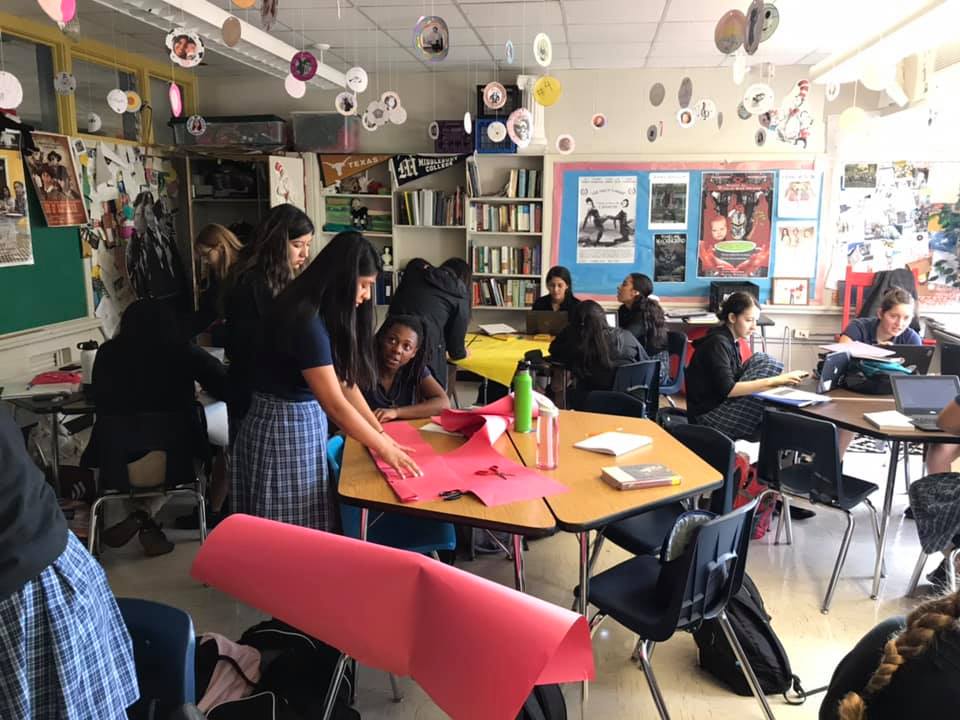
    I never wanted to be a teacher. Yet, I am about to start my 30thyear teaching in public schools in Texas. I have worked in four middle schools and three high schools, taught 7ththrough 12thgrade, taught newspaper, yearbook, English 7th-12thgrade, pre-AP English (8th-10th), Gifted and Talented middle school English, Advanced Placement Language and Composition, Advanced Placement Literature and Composition, Dual Credit English through Austin Community College, and The University of Texas at Austin. I even taught a German class for a semester. This year I will be teaching four sections of Advanced Placement Literature and Composition, and for the first time a creative writing class, as well as a film studies class, also for the first time. With an average of 150 students a year, I will have had contact with 4,500 students in my classrooms. My first students, 7thgraders in Beeville, Texas are turning 43 years old this year. It is possible that their 13-year-old children could have been in my class at one point in the last decade.

    Over time I have come to like teaching, although every year I think about quitting and doing something else, but am never sure what it would be that I could do.  Every few years for the last 30, I start to think I am pretty good at what I do, then something happens to make me realize that perhaps I am not as good as I think. Teaching is a humbling profession.

    As a high school student I would have scoffed at the idea of becoming a teacher. The last thing I wanted was to return to school after graduating. Now I feel at home the most when I am in a classroom, either as a student or as a teacher. I left high school to become a journalist, but a professors advice to find the victim’s mother to get a good quote, drove me that same day to change my major to English. I like to write, although my first English advisor told me cynically and accurately, “One does not necessarily learn to write in English.”

    Right out of college I worked as a baker at a local bakery in Austin, Texas French Bread. It was only for a few years that I worked there, but it still holds some of my fondest memories. One morning  (4am) on the way to work, as I waited on the stop light to change, I thought I should do something with my English degree. When my shift ended at noon, I walked over to UT and found out what I needed to do to become certified to teach in Texas.  A bit more than thirty years later, that quick, almost whimsical decision at a stop light led me to where I am now, teaching at an all girl public high school in Austin, Texas— and my life’s work.


    (My plan is to write about my life as a teacher over the course of this school year. Topics will be determined pretty much in the same manner I decided to teach—through chance and whimsy).

  • Austin, Texas: circa 1980
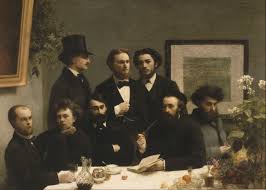
    We were at an art opening, somewhere downtown near the warehouses where small machine parts were stored, before the buildings were turned into fashionable bars for the newly minted college graduates looking for places to spend their first independent incomes in one of the spasms of gentrification Austin has endured for the last 40 years. But that was yet to come. It was an old building, bare walls, no heating, or air-conditioning. The owner probably rented out the space cheap for the length of the show. Bits of cheese on crackers, tortilla chips and salsa were available to carry about on small paper plates. Generic jugs of red and white wine were scattered about the table, as well as a galvanized tub filled with the ubiquitous Shiner Bock. Blondie, The Police, or some other cross over “punk” played on a home stereo someone had set up in the corner. The artists were local college art professors trying to seem relevant to the to the gaggle of students who were there for the free beer and wine, before heading out to their own parties with live local bands. I wandered the room pretending to look at the art on the walls. The prices were too high for my part-time job and rent. Most were abstract, with a few figurative pieces trying to have an exotic southwestern feel to them. But even at 20 they felt forced and derivative.  I thought about the painting by Fantin-Latour, Un Coin De Table, where Verlaine and Rimbaud were sitting at a table with contemporary Parisian artists. The story went that one artist refused to be in the same painting as that nasty boy (Rimbaud). So where he sat the artist put a vase of flowers.  I wondered what Rimbaud would think about the conversations the students and professors were having, the fawning praise, the studiously ironic responses. I felt callow, and slightly embarrassed. I left quickly, saying I was going out for a smoke, and went home for the night to write.

    (August 11, 2017)