It has been several decades, at least, since I read Eliot’s Four Quartets from beginning to end in one sitting. But since the poem came up in a conversation a couple of days ago, and Lisa has gone out of town, I read them out loud to myself in one go. It is an amazing work of art: time, faith, God, identity, sense of place, abstract while being incredibly precise in concrete details which fold back into the abstract. The usual allusions to everything in world literature and religion, but so subtle and fast it becomes as if you are reading about Jonah, Arjuna, Charles the 2nd, and many others for the first time. And such a magisterial voice and a musicality which lifts the reader to intellectual heights before they realize what is happening. When, 30 years ago, I read The Quartets for a class on the Modern long poem, Walt Litz, my prof, described it as “philosophical poetry, not philosophy as poetry.” If you haven’t read it, and want something deep, but not as daunting and dark as The Wasteland, then you should read it. It made me think about the first time I heard Beethoven’s Ninth, or Handel’s Messiah all the way through. And if you have read it, then it might be time to look again. I remember reading once that different poets often speak to you differently at different times of your life. The Four Quartets speak differently now than they once did. “My words echo/ thus in your mind.”
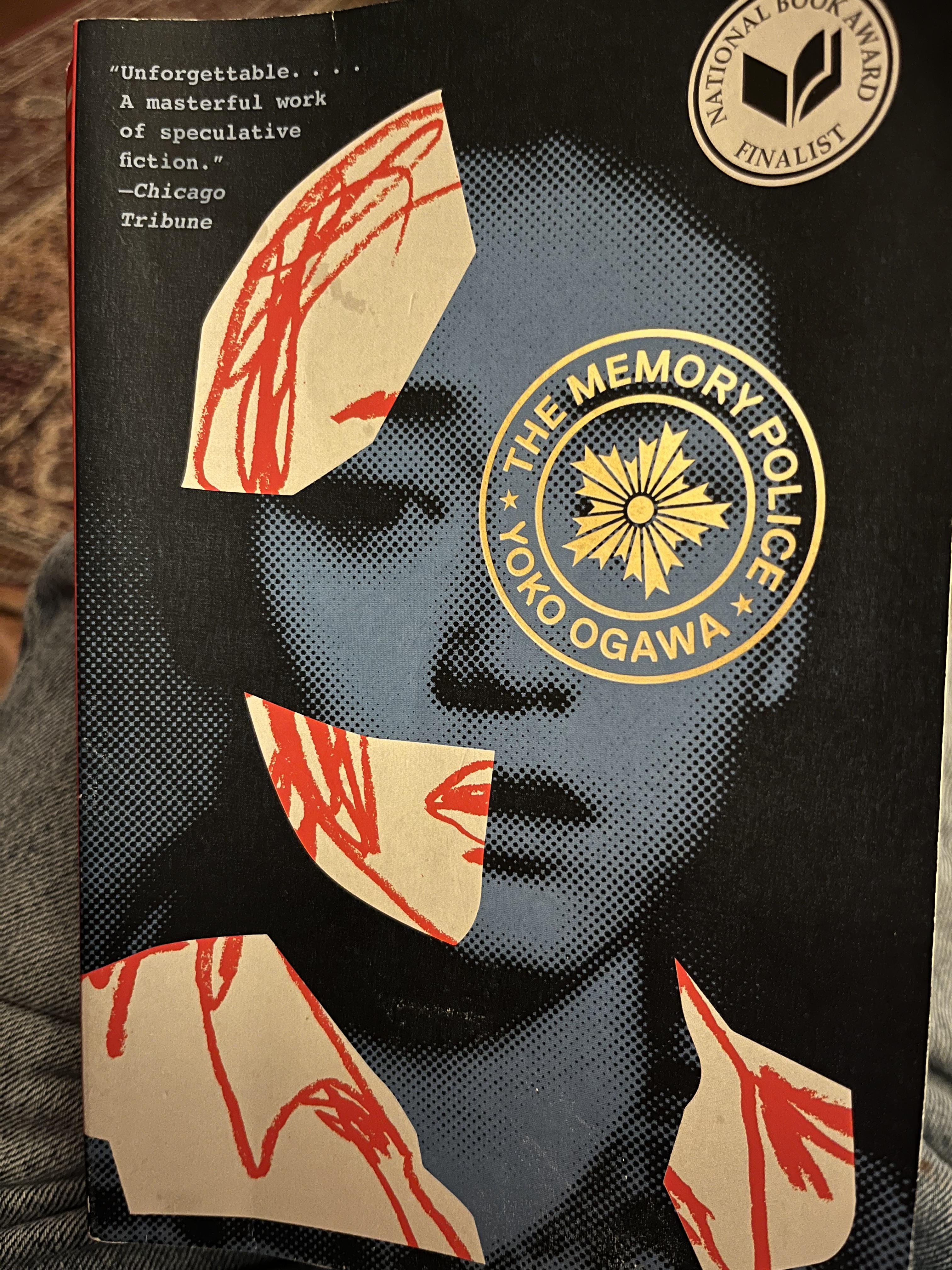
I finished the Memory Police last night, but couldn’t summon enough energy to write a response. It was curious. It was interesting. It was ART!! Were there great lines and thoughts? Yes. Did it make sense? Not at first glance, which this response is. The novel (as the blurb on the back states) takes place on an unknown island where objects keep disappearing. Disappearing completely, even from the memory of most of the people on the island. Those who can still remember are taken away to some unknown place, for some unknown fate by the Gestapo-like Memory Police. The last sentence of the blurb says “The Memory Police is a stunning novel about the trauma of loss.” I guess that is true, but only on one level. I would say it is more about the control of a community’s narrative; How history can be erased, and how we all just go along. How writing extends and saves individual memory for the next generations, who lose and save and create their own memories. How small seemingly unimportant objects can embody massive recollections.
Random Thoughts/Questions: None of the characters have names. There is a narrator, the novelist; the old man, who used to be the ferryman before the ferry disappeared, and R, who does not forget. The novelist is writing a novel, which sporadically we (the reader) get to read.Is the old man an allusion to Charon? Are the people who forget dead? The narrator is writing a novel, but loses her voice and can’t remember how to write. R, who used to proofread the narrator’s novels, keeps encouraging her to write, almost like editors who finish novelists books posthumously. Does “R” stand for reader? which is us, as we try to create meaning out of other’s incomplete memories?
Quotes:
“When I was a child, the whole place seemed… a lot fuller, a lot more real. But as things got thinner, more full of holes, our hearts got thinner, too, diluted somehow, I suppose that kept things in balance… And even when the balance begins to collapse, something remains.”
“I have the feeling my voice may come back one day if I study the letters imprinted on the used ribbon.”
“I’d imagine you’d be uncomfortable, with your heart full of so many forgotten things.”
“Memories don’t just pile up—- they also change over time. And sometimes they fade of their own accord.”
“Each one of us hides them away in secret. So, since out adversary is invisible, we are forced to use out intuition. It is extremely delicate work. In order to unmask these invisible secrets, to analyze and sort and dispose of them, we must work in secret, to protect ourselves.”
“Memories are a lot tougher than you might think. Just like the hearts that hold them”
“When you lost your voice, you lost the ability to make sense of yourself.”
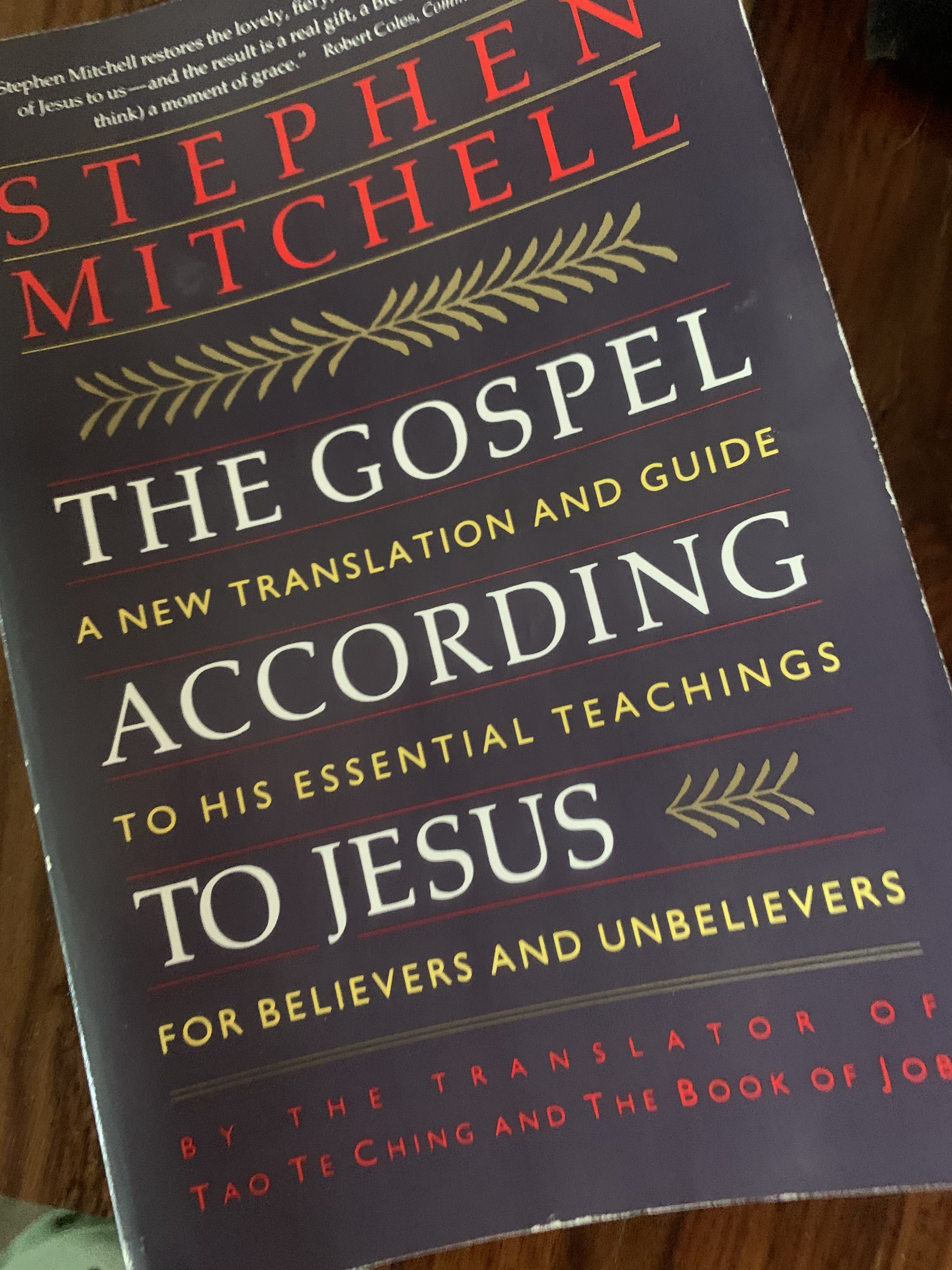
On the advice of a character from a Jim Harrison novel I was reading many years ago, I ordered two translations of Stephen Mitchell: The Book of Job, and The Gospel According to Jesus. I finally got around to reading one of them (one big advantage of retirement). Over the last couple of weeks I have read The Gospel According to Jesus. It was interesting and worthwhile. It opens with a lengthy introduction, followed by a translation of the parts of the gospels which in some versions would be the red-letter parts. After that section, Mitchell returns to the various parts thematically, accompanied with commentary. The commentary is a mixture of Mitchell, selections from Biblical scholars, and similar themes in philosophy (Buddhist, Taoist), and poetry (Blake, Rilke for example). As one of the blurbs on the back of the book says, “This approach succeeds brilliantly. Jesus, or at least Mitchell’s attractive portrait of him, leaps. into life and will fire the interest of believers and nonbelievers alike. (Harvey Cox)” And no, I have not abandoned my apostasy.