Category: memoir

  • My father’s ghost has returned

    to haunt me after decades

    of silence. I only knew

    his decline; now, I’m learning

    my own, a slow remembrance.


    I’m no Hamlet; to avenge

    his death, I would kill myself,

    there would not be a question.

    Telling that story once more,

    I am what remains of him.


    At night looking for water,

    not as broken as he was,

    I see him in the mirror,

    frowning at me from the side.

    My body reflects his own.


    My mom used him as a threat

    even after he was gone:

    If you could be half the man

    he was…if he could see you…

    what do you think he would say?

    She has been gone for years now,

    while he hangs on the edges

    darkly brooding as in life,

    a storm always eminent,

    on the verge of violence.


    I saw my future at eight,

    and a clearer past today:

    his presence was an absence

    always nearby, yet distant

    like a shadow on water.

    (November 16, 2025)

  • I had a dream/nightmare this morning. I was returning to  a teaching job at a high school where I taught English Literature and Composition 14 years ago. The dream began at an English Department meeting where we were being introduced to a newly purchased curriculum that emphasized teaching the students how to spell. The curriculum came with “can’t fail lessons” and lots of pre-made, easy to grade, worksheets. I was arguing against the program, of course. I tried to explain the benefits of teaching reading and writing through a workshop system, of course. No one was listening to me, or the presentation from the district, of course. Instead, the other teachers spent the time complaining about their students and the administration, of course.  Richard, my friend, tried to calm me down, but I took it as he was just patronizing me to get me to shut up. The meeting broke up. I wandered the halls looking for my classroom. I realized that no one had shown me where I was supposed to teach. The halls were crowded. It seemed to be lunch, since no one was in any of the classrooms, instead they were milling about in the common areas. Teachers rushed about, overwhelmed. Students gossiped, politely ignoring me as I walked around the building, lost. I never should have come back to teaching, I thought. I should quit now, I thought. But I can’t quit. I need the money: If I quit, I won’t have any income, I thought. I kept walking around the building in a growing panic. I didn’t know where to go. I woke up, as I remembered that I was retired, that I had a pension, that I wasn’t teaching anymore. That I did not have to teach anymore. It was over. It was over.

    (September 10, 2025)

  • This is how this story goes, or at least what I can remember from how Dad told it. I have probably told this story as many, if not more, times than my dad. Uncle Les had gone off to college in the late 1800’s.  Every now and then a letter from him would arrive that first semester, and then they didn’t. My Grandfather Noel, Les’ brother, saddled up his horse and rode off to check on things. When he arrived, Les’ dorm room appeared as if Les had just walked out and would return any minute. He had been missing for several months. Then years later, around 1906, when my dad was three years old, a man came riding up to the “dirt” farm Noel struggled to eek a living from out near Liberty Hill. The man had two large saddle bags draped over his horse, two bandoliers criss-crossing his chest, and two large pistols hanging from his hips. The man was Uncle Les. After he dismounted, he walked into the house and hung his pistols from a peg on the wall. Les never touched those guns again. “Leave those guns alone, Ralph They’re nothing but trouble,” my Grandmother Pearl told the excited three year old. Les took his saddle bags out to the barn where he slept for the next 7 years as he worked for his brother on the farm for room and board.  After seven years, Les took the almost forgotten saddle bags and bought a ranch out west. Even as children, we saw the holes in Dad’s story: Where did Les get the money for his ranch? Noel only paid him with food and a place to sleep. Where had Les been all those years after disappearing from his college? What had he been doing? After being gone for so long, why did he wait for seven years before he bought his ranch? What was in those two saddle bags? Was any of what Dad said over the years about Les true in any way? How much have I filled in the holes of my memory with conjecture?

    (September 7, 2025)

  • “You should understand

    the way it was

    back then,

    because it is the same

    even now.”

    from Storyteller by Leslie Marmon Silko

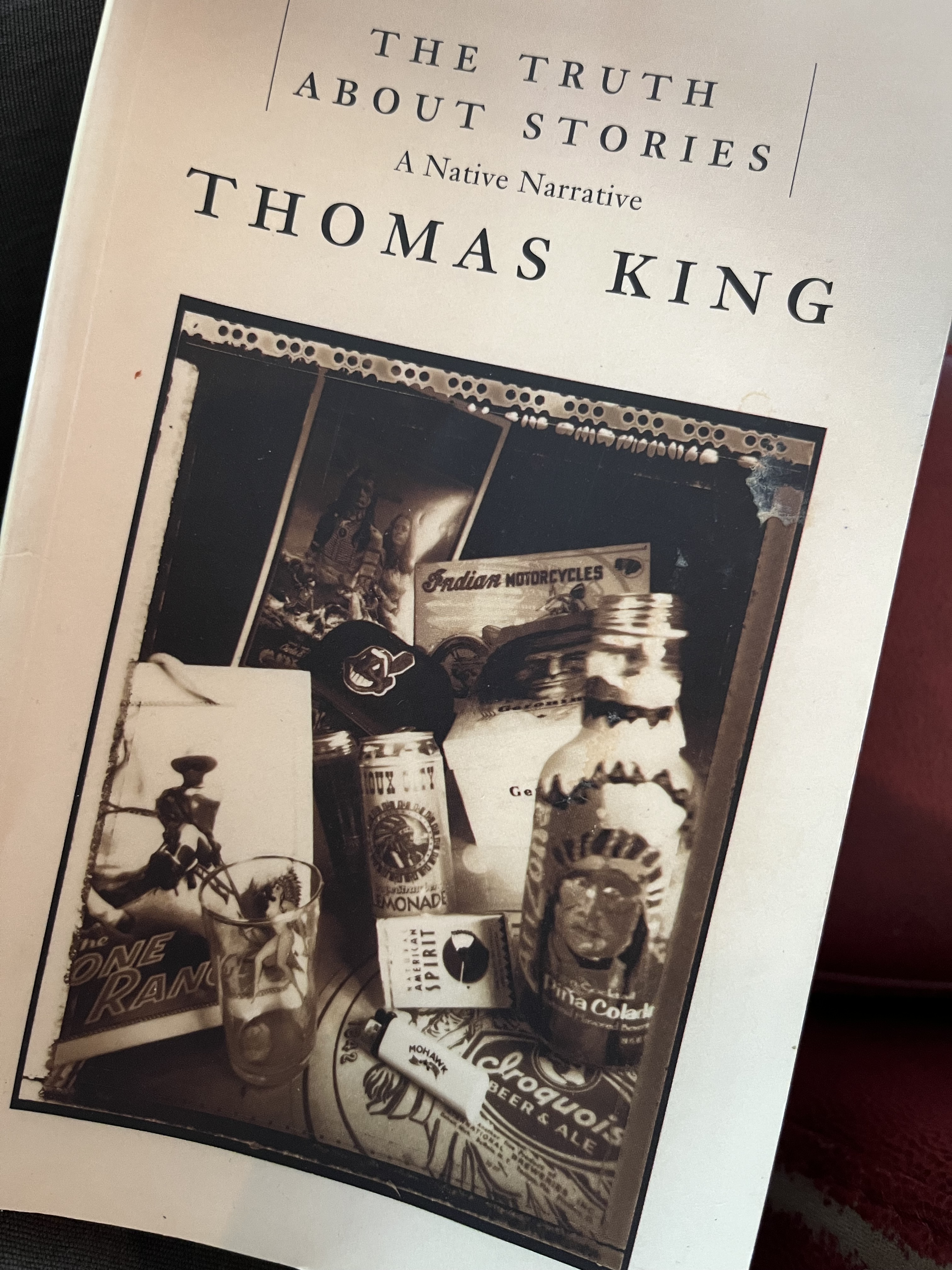
    Today I finished (for RFB) Storyteller by Leslie Marmon Silko. It reminded me of Way to Rainy Mountain by N. Scott Momaday in the way it blended personal narratives, with native-American stories, and history. The three aspects being, in reality, inseparable. In the case of Storyteller, the stories, poetry, photographs orbit around each other to create the idea of “story” as what defines us in our lives: the past, present, mythic all combine to create the culture we live in as well as the individual person who lives inside of  the culture. It is a fairly subtle nuanced book. Silko does not spell it all out in the way Thomas King does in “The Truth About Stories,” a book I finished a few weeks ago. King also blends personal narrative, with myth, and history. Instead, Silko, lays out the parts of her collection in a type of collage, where the various parts generate a collective power creating a larger whole from the smaller parts. 

    Here are just some lines I underlined as I read:

    “But sometimes what we call “memory” and what we call “imagination” are not so easily distinguished.”

    “The story was the important thing and little changes here and there were really part of the story. There were even stories about the different versions of stories and how they imagined these differing versions came to be.”

    “We were all laughing now, and we felt good saying things like this. “Anybody can act violently—-there is nothing to it; but not every person is able to destroy his enemy with words.”

    “even silence was alive in his stories”

    “the memory

    spilling out

    into the world”

    “So they pause and from their distance

    outside of time

    They wait.”

    “laugh if you want to

    but as I tell the story

    it will begin to happen.”


  • This is the second, maybe third, time I have read this book. It is that good. Oscar Wilde wrote that a book that isn’t worth reading twice is not worth reading once. The Truth about stories is worth reading once, maybe even three times. “The truth about stories is that is all that we are.” King repeats throughout the book as he tells stories within stories, mixing personal narrative with native “myth” and historical facts to illustrate, expand and deepen each section/chapter of his book. His themes are identity, how we become who we think we are, how we can change who we think we are; How others come to define us through the stories they tell about ourselves and themselves; and that we can change our world by changing the stories we tell each other. King is an indigenous Canadian. He focuses  early on in the book about how one is an Indian, and how a large part of that definition is provided by the non-indigenous, from how one is supposed to dress to be seen as authentic, to convoluted arcane laws developed by the government in their attempts to control and eventually eliminate the Indian. He has a wonderful light touch in his writing style that makes an otherwise grim tale less horrific without sounding paternalistic. King begins each chapter with the story of the world carried on the back of a turtle, which is carried on another turtle ad infinitum. I assume to point out that there is never a sole basis for the story we live within. He ends each chapter in a similar way connecting the end to one of the stories from that chapter. Here is one of them: “Take it. It’s yours. Do with it what you will. Tell it to your children. Turn it into a play. Forget it. But don’t say in the years to come that you would have lived your life differently if only you had heard this story. You’ve heard it now.”

  • I have been reading Williams since I was in high school when his selected poems was one of the texts in a creative writing class I had received a scholarship to attend. He has been one of the recurring poetic presences in my literary life. Over the last week I have read from start to finish his last book of poetry, for which he won posthumously the Pulitzer Prize, Pictures from Brueghel and other Poems. I have read the Brueghel series multiple times over the years, teaching several of them, like the Fall of Icarus, in my classes. Additionally I have read most of the others in the book, opening it casually over the years, or have read them in anthologies of his work, or modernist anthologies. But I don’t think I have ever sat down and read the volume cover to cover, even if I have had this copy for at least 40 years. I really enjoyed reading the longer poems: The Desert Music, and Asphodel, That Greeny Flower again. Williams unique, rhythm and voice— what he called the variable foot— are a delight of the American idiom. I felt as if I could hear his calm voice speaking in the room. I think I will go back and read his complete works again, taking advantage of the chronological order of those works, as well as being grouped together with the poems originally published in volumes of poetry. (A side note: in grad school at Bread Loaf I took a class on the Modern long poem with Walt Litz, the editor of the first volume of the Collected Works). 

    (April 10, 2025)

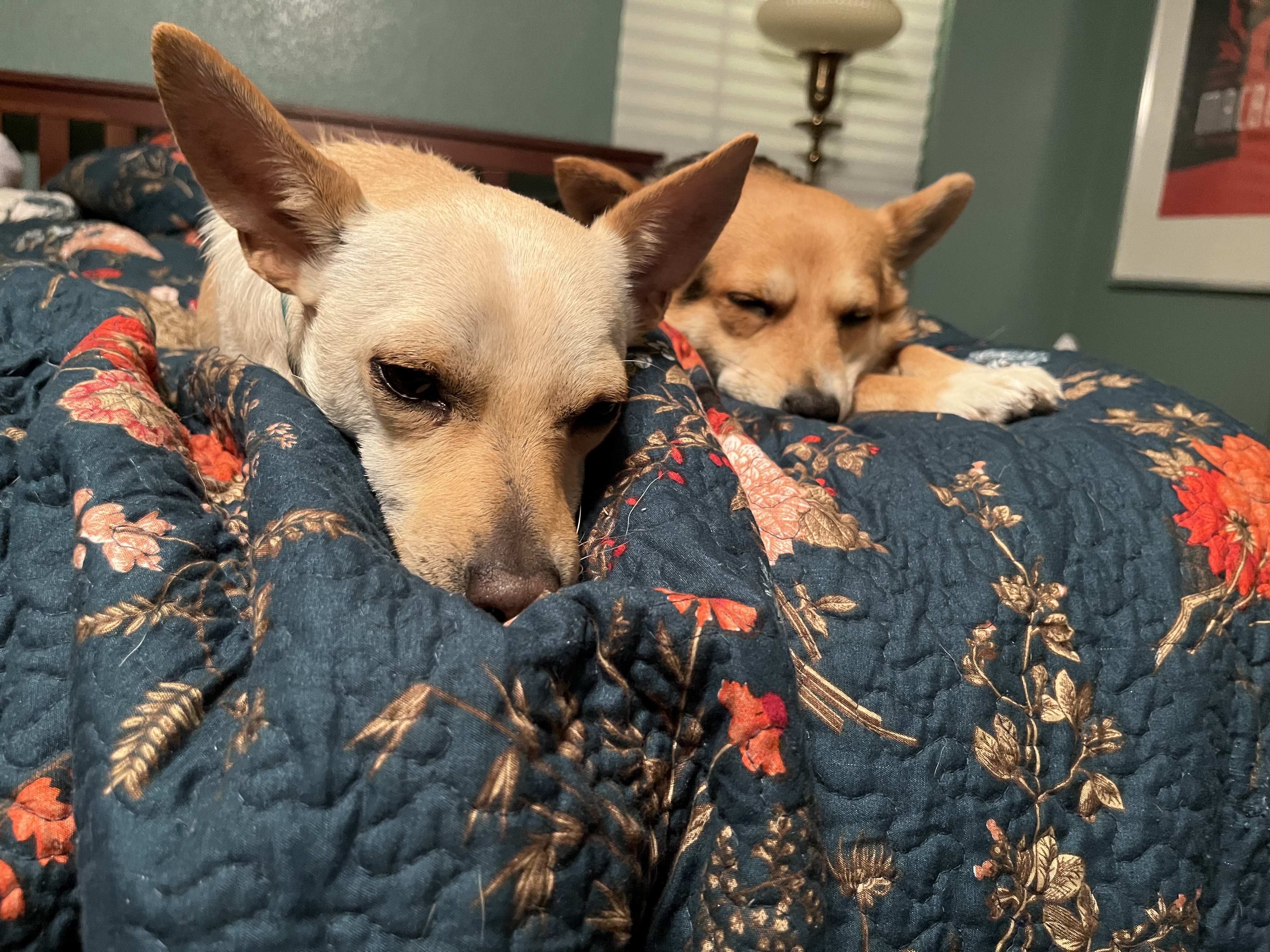
  • Our two dogs scuffle loudly at my feet.

    Curtains flutter in the window near me.

    The afternoon has suddenly grown late.

    I do not like the book I am reading,

    I put it down and pick up another.

    It is one I’ve read before: poetry,

    so it’s like I’ve never read it at all.

    “the mind and the poem are all apiece”


    A few weeks later than they did last year,

    the roses have begun to bloom again.

    Though, perhaps not, my memory follows

    its own soft path through the rooms of the house.

    The dogs with their play tussle forgotten

    curl in the corner upon each other.

    (April 1, 2025)

  • Over the last week I re-read Roger Zelazny’s The First Chronicles of Amber: (Nine Princes in Amber, The Guns of Avalon, Sign of the Unicorn, The Hand of Oberon, and The Courts of Chaos). I first read this series in the mid to late 1970’s. I was in my mid-teens, when I pretty much only read Sci-Fi and Fantasy novels. I think the Amber series was probably my first real exposure to multiple reality, and the idea that we control and can change the reality we are born into. This time through I noticed ideas of ontological basis to reality versus epistemological understandings. Here is a bit from near the end: “Yes. You see, we are hatched and we drift on the surface of events. Sometimes, we feel that we actually influence things, and this gives rise to striving. This is a big mistake, because it creates desires and builds up a false ego when just being should be enough. That leads to more desires and more striving and there you are, trapped.” I don’t really remember any of this when I read it the first time 50 years ago. I am sure I absorbed it somehow, just not consciously. For the most part, I enjoyed it well enough this last week; I mean I obviously finished it again. On the whole it is still a fun fantasy novel filled with sword fights and family intrigue and back stabbing, accompanied by quick insertions of Platonism without being too pedantic about it all. There are another five books in the series; I will not seek them out.

  • The thing is you won’t live long

    anyway

    the thing is to see where you are

    While you are—

    —George Oppen

    fool, look out the window

    And write

    —George Oppen

    You must go on. I can’t go on. I’ll go on.

    ― Samuel Beckett

    I made the mistake of looking at an old “manuscript” from about 15 years ago. I made it about 10-12 pages in before I ran across a couple of lines that I could call good enough to be poetry. There are about 40 more pages to go. I hesitate to go on. I have always over the decades cycled up and down in my opinion of my writing. I know, every writer has doubts. But that does not make it any less depressing when I am plummeting, nor any more justifiable when I am flying high. I remember Robert Frost saying somewhere that he didn’t write experimental poetry, because experimental poem was another name for failed poem. The poem either worked or it did not. If it did, then it was not an experiment; if it failed, then it wasn’t a poem. The old manuscript was not a poem—which was depressing. Instead it was a series of posturing hoping without hope to somehow adhere from one poem/stanza/blither to another without any real attempt on my part beyond “chance” in some misguided belief that John Cage’s ghost would descend to lead me out of the wilderness of my hubris. I take solace in the belief that I knew it was crap, because I put it away and never really looked at it for the last 15 years. I somehow knew without knowing….I am smarter than I let myself be (to use a mantra I said about my students on myself).* My current plan is to plow through the fallow field, and see if there are some living roots that can be salvaged. It will be a trudge. But then, what else would I be doing.

    *They are smarter than we let them be.

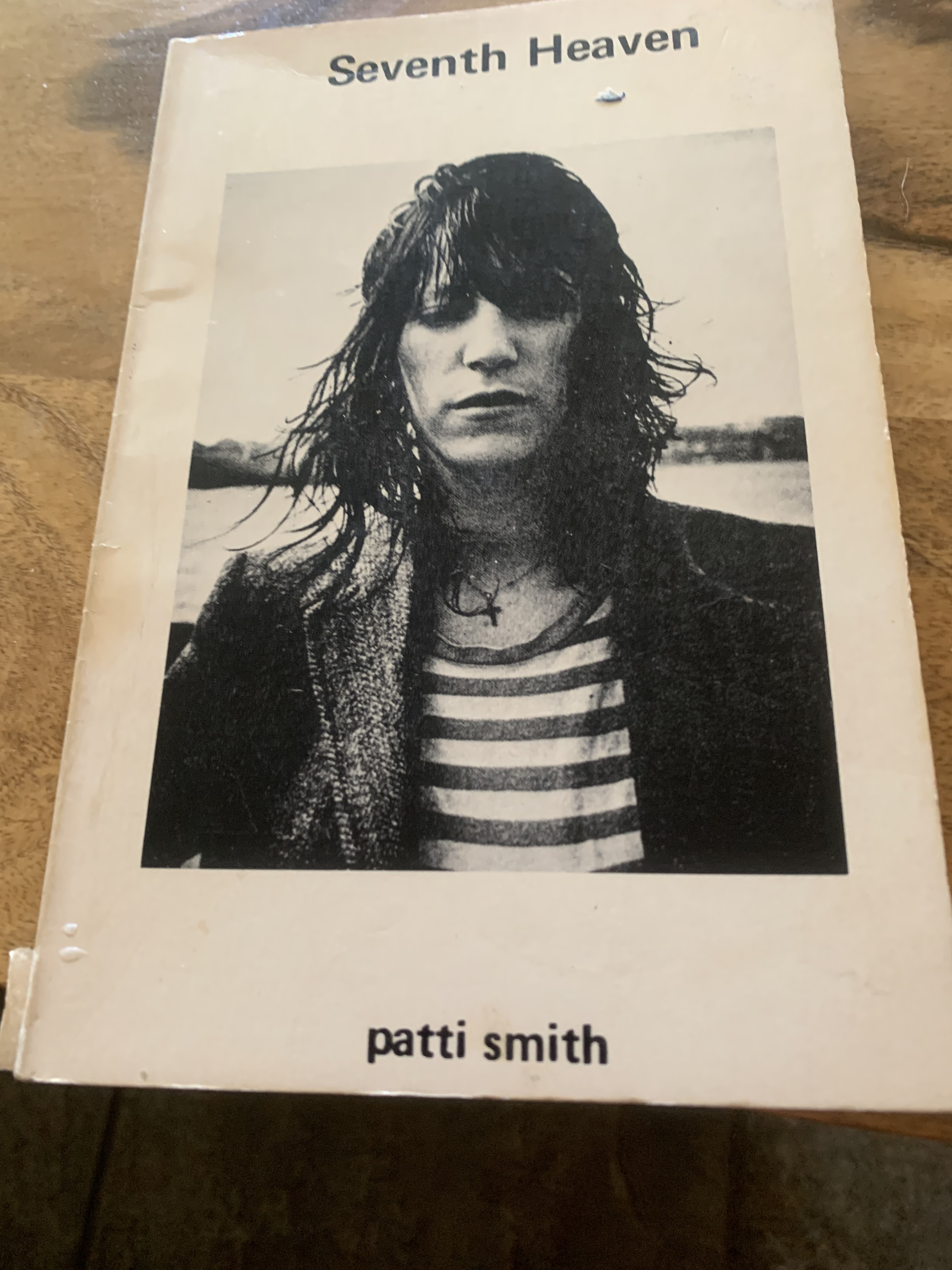
  • I re-read “Seventh Heaven” by Patti Smith last night. Around Christmas of 1977, I was participating in a UIL speech tournament at Austin High School. There are a number of stories connected to this trip, none of which have to do with the topic at hand: “Seventh Heaven” by Patti Smith. I had both of Patti Smith’s albums at the time: Horses, and Radio Ethiopia. I was enamored of her and the very different aesthetic she projected into my 16-year- old mind. While on a break from the speech tournament, we went to an independent book store near UT, Grok Books. There in the poetry section (one that was not like the poetry offerings in Victoria, Texas), I found a book of poetry by Patti Smith. It cost $2.95. What a deal. I remember reading it in the cafeteria/auditorium of Austin High School as we waited to see if we had placed in Duet Acting. One of the girls on the trip asked to see what I was reading.  She read the poem “Fantasy,” quickly handed it back to me with a look of confused distaste.  “You like this?” I had to admit— I did. Still do. More so, I think, for the nostalgia of it all, than for the poetry itself. But as Roger Shattuck wrote: we spend a lifetime reading and studying poetry in an attempt to understand, and then try to read it once again with an innocent eye. Can’t really do that.

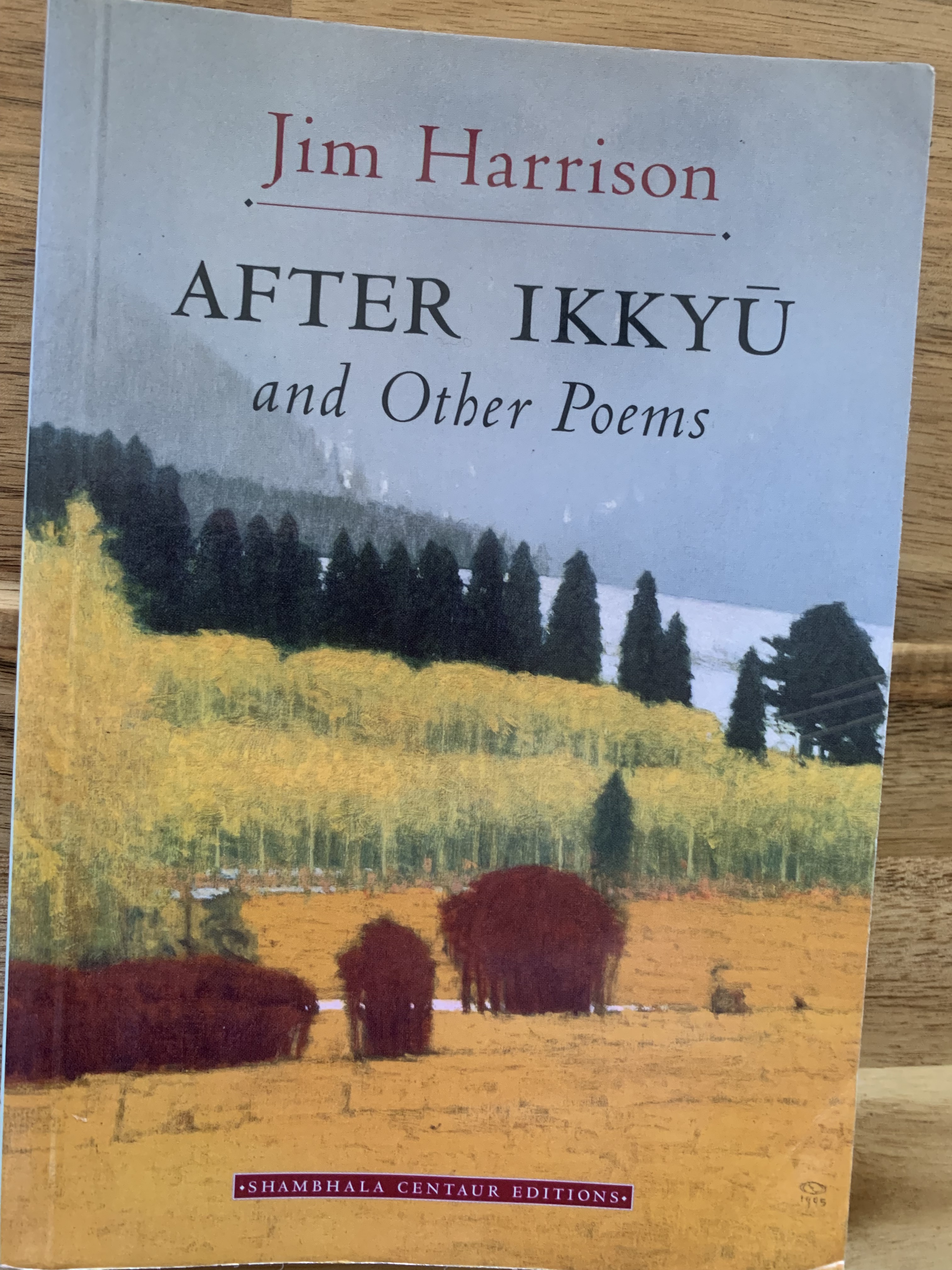
  • I read “After Ikkyu” by Jim Harrison again last night. Over the last 30 years I must have read this book 30-40 times all the way through (It is short), and then countless other times dipped into it for psychic and spiritual relief. After Ikkyu was another book I stumbled across at a Half-Price books. I had never heard of Jim Harrison, and had never heard of Ikkyu, so that day I pulled After Ikkyu off the shelf was an important date in my poetic literacy. Harrison over the next few months quickly became my favorite poet and novelist. I even read his memoir, and collection of essays written for foodie magazines. The poems in After Ikkyu are modeled after the Japanese poet Ikkyu. They are brief observations about the fleeting nature of life, and our constant inability to see the beauty right in front of us. The poems are imagisticly clean, and delivered with a wry sense of humor. Every time I read them I am stunned by their beauty, craftsmanship, wisdom and wit. 

    (February 28, 2025)

  • I found “The Laughter of the Sphinx” by Michael Palmer on one of our bookshelves a couple of days ago. I finished it today. Back in the early 80’s while still an undergrad at UTAustin, I spent an inordinate amount of time in the Half-Price Book store which was then located at 15th and Lavaca (now torn down and replaced by a bank building, like much of Austin). I would spend hours going through the record albums, or poetry section, both of which were rather large. (Poetry is no longer a very large section in any of the Half-Price book stores nowadays). Emily Dickinson wrote that she knew something was poetry when the back of her head exploded when she read it. In the early 80’s, while my head did not explode, I would feel the words thicken on the page, taking on a physicality which went beyond the page. This would happen even if I could not understand what the poem was saying. I felt this when I read Pound and Ashbery for the first time, and still happens whenever I read Dickinson.  It happened when I read Michael Palmer’s “Notes for Echo Lake” standing in the cold aisle of the poorly heated Half-Price Books. Over the years I continued to read and buy copies of Palmer’s work. I’m not sure he has gotten easier to read, or I am not as shallow a reader as I was in my early 20’s, but I did find more to hang on to than I did in my youth. If you have not read Palmer, “The Laughter of the Sphinx” would be a good place to start. It is an abstract and surrealistic delight, while sometimes taking on the concrete feel of the Objectivists. Perhaps I’ve been reading too much George Oppen lately, but several times in “The Laughter of the Sphinx” the poems read like Objectivist pieces. In an interview I read with Palmer decades ago, he said he did not like the term avant-garde because it assumed a direction. I love getting lost in his poetry.

    (February 22, 2025)