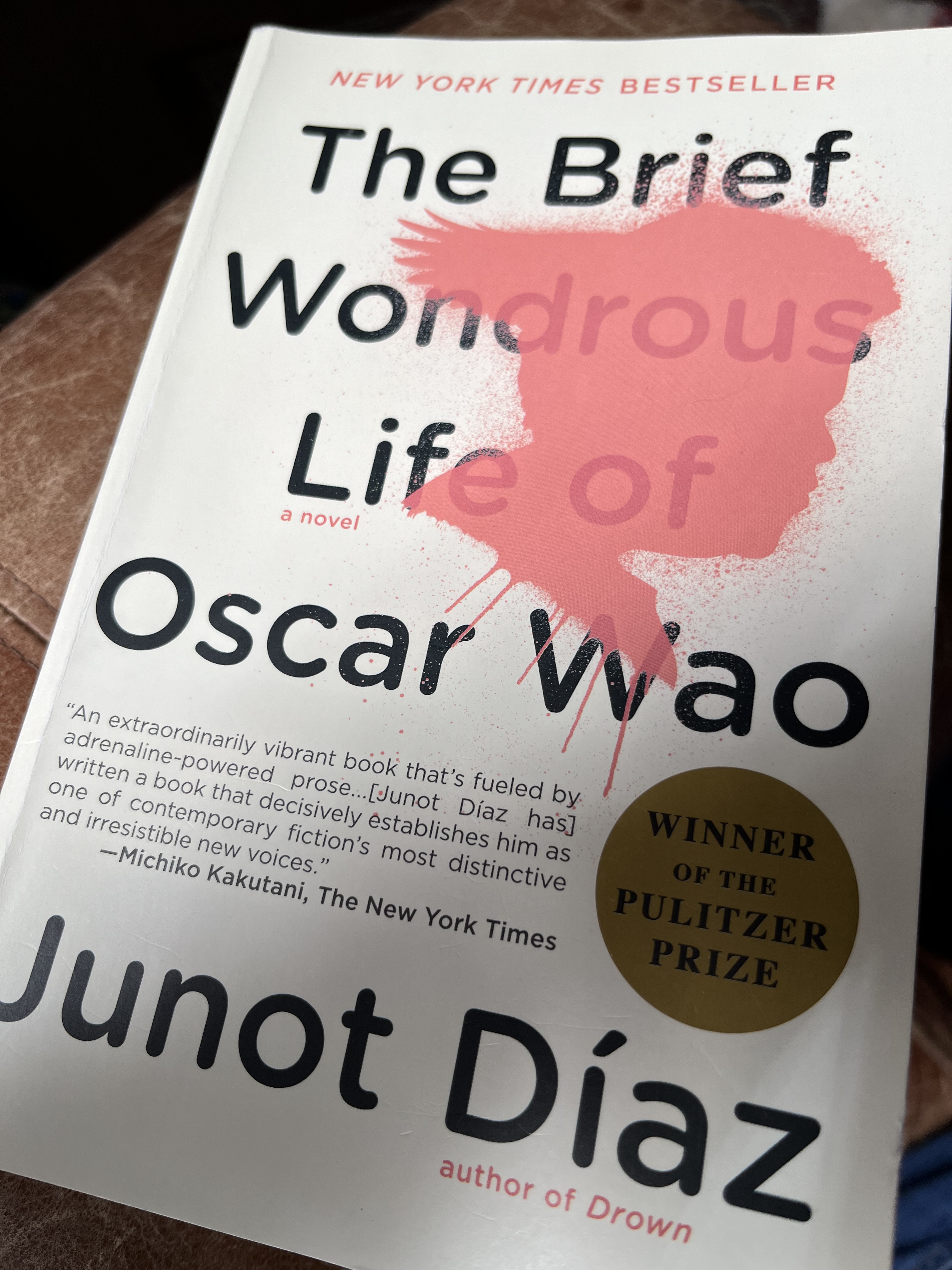
I finished The Brief Wondrous Life of Oscar Wao by Junot Díaz, the RFB book for February, just now. By the end I liked it better than I did while I was reading it. In other words, Diaz brought it to a close masterfully. It is a sweeping family drama story on a simple level. But more so how history-in-person, history-in-place, and how the stories you hear from your family’s history form a large part of your destiny, identity and “fuku” (curse, I believe). Ultimately it is a story of love, albeit a tragic story of love. A line from near the end of the book: “ She was the kind of girlfriend God gives you young, so you’ll know loss the rest of your life.” A line from the narrator, which I believe is the opposite of what was given to Oscar, which was more the kind of girl God gives you so that you will know the power of love to bring you happiness. Even if only for a brief wondrous moment of your life.
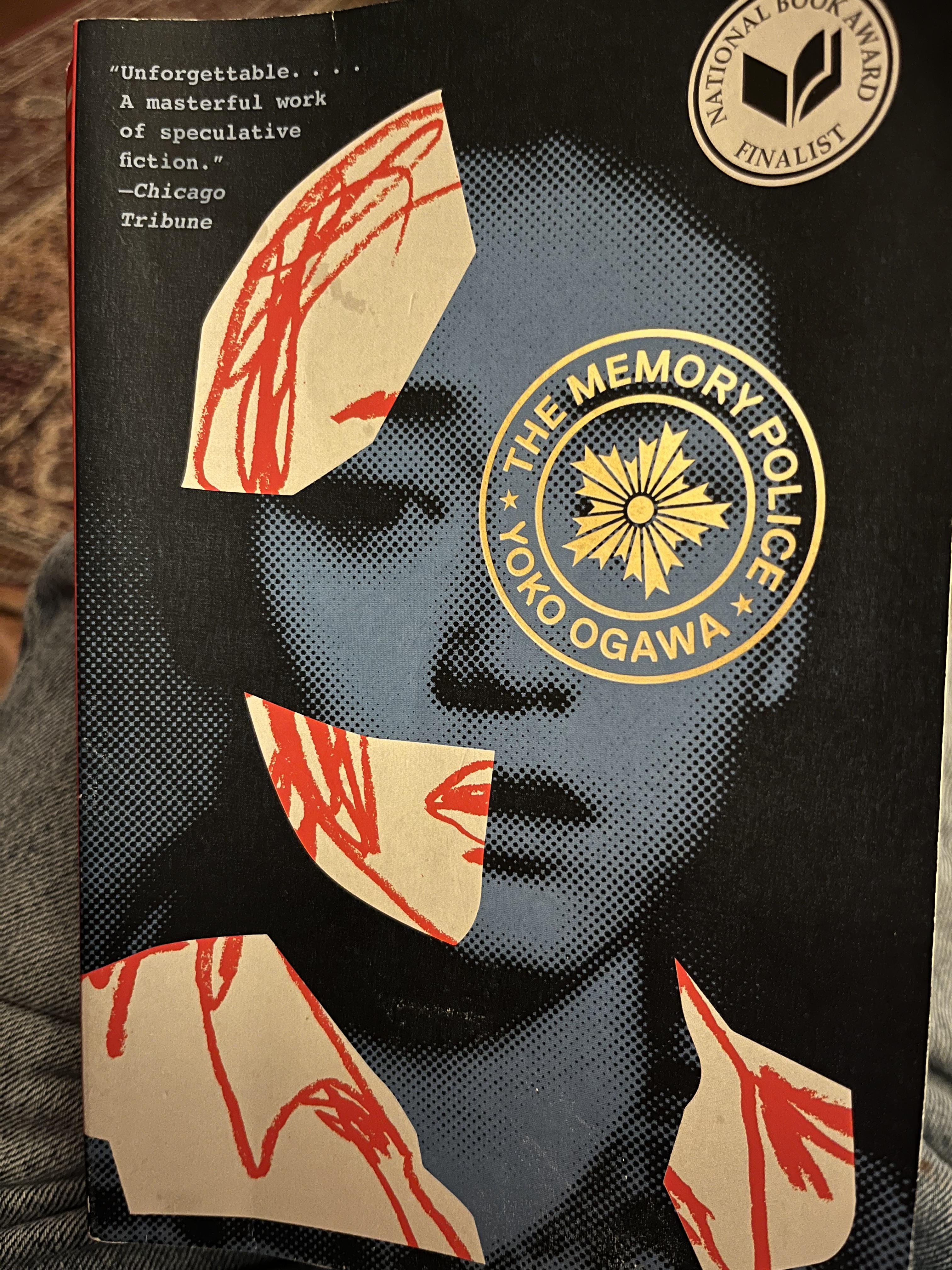
I finished the Memory Police last night, but couldn’t summon enough energy to write a response. It was curious. It was interesting. It was ART!! Were there great lines and thoughts? Yes. Did it make sense? Not at first glance, which this response is. The novel (as the blurb on the back states) takes place on an unknown island where objects keep disappearing. Disappearing completely, even from the memory of most of the people on the island. Those who can still remember are taken away to some unknown place, for some unknown fate by the Gestapo-like Memory Police. The last sentence of the blurb says “The Memory Police is a stunning novel about the trauma of loss.” I guess that is true, but only on one level. I would say it is more about the control of a community’s narrative; How history can be erased, and how we all just go along. How writing extends and saves individual memory for the next generations, who lose and save and create their own memories. How small seemingly unimportant objects can embody massive recollections.
Random Thoughts/Questions: None of the characters have names. There is a narrator, the novelist; the old man, who used to be the ferryman before the ferry disappeared, and R, who does not forget. The novelist is writing a novel, which sporadically we (the reader) get to read.Is the old man an allusion to Charon? Are the people who forget dead? The narrator is writing a novel, but loses her voice and can’t remember how to write. R, who used to proofread the narrator’s novels, keeps encouraging her to write, almost like editors who finish novelists books posthumously. Does “R” stand for reader? which is us, as we try to create meaning out of other’s incomplete memories?
Quotes:
“When I was a child, the whole place seemed… a lot fuller, a lot more real. But as things got thinner, more full of holes, our hearts got thinner, too, diluted somehow, I suppose that kept things in balance… And even when the balance begins to collapse, something remains.”
“I have the feeling my voice may come back one day if I study the letters imprinted on the used ribbon.”
“I’d imagine you’d be uncomfortable, with your heart full of so many forgotten things.”
“Memories don’t just pile up—- they also change over time. And sometimes they fade of their own accord.”
“Each one of us hides them away in secret. So, since out adversary is invisible, we are forced to use out intuition. It is extremely delicate work. In order to unmask these invisible secrets, to analyze and sort and dispose of them, we must work in secret, to protect ourselves.”
“Memories are a lot tougher than you might think. Just like the hearts that hold them”
“When you lost your voice, you lost the ability to make sense of yourself.”
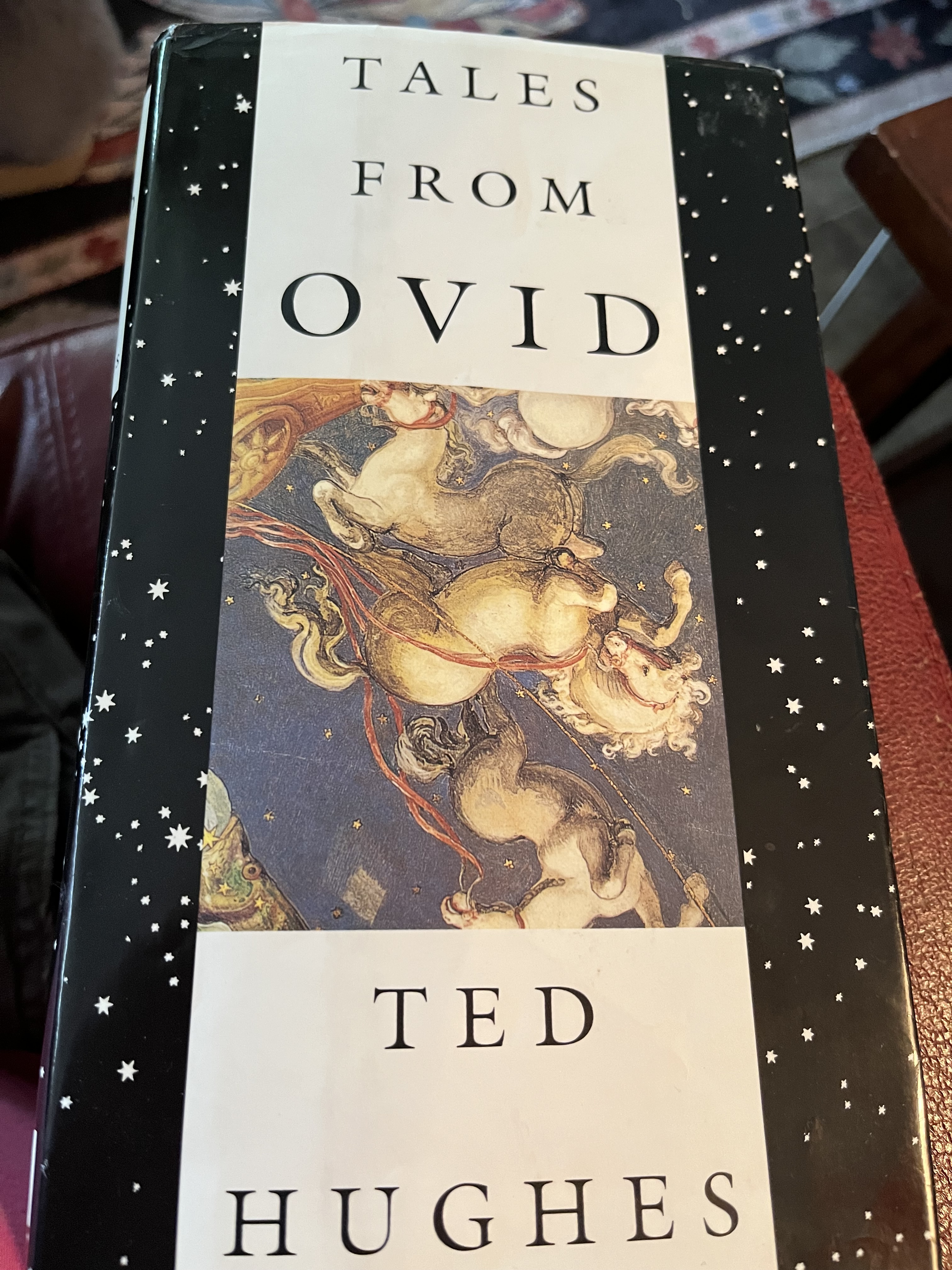
Finished this today. Kind of like The Metamorphoses’ Greatest Hits. That is not a criticism. I had not heard of some of the tales, and I liked the non-bowlderized versions of the others, having read most of the tales in kids versions to my children decades ago. It was a fun read. If you see it used somewhere, it is worth picking up. Trivia for some of you guys: Ted Hughes was married to Sylvia Plath. ( I like pointing that out since he was apparently an ass to her. Now to the younger readers, he is a footnote to her. He was no slouch as a poet, however. The Crow is especially good as I remember).
I finished reading (again) I, Claudius by Robert Graves this morning. It is the RFB book for July. I first read it when I was in high school, forty years ago. I loved it then, and loved it again this time. It is a historical novel, set in Imperial Rome, told from the point of view of Claudius, who is seen as a harmless buffoon by his murderous relatives. Because of their opinion of him, he manages to survive all of the palace intrigues, and by the end of the novel, becomes emperor of Rome. (This is not really a spoiler if you have any knowledge of Roman history). The book ends with Claudius being declared emperor. In the sequel Claudius the God, his stint as ruler of Rome is told. I don’t have any plans on reading it again, but who knows. I remember it being as fun as I, Claudius. I, Claudius is funny, and historically accurate, as far as I know. The colder than ice ambitions of the characters as they maneuver for power is stunningly familiar to the current political situation here in the US. (sadly).
I found “The Laughter of the Sphinx” by Michael Palmer on one of our bookshelves a couple of days ago. I finished it today. Back in the early 80’s while still an undergrad at UTAustin, I spent an inordinate amount of time in the Half-Price Book store which was then located at 15th and Lavaca (now torn down and replaced by a bank building, like much of Austin). I would spend hours going through the record albums, or poetry section, both of which were rather large. (Poetry is no longer a very large section in any of the Half-Price book stores nowadays). Emily Dickinson wrote that she knew something was poetry when the back of her head exploded when she read it. In the early 80’s, while my head did not explode, I would feel the words thicken on the page, taking on a physicality which went beyond the page. This would happen even if I could not understand what the poem was saying. I felt this when I read Pound and Ashbery for the first time, and still happens whenever I read Dickinson. It happened when I read Michael Palmer’s “Notes for Echo Lake” standing in the cold aisle of the poorly heated Half-Price Books. Over the years I continued to read and buy copies of Palmer’s work. I’m not sure he has gotten easier to read, or I am not as shallow a reader as I was in my early 20’s, but I did find more to hang on to than I did in my youth. If you have not read Palmer, “The Laughter of the Sphinx” would be a good place to start. It is an abstract and surrealistic delight, while sometimes taking on the concrete feel of the Objectivists. Perhaps I’ve been reading too much George Oppen lately, but several times in “The Laughter of the Sphinx” the poems read like Objectivist pieces. In an interview I read with Palmer decades ago, he said he did not like the term avant-garde because it assumed a direction. I love getting lost in his poetry.
Poems of witness. Too bad they must continue to be written. These were written by a 27 year old woman in the dying Soviet Union’s gulags. Carved into soap with a matchstick, then washed away after being memorized.
And then they’ll torch the cattle, houses with napalm,
measure the children with wheels of a tank,
level walls to the ground.
But maybe they won’t touch the crazed old women—
and don’t keep bringing up the schoolbook: the condemned
know the histories—
time’s worn thin above the place of execution, begins to leak.
God grant you don’t learn what the wife of salt will see:







 subtext