I finished There are Rivers in the Sky a couple of days ago. Usually I try to respond as soon as I finish a book, but this time it had to ferment a bit before I could respond. Not that the couple of days more has made it more clear what I am thinking. We read one of her books, 10 Minutes 38 Seconds in This Strange World, for RFB last year. I really liked it, so I looked forward to reading Rivers in the Sky. Like 10 Minutes, Rivers is built around multiple story lines which by the end of the novel converge nicely without sounding forced. Both books stress the importance of community, 10 Minutes on a small group of divergent friends, whereas Rivers weaves a broader tapestry across centuries if not millennia. The connecting thread across time is the Mesopotamian Epic of Gilgamesh, the earliest written piece of world literature arising from the earliest civilization. Which of course, is significant to the novel as a whole. One of the story lines is set in Victorian England (the height of the English Empire), when England is pillaging the past Empires of relics and putting them on display in the British Museum. One of the relics they find is the before unknown Epic of Gilgamesh. It is found in fragments, over time, mainly in the abandoned ruins of the once great city of Nineveh. Another story line involves a small group of people, descended from the Sumerians, considered to be devil worshippers by the dominant religious groups. While the third story line, also descendants from the region of Mesopotamia, Iraq, who have immigrated to contemporary England. Through all three threads, the importance of story, the written word, tradition, and change flow like the rivers,(The Thames and Tigris), which dominate the imagery in the novel. The pollution, re-birth(in the case of the Thames), the destructive and nurturing aspects of the rivers and water in general are constantly in play. Overall it was an enjoyable experience.
One quote out of dozens I underlined: “Hatred is a poison in three cups. The first is when people despise those they desire—because they want to have them in their possession. It’s all out of hubris! The second is when people loathe those they do not understand. It’s all out of fear! Then there is the third kind—when people hate those they have hurt”
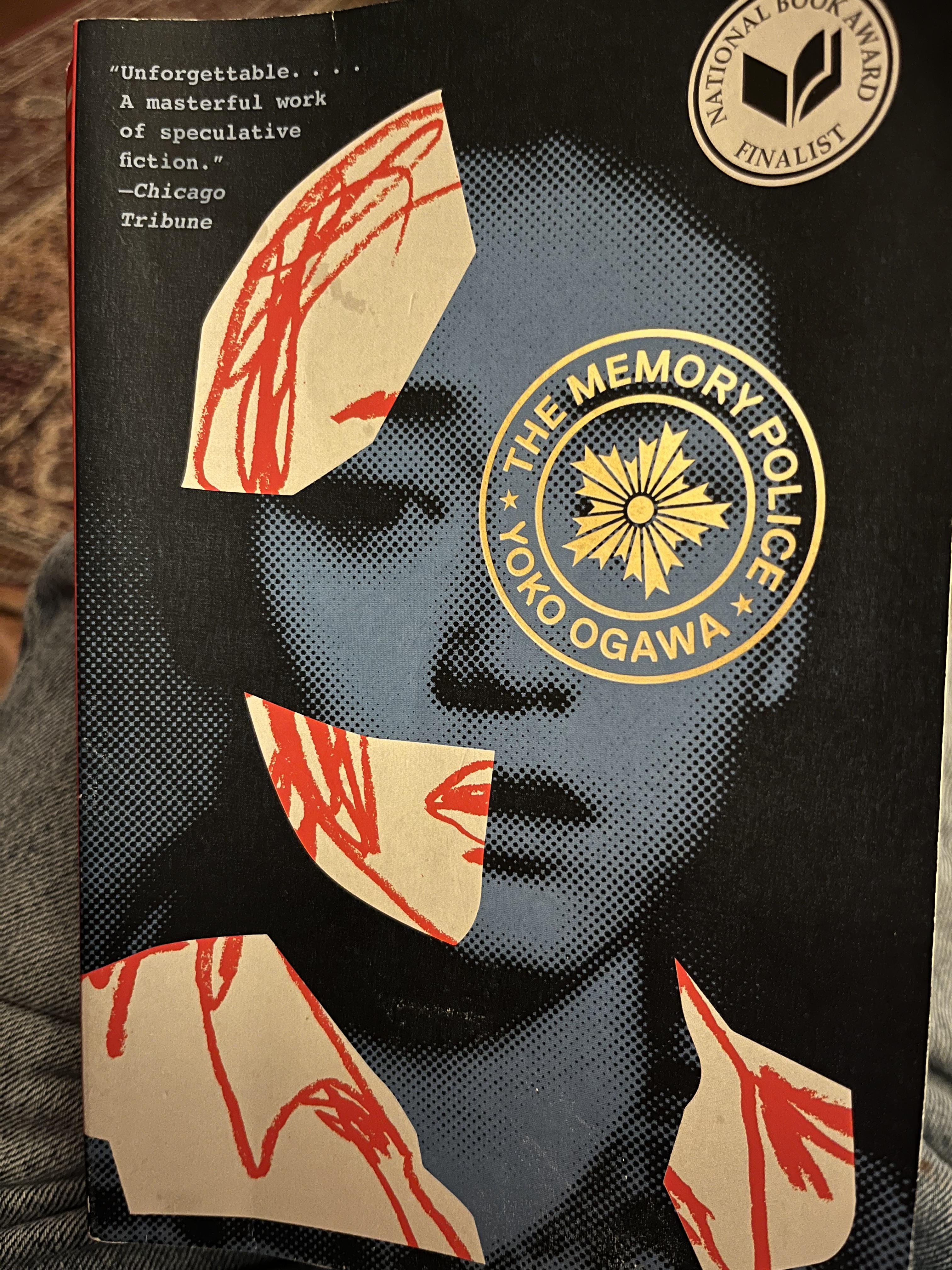
I finished the Memory Police last night, but couldn’t summon enough energy to write a response. It was curious. It was interesting. It was ART!! Were there great lines and thoughts? Yes. Did it make sense? Not at first glance, which this response is. The novel (as the blurb on the back states) takes place on an unknown island where objects keep disappearing. Disappearing completely, even from the memory of most of the people on the island. Those who can still remember are taken away to some unknown place, for some unknown fate by the Gestapo-like Memory Police. The last sentence of the blurb says “The Memory Police is a stunning novel about the trauma of loss.” I guess that is true, but only on one level. I would say it is more about the control of a community’s narrative; How history can be erased, and how we all just go along. How writing extends and saves individual memory for the next generations, who lose and save and create their own memories. How small seemingly unimportant objects can embody massive recollections.
Random Thoughts/Questions: None of the characters have names. There is a narrator, the novelist; the old man, who used to be the ferryman before the ferry disappeared, and R, who does not forget. The novelist is writing a novel, which sporadically we (the reader) get to read.Is the old man an allusion to Charon? Are the people who forget dead? The narrator is writing a novel, but loses her voice and can’t remember how to write. R, who used to proofread the narrator’s novels, keeps encouraging her to write, almost like editors who finish novelists books posthumously. Does “R” stand for reader? which is us, as we try to create meaning out of other’s incomplete memories?
Quotes:
“When I was a child, the whole place seemed… a lot fuller, a lot more real. But as things got thinner, more full of holes, our hearts got thinner, too, diluted somehow, I suppose that kept things in balance… And even when the balance begins to collapse, something remains.”
“I have the feeling my voice may come back one day if I study the letters imprinted on the used ribbon.”
“I’d imagine you’d be uncomfortable, with your heart full of so many forgotten things.”
“Memories don’t just pile up—- they also change over time. And sometimes they fade of their own accord.”
“Each one of us hides them away in secret. So, since out adversary is invisible, we are forced to use out intuition. It is extremely delicate work. In order to unmask these invisible secrets, to analyze and sort and dispose of them, we must work in secret, to protect ourselves.”
“Memories are a lot tougher than you might think. Just like the hearts that hold them”
“When you lost your voice, you lost the ability to make sense of yourself.”
This is how this story goes, or at least what I can remember from how Dad told it. I have probably told this story as many, if not more, times than my dad. Uncle Les had gone off to college in the late 1800’s. Every now and then a letter from him would arrive that first semester, and then they didn’t. My Grandfather Noel, Les’ brother, saddled up his horse and rode off to check on things. When he arrived, Les’ dorm room appeared as if Les had just walked out and would return any minute. He had been missing for several months. Then years later, around 1906, when my dad was three years old, a man came riding up to the “dirt” farm Noel struggled to eek a living from out near Liberty Hill. The man had two large saddle bags draped over his horse, two bandoliers criss-crossing his chest, and two large pistols hanging from his hips. The man was Uncle Les. After he dismounted, he walked into the house and hung his pistols from a peg on the wall. Les never touched those guns again. “Leave those guns alone, Ralph They’re nothing but trouble,” my Grandmother Pearl told the excited three year old. Les took his saddle bags out to the barn where he slept for the next 7 years as he worked for his brother on the farm for room and board. After seven years, Les took the almost forgotten saddle bags and bought a ranch out west. Even as children, we saw the holes in Dad’s story: Where did Les get the money for his ranch? Noel only paid him with food and a place to sleep. Where had Les been all those years after disappearing from his college? What had he been doing? After being gone for so long, why did he wait for seven years before he bought his ranch? What was in those two saddle bags? Was any of what Dad said over the years about Les true in any way? How much have I filled in the holes of my memory with conjecture?
He didn’t know how to act, and had no script to follow. She knew her part without book, and said all her lines with ease. This was, she pointed out, not her first time in this role. It was, he thought, a true love story, not just another chance for her to reprise a stock character. Repeatedly, she set the scene, hitting her mark, an easy cue to follow. Scene after scene, he vaguely wandered the stage, wishing he knew what to say; wishing he knew what to do; unable to act on his desires. She was confused. What was his motivation? Why wouldn’t he act? Why did he not respond correctly? Eventually, the farce ended as it began, without preamble, or resolution. Some one laughed in the wings, followed by a slow clap. Then, like a ghost, she left the stage, leaving him to ponder their performance alone, as the lights slowly faded past memory.
I finished reading (again) I, Claudius by Robert Graves this morning. It is the RFB book for July. I first read it when I was in high school, forty years ago. I loved it then, and loved it again this time. It is a historical novel, set in Imperial Rome, told from the point of view of Claudius, who is seen as a harmless buffoon by his murderous relatives. Because of their opinion of him, he manages to survive all of the palace intrigues, and by the end of the novel, becomes emperor of Rome. (This is not really a spoiler if you have any knowledge of Roman history). The book ends with Claudius being declared emperor. In the sequel Claudius the God, his stint as ruler of Rome is told. I don’t have any plans on reading it again, but who knows. I remember it being as fun as I, Claudius. I, Claudius is funny, and historically accurate, as far as I know. The colder than ice ambitions of the characters as they maneuver for power is stunningly familiar to the current political situation here in the US. (sadly).
Of course as seventeen year olds, we thought we were being quiet as the five of us grabbed the watermelons from the patch he had in his front yard. Giggling drunk and high, we stumbled over the rows to the panel van, juggling as many of the melons as we were able to carry each trip. Then the house lights blazed through the open windows, the screen door slammed open banging against the house, and he exploded onto the porch raging. We scattered like rats. “What the hell,” he screamed as if an evangelical preacher come Sunday morning condemning all sinners. Not waiting for the expected shot gun blast to rend the air, we leapt without grace over the rows of watermelons, scrambling into the van that idled nearby. Nate hit the gas before we were completely in. The van’s doors flapped open like mouths panting. We all screamed for our lives, as watermelons rolled out the back to thud like dead bodies onto the moonlit summer street.
The shuttlecock flits nimbly across the loom with a soft clacking beat. “For every time I’ve told this tale, I’ve told it twice again,” she implies with a sigh as she begins. She speaks of patience and home, and slow unsolicited seductions, as time unravels across the floor like red pools of forgetfulness at her feet.
He watches her hands shift the threads as if playing upon a lyre. He thinks, “There are so many ways through the woods; so many rivers and creeks to cross; so many hollows and caves to wander lost, always different, always the same as the ones crossed before.”
For years and years as he wandered, he watched the waves pulse repetitive hallucinations and horrors towards a horizon he could no longer see. Unearthly monsters churned the waters feeding one upon the other; the past devoured the past with a ceaseless hunger for more. While elsewhere late at night, she walked the halls without a light, leaned against a shuttered door, and listened to the incessant voices muttering their plots and plans for a life she abhorred.
As the story faltered to its close, there was no soft landfall upon the strand, no wreck scattered upon a beach; no violence in their reunion, nor familial embrace. What had grown between them, tangled like olive tree roots upon a cliff, could not be troubled enough to be called love, if it could be called anything at all.







 subtext