a honey bear sits
nearly empty on a tray
by two cold tea bags
(April 2, 2025)
by

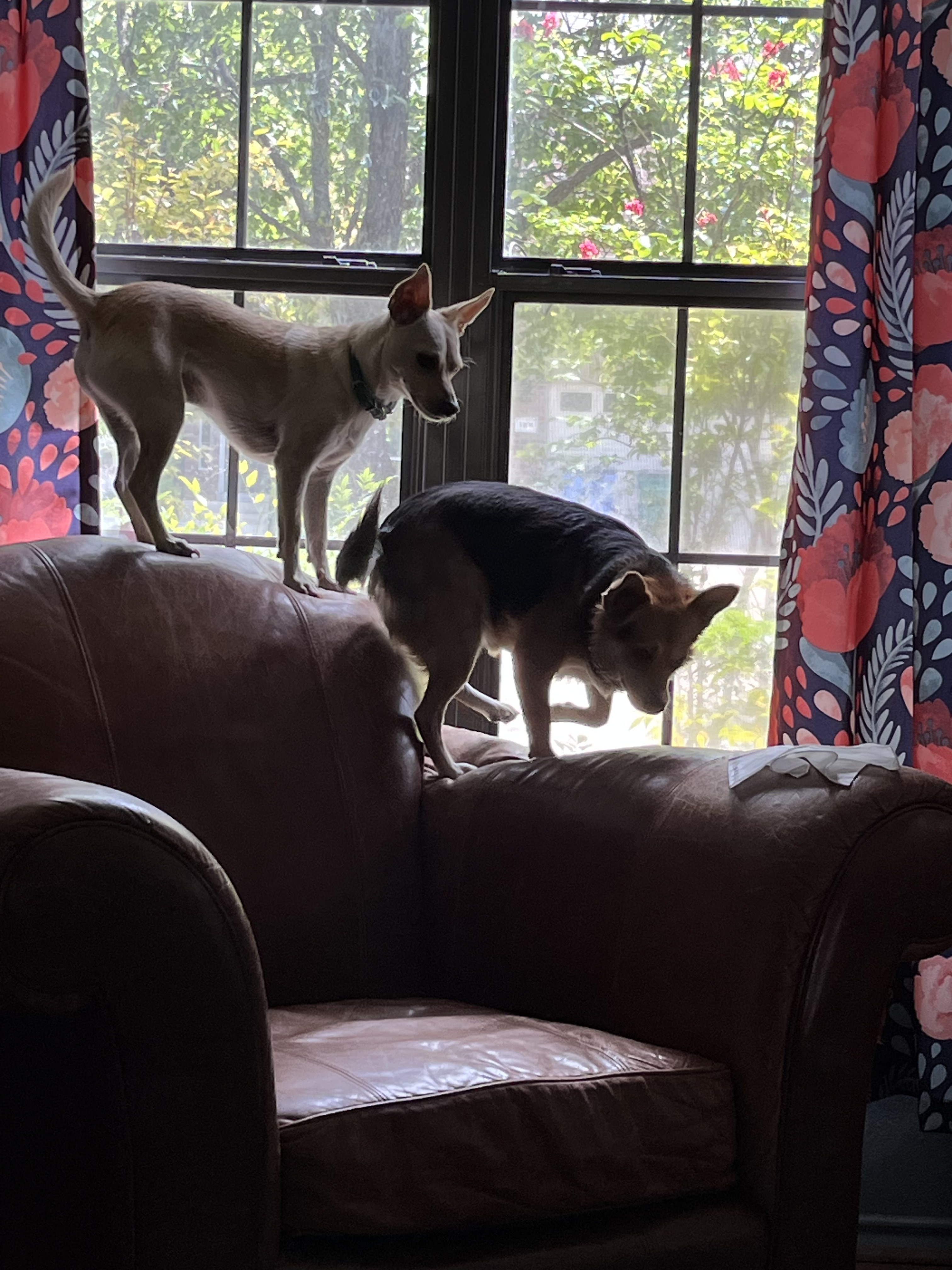
Our two dogs scuffle loudly at my feet.
Curtains flutter in the window near me.
The afternoon has suddenly grown late.
I do not like the book I am reading,
I put it down and pick up another.
It is one I’ve read before: poetry,
so it’s like I’ve never read it at all.
“the mind and the poem are all apiece”
A few weeks later than they did last year,
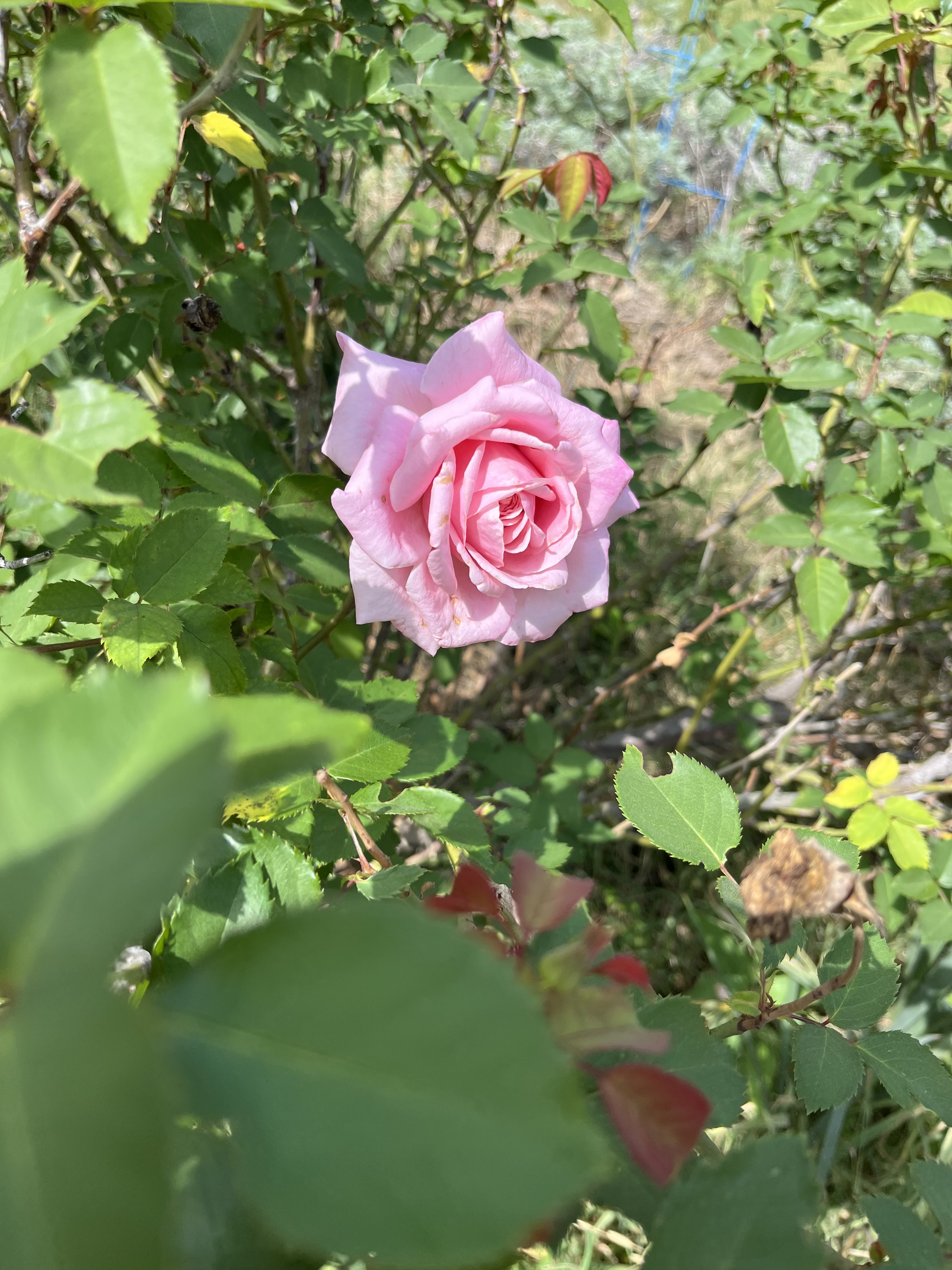
the roses have begun to bloom again.
Though, perhaps not, my memory follows
its own soft path through the rooms of the house.
The dogs with their play tussle forgotten
curl in the corner upon each other.
(April 1, 2025)

tells a story
to entertain
to make belief
an allowance
to comfort
and hide
from whatever
needs be
feared
(March 31, 2025)

Over the last week I re-read Roger Zelazny’s The First Chronicles of Amber: (Nine Princes in Amber, The Guns of Avalon, Sign of the Unicorn, The Hand of Oberon, and The Courts of Chaos). I first read this series in the mid to late 1970’s. I was in my mid-teens, when I pretty much only read Sci-Fi and Fantasy novels. I think the Amber series was probably my first real exposure to multiple reality, and the idea that we control and can change the reality we are born into. This time through I noticed ideas of ontological basis to reality versus epistemological understandings. Here is a bit from near the end: “Yes. You see, we are hatched and we drift on the surface of events. Sometimes, we feel that we actually influence things, and this gives rise to striving. This is a big mistake, because it creates desires and builds up a false ego when just being should be enough. That leads to more desires and more striving and there you are, trapped.” I don’t really remember any of this when I read it the first time 50 years ago. I am sure I absorbed it somehow, just not consciously. For the most part, I enjoyed it well enough this last week; I mean I obviously finished it again. On the whole it is still a fun fantasy novel filled with sword fights and family intrigue and back stabbing, accompanied by quick insertions of Platonism without being too pedantic about it all. There are another five books in the series; I will not seek them out.

always the desire
to be ten years ago
when life was easier
as now ten years hence
(March 29, 2025)
by

The grass is dead; heat
and lack of water condemned
it to a fiery death.
The sun sets the sky
on fire; the air vanishes
with the last ember.
The dark cannot grant
reprieve from the constant heat;
our sweat turns to ash.
There is no relief.
Our father has failed us all
The sun chars the dark.
God smells of stale death in ice;
A silent corpse’s last breath.
(March 24, 2025)

caught in the pulse
throb and gurgle
of our body’s
contained sloppishness
we find ourselves
always too late
as if a vast wave
loomed behind us
knowing the next second
so intently our ignorance
of where we are
consumes any awareness
thus cursed with inability
to be still, we breathe
(March 21, 2025)

It is not safe. Bears ramble
through the valley, eating
fruit and honey. Berries
stain the forest floor
in blackish red swathes
like ink poured accidentally
across a policeman’s ledger.
They have crossed the road
which runs along the edge
of the park. The dam moves
with purpose, followed close
by her rapacious cubs,
their long tongues loll
wetly from their mouths
like loose rubber pendulums.
Make no mistake, this time
it is more than mere hunger
which curls her black lips
into a sharpened smile,
more than resurgent spring,
more than the fate of time
at history’s end,
but revenge.
(March 21, 2025

“Conversation is precarious.”
—Anne Carson
near here someone waits
they are there patient and sublime
in their waiting as if purpose
were only an excuse to wake
once more into conversation
especially one decades old
where the edges decayed
softened in the thick of time
become vague ambiguous
easier to misunderstand
to trust the distorted echos
before falling away into silence
like pebbles off cliff walls
fall into a foggy crevasse
(March 18, 2025)

I have dipped into the anthology, reading a poem here and there since I was given the book by a friend several months ago. Over the last couple of days, I read from start to finish. Finishing a few minutes ago. I have always enjoyed anthologies of poetry, finding new poets (to me), who have turned into favorites over the years. “You are Here” is no different. All of the poems have something to do with the natural world. This is not to say they are Romantic (as in Romanticism). Many of the poems are laments for a dying world, which we (humans) are killing. “She is almost two. I am seventy-five./I won’t be here when the worst/ of what’s coming comes.I think about it/ and then try not to think about it./ and then try to think/ because if we don’t—but I can hardly grasp it.” Ellen Bass writes thinking about the coming climate apocalypse. All of the poets are aware of the world they are observing and engage with it with touches of wit, beauty and horror. My favorite poem “Staircase” is by Jason Schneiderman. I will search out more of his writing. Here is a passage near the end of the stream of consciousness prose poem: “And oh my God, are you as exhausted as I am from grieving the planet? Tell me how not to be hysterical every time I see what’s coming. Every time I see what’s here. Tell me how to accept that it didn’t have to be his way but that it it. Tell me how to accept this sun, this fire, this sky, this day. Dun’t leave me here in these ashes.” The only complaint I have about the anthology is each poem is preface by the poets c.v. each of which read pretty much like the one before it. Too much about credentials of the poet, rather than the pope of the poems. I would rather the focus be on the poems, with the poets bios collected at the end of the anthology. It is the poetry that matters.
by

Most of my lies
belong to me
forming a tight
enameled sarcophagus
in which I will be
remembered.
Others I have
gathered overtime
like dust bunnies
in unused front parlors
tucked softly under chairs.
Like someone else’s
discarded old clothes,
they are obvious,
and fit poorly. Over time,
I have become comfortable
with most of life’s happenstance.
Even now I pretend to know
in my silence, nodding sagely
over other’s conversations,
as if I had some wisdom
beyond circumstance,
allowing their thin opinions
to cling to me, layering
my cold emptiness
beneath wet shrouds.
(March 7, 2025)
by
The thing is you won’t live long
anyway
the thing is to see where you are
While you are—
—George Oppen
fool, look out the window
And write
—George Oppen
You must go on. I can’t go on. I’ll go on.
― Samuel Beckett
I made the mistake of looking at an old “manuscript” from about 15 years ago. I made it about 10-12 pages in before I ran across a couple of lines that I could call good enough to be poetry. There are about 40 more pages to go. I hesitate to go on. I have always over the decades cycled up and down in my opinion of my writing. I know, every writer has doubts. But that does not make it any less depressing when I am plummeting, nor any more justifiable when I am flying high. I remember Robert Frost saying somewhere that he didn’t write experimental poetry, because experimental poem was another name for failed poem. The poem either worked or it did not. If it did, then it was not an experiment; if it failed, then it wasn’t a poem. The old manuscript was not a poem—which was depressing. Instead it was a series of posturing hoping without hope to somehow adhere from one poem/stanza/blither to another without any real attempt on my part beyond “chance” in some misguided belief that John Cage’s ghost would descend to lead me out of the wilderness of my hubris. I take solace in the belief that I knew it was crap, because I put it away and never really looked at it for the last 15 years. I somehow knew without knowing….I am smarter than I let myself be (to use a mantra I said about my students on myself).* My current plan is to plow through the fallow field, and see if there are some living roots that can be salvaged. It will be a trudge. But then, what else would I be doing.
*They are smarter than we let them be.

I re-read “Seventh Heaven” by Patti Smith last night. Around Christmas of 1977, I was participating in a UIL speech tournament at Austin High School. There are a number of stories connected to this trip, none of which have to do with the topic at hand: “Seventh Heaven” by Patti Smith. I had both of Patti Smith’s albums at the time: Horses, and Radio Ethiopia. I was enamored of her and the very different aesthetic she projected into my 16-year- old mind. While on a break from the speech tournament, we went to an independent book store near UT, Grok Books. There in the poetry section (one that was not like the poetry offerings in Victoria, Texas), I found a book of poetry by Patti Smith. It cost $2.95. What a deal. I remember reading it in the cafeteria/auditorium of Austin High School as we waited to see if we had placed in Duet Acting. One of the girls on the trip asked to see what I was reading. She read the poem “Fantasy,” quickly handed it back to me with a look of confused distaste. “You like this?” I had to admit— I did. Still do. More so, I think, for the nostalgia of it all, than for the poetry itself. But as Roger Shattuck wrote: we spend a lifetime reading and studying poetry in an attempt to understand, and then try to read it once again with an innocent eye. Can’t really do that.
by


I read “After Ikkyu” by Jim Harrison again last night. Over the last 30 years I must have read this book 30-40 times all the way through (It is short), and then countless other times dipped into it for psychic and spiritual relief. After Ikkyu was another book I stumbled across at a Half-Price books. I had never heard of Jim Harrison, and had never heard of Ikkyu, so that day I pulled After Ikkyu off the shelf was an important date in my poetic literacy. Harrison over the next few months quickly became my favorite poet and novelist. I even read his memoir, and collection of essays written for foodie magazines. The poems in After Ikkyu are modeled after the Japanese poet Ikkyu. They are brief observations about the fleeting nature of life, and our constant inability to see the beauty right in front of us. The poems are imagisticly clean, and delivered with a wry sense of humor. Every time I read them I am stunned by their beauty, craftsmanship, wisdom and wit.
(February 28, 2025)
by

“way leads onto way”
Robert Frost
I was reading a poem
about how hard it is
to attend to the world
with all its distractions,
and; I lose that poem
to my thoughts of the poem.
Even now, as I write
this poem about losing
the poem I read,
I lose the thoughts
in my head, and the poem
I meant to write instead.
(February 27, 2025)