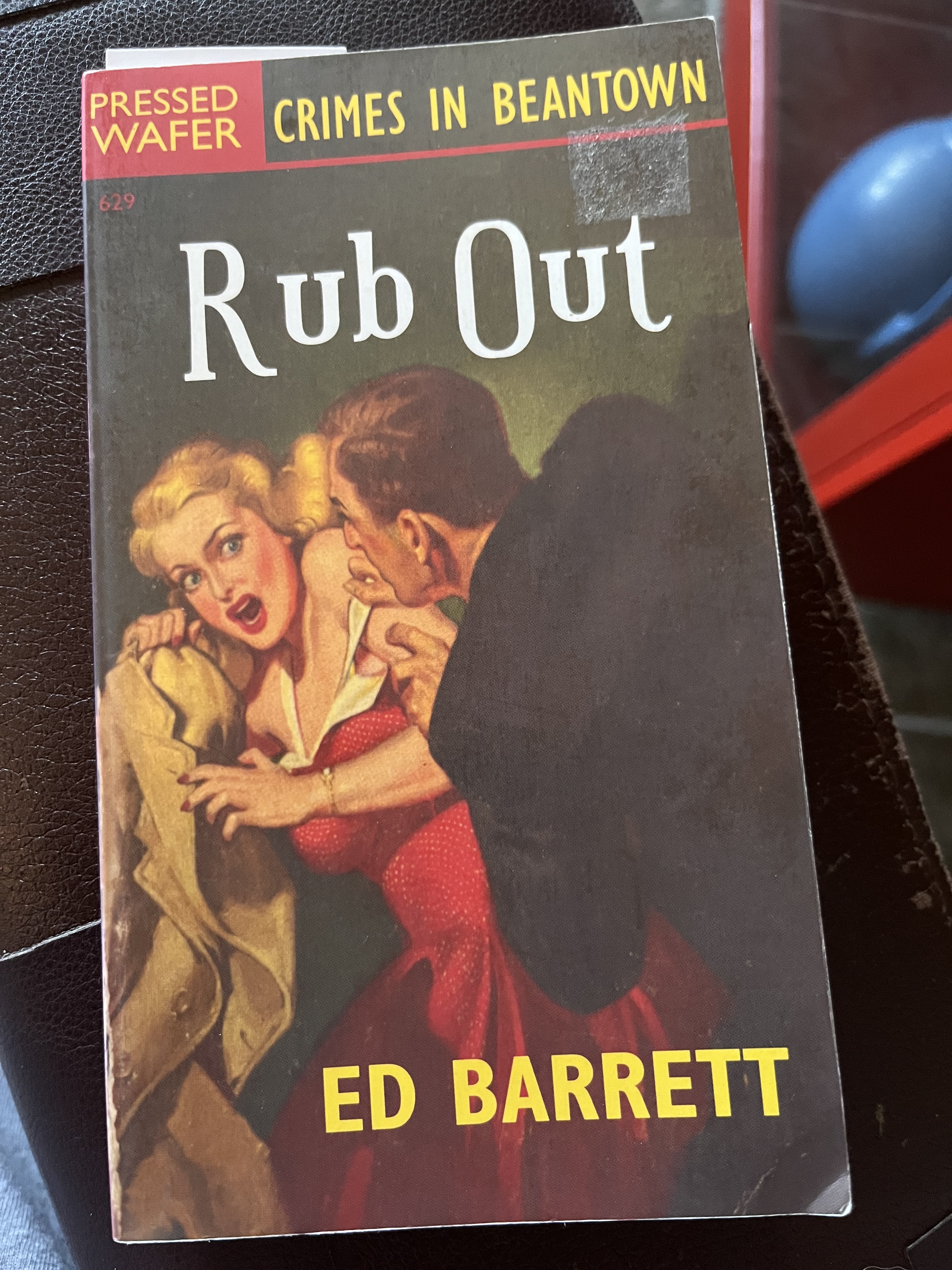
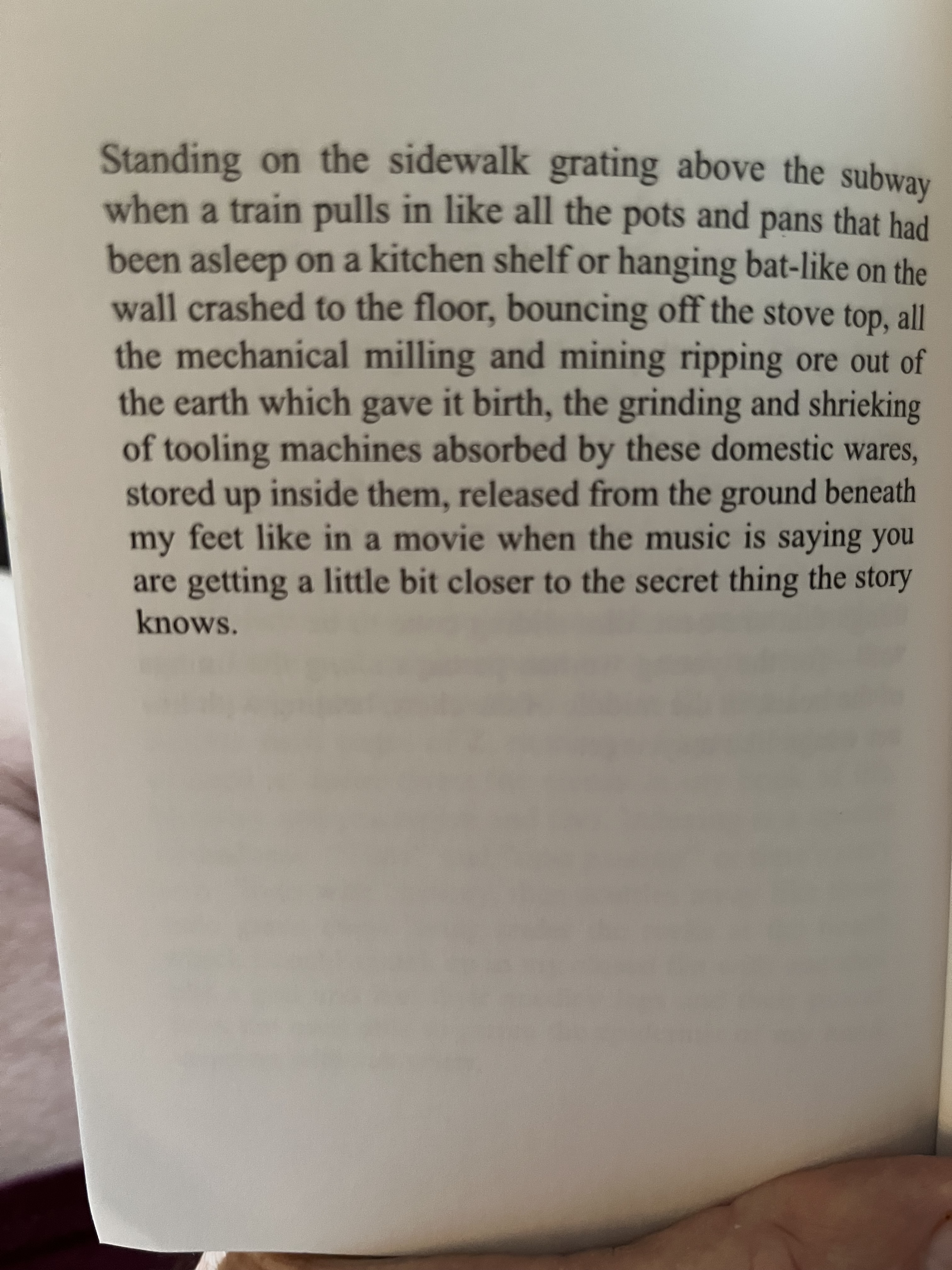
I finished Rub Out by Ed Barrett last night. I have no idea where or when I bought this book. But I found it on my shelf a few months back and have been reading at it since then. It is an interesting set of poems as a mystery novel/1940’s crime noir as if written by John Ashbery. I’m thinking I need to read it again, over a shorter amount of time. I also think I should find someone to read it with, so that I have someone to talk to about it. Here is a quote I copied down several weeks ago: “expectation outweighs desire for most of life”
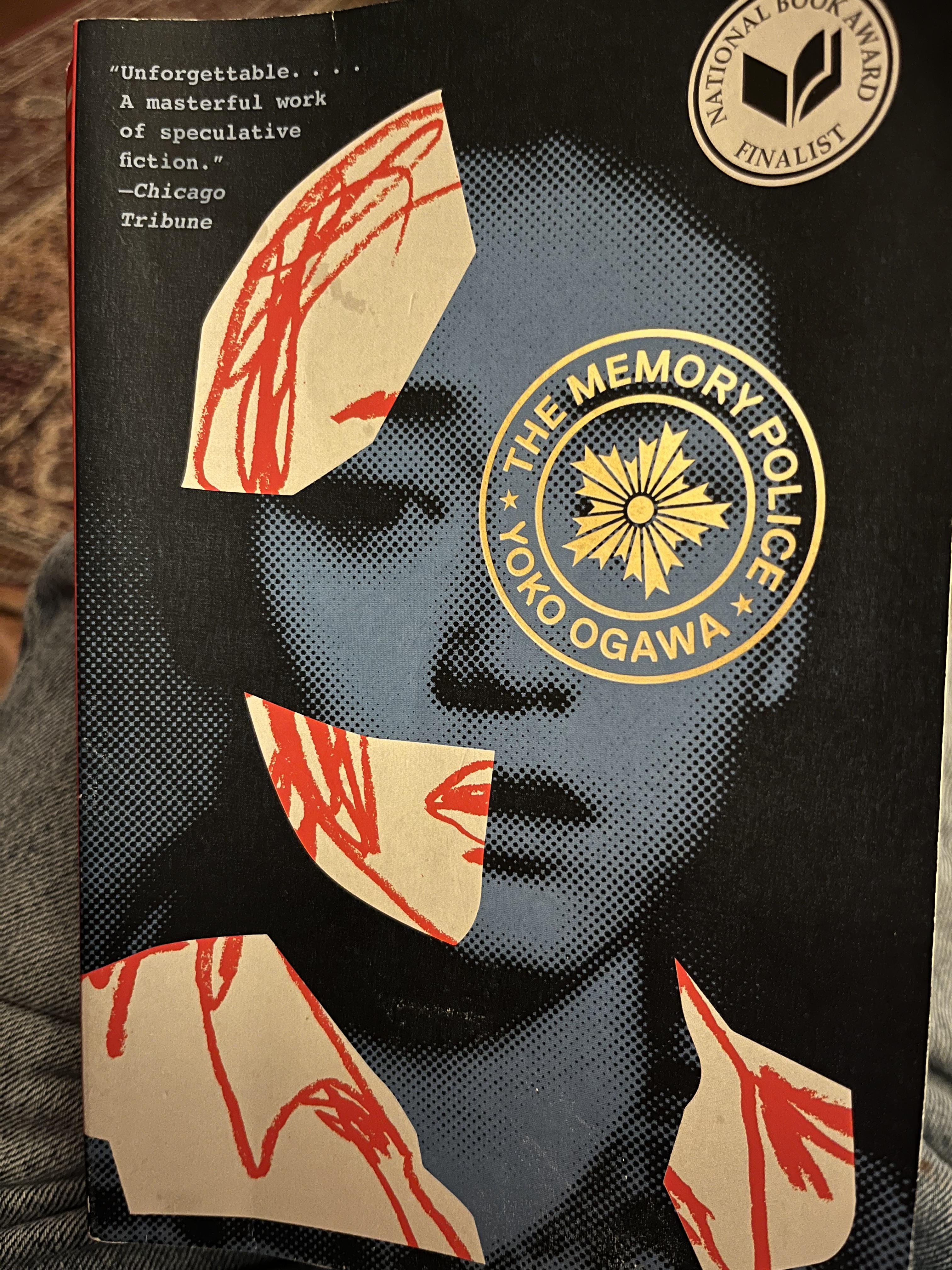
I finished the Memory Police last night, but couldn’t summon enough energy to write a response. It was curious. It was interesting. It was ART!! Were there great lines and thoughts? Yes. Did it make sense? Not at first glance, which this response is. The novel (as the blurb on the back states) takes place on an unknown island where objects keep disappearing. Disappearing completely, even from the memory of most of the people on the island. Those who can still remember are taken away to some unknown place, for some unknown fate by the Gestapo-like Memory Police. The last sentence of the blurb says “The Memory Police is a stunning novel about the trauma of loss.” I guess that is true, but only on one level. I would say it is more about the control of a community’s narrative; How history can be erased, and how we all just go along. How writing extends and saves individual memory for the next generations, who lose and save and create their own memories. How small seemingly unimportant objects can embody massive recollections.
Random Thoughts/Questions: None of the characters have names. There is a narrator, the novelist; the old man, who used to be the ferryman before the ferry disappeared, and R, who does not forget. The novelist is writing a novel, which sporadically we (the reader) get to read.Is the old man an allusion to Charon? Are the people who forget dead? The narrator is writing a novel, but loses her voice and can’t remember how to write. R, who used to proofread the narrator’s novels, keeps encouraging her to write, almost like editors who finish novelists books posthumously. Does “R” stand for reader? which is us, as we try to create meaning out of other’s incomplete memories?
Quotes:
“When I was a child, the whole place seemed… a lot fuller, a lot more real. But as things got thinner, more full of holes, our hearts got thinner, too, diluted somehow, I suppose that kept things in balance… And even when the balance begins to collapse, something remains.”
“I have the feeling my voice may come back one day if I study the letters imprinted on the used ribbon.”
“I’d imagine you’d be uncomfortable, with your heart full of so many forgotten things.”
“Memories don’t just pile up—- they also change over time. And sometimes they fade of their own accord.”
“Each one of us hides them away in secret. So, since out adversary is invisible, we are forced to use out intuition. It is extremely delicate work. In order to unmask these invisible secrets, to analyze and sort and dispose of them, we must work in secret, to protect ourselves.”
“Memories are a lot tougher than you might think. Just like the hearts that hold them”
“When you lost your voice, you lost the ability to make sense of yourself.”
Today I finished (for RFB) Storyteller by Leslie Marmon Silko. It reminded me of Way to Rainy Mountain by N. Scott Momaday in the way it blended personal narratives, with native-American stories, and history. The three aspects being, in reality, inseparable. In the case of Storyteller, the stories, poetry, photographs orbit around each other to create the idea of “story” as what defines us in our lives: the past, present, mythic all combine to create the culture we live in as well as the individual person who lives inside of the culture. It is a fairly subtle nuanced book. Silko does not spell it all out in the way Thomas King does in “The Truth About Stories,” a book I finished a few weeks ago. King also blends personal narrative, with myth, and history. Instead, Silko, lays out the parts of her collection in a type of collage, where the various parts generate a collective power creating a larger whole from the smaller parts.
Here are just some lines I underlined as I read:
“But sometimes what we call “memory” and what we call “imagination” are not so easily distinguished.”
“The story was the important thing and little changes here and there were really part of the story. There were even stories about the different versions of stories and how they imagined these differing versions came to be.”
“We were all laughing now, and we felt good saying things like this. “Anybody can act violently—-there is nothing to it; but not every person is able to destroy his enemy with words.”
I have dipped into the anthology, reading a poem here and there since I was given the book by a friend several months ago. Over the last couple of days, I read from start to finish. Finishing a few minutes ago. I have always enjoyed anthologies of poetry, finding new poets (to me), who have turned into favorites over the years. “You are Here” is no different. All of the poems have something to do with the natural world. This is not to say they are Romantic (as in Romanticism). Many of the poems are laments for a dying world, which we (humans) are killing. “She is almost two. I am seventy-five./I won’t be here when the worst/ of what’s coming comes.I think about it/ and then try not to think about it./ and then try to think/ because if we don’t—but I can hardly grasp it.” Ellen Bass writes thinking about the coming climate apocalypse. All of the poets are aware of the world they are observing and engage with it with touches of wit, beauty and horror. My favorite poem “Staircase” is by Jason Schneiderman. I will search out more of his writing. Here is a passage near the end of the stream of consciousness prose poem: “And oh my God, are you as exhausted as I am from grieving the planet? Tell me how not to be hysterical every time I see what’s coming. Every time I see what’s here. Tell me how to accept that it didn’t have to be his way but that it it. Tell me how to accept this sun, this fire, this sky, this day. Dun’t leave me here in these ashes.” The only complaint I have about the anthology is each poem is preface by the poets c.v. each of which read pretty much like the one before it. Too much about credentials of the poet, rather than the pope of the poems. I would rather the focus be on the poems, with the poets bios collected at the end of the anthology. It is the poetry that matters.







 subtext