“So many of us use when at our craft/of transmuting our life into words.//The essence is always lost.”
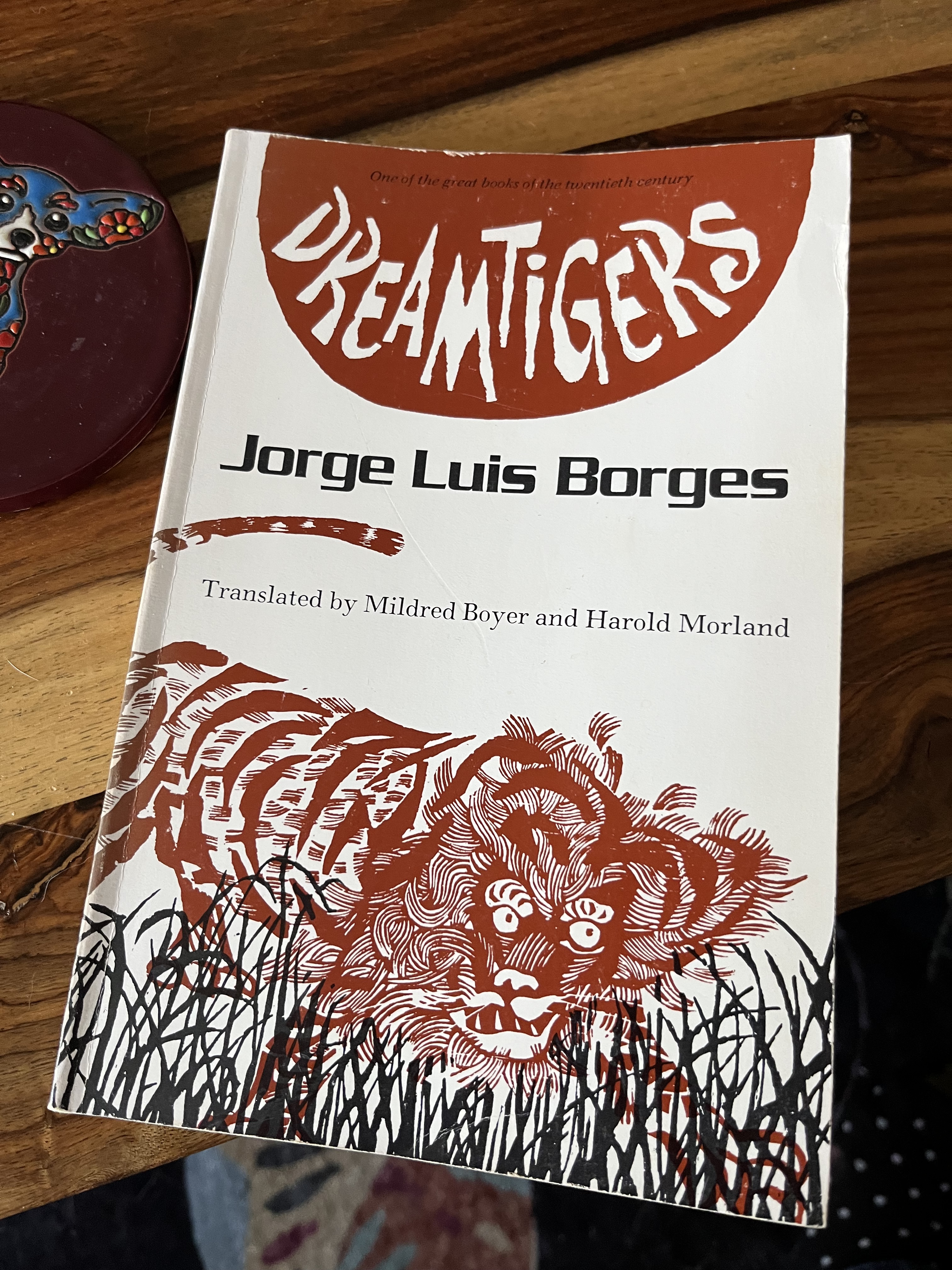
I have read three other books by Borges over the years: Labyrinths, The Book of Sand, and Ficciones. They have all been thought provoking and strange. I first heard of Borges as a fictional character in Umberto Eco’s “The Name of the Rose,” which makes sense as I finished “Dreamtigers” this afternoon. In “Dreamtigers” one of the themes Borges causes the reader to think about is identity. Specifically who is the real “Borges” (and us by extension) the one created by us that we present to the world as us, or the one that created the presentation. “Dreamtigers” is divided into two sections. The first comprised of parable-like reflections revolving around themes of memory, identity, creativity, and mirrors. The second section made up of poems, which touch upon similar themes and images. One of the ideas that have lingered with me after finishing the book is the thought that our unique experience of life which each of us possess and create though our life…vanishes as we die. “Events far-reaching envoy to people all space, whose end is nonetheless tolled when one man dies, may cause us wonder. But something, or an infinite number of things, dies in every death, unless the universe is possessed of a memory, as the theosophists have supposed.” I know that this is obvious, but also profound. Nietzsche said that in the end we only experience ourselves. And Borges extends this with the thought that this individual experience dies with the life of the person. Unless as he says, the universe possess a memory. And even then, that memory is changed and erased by the future which remembers us in their own individual experiences. “There is not a single thing on earth that oblivion does not erase or memory change, and when no one knows into what images he himself will be transmuted by the future.”
memory agitates into vision media res: the precise moment of peak self-revulsion, the inaction, the cowardice, the lie inherent in regret— when nothing more could have been done, nor anything now retroactively applied which can act as balm to the shame carried for decades through the day in those quiet moments on the way to work, waiting for the light to turn green, or some phrase, or song on the radio which tumbles memory’s cascade through the spongey canyons to again reconfigure itself into this contiguous present as some other story without static cause
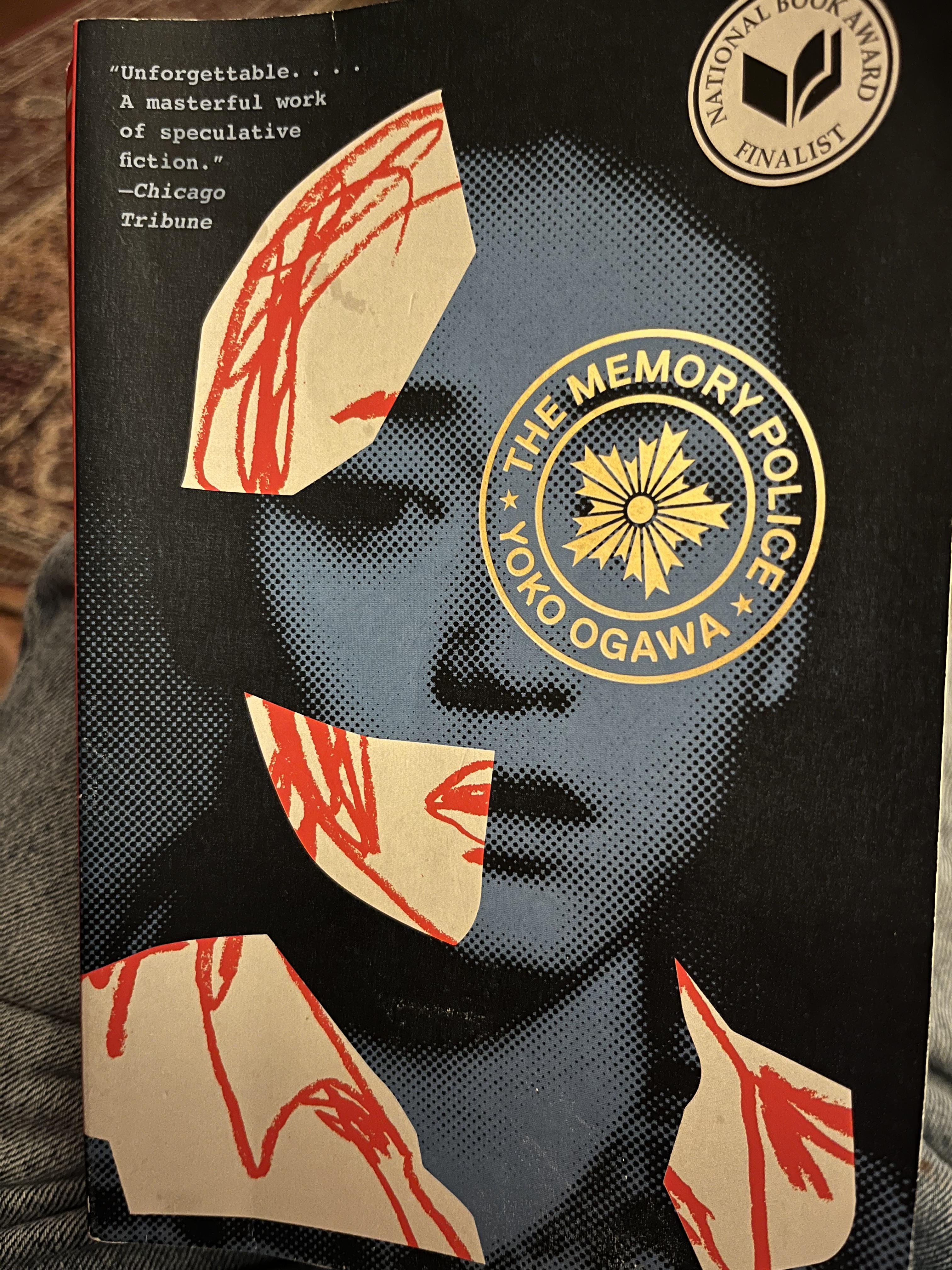
I finished the Memory Police last night, but couldn’t summon enough energy to write a response. It was curious. It was interesting. It was ART!! Were there great lines and thoughts? Yes. Did it make sense? Not at first glance, which this response is. The novel (as the blurb on the back states) takes place on an unknown island where objects keep disappearing. Disappearing completely, even from the memory of most of the people on the island. Those who can still remember are taken away to some unknown place, for some unknown fate by the Gestapo-like Memory Police. The last sentence of the blurb says “The Memory Police is a stunning novel about the trauma of loss.” I guess that is true, but only on one level. I would say it is more about the control of a community’s narrative; How history can be erased, and how we all just go along. How writing extends and saves individual memory for the next generations, who lose and save and create their own memories. How small seemingly unimportant objects can embody massive recollections.
Random Thoughts/Questions: None of the characters have names. There is a narrator, the novelist; the old man, who used to be the ferryman before the ferry disappeared, and R, who does not forget. The novelist is writing a novel, which sporadically we (the reader) get to read.Is the old man an allusion to Charon? Are the people who forget dead? The narrator is writing a novel, but loses her voice and can’t remember how to write. R, who used to proofread the narrator’s novels, keeps encouraging her to write, almost like editors who finish novelists books posthumously. Does “R” stand for reader? which is us, as we try to create meaning out of other’s incomplete memories?
Quotes:
“When I was a child, the whole place seemed… a lot fuller, a lot more real. But as things got thinner, more full of holes, our hearts got thinner, too, diluted somehow, I suppose that kept things in balance… And even when the balance begins to collapse, something remains.”
“I have the feeling my voice may come back one day if I study the letters imprinted on the used ribbon.”
“I’d imagine you’d be uncomfortable, with your heart full of so many forgotten things.”
“Memories don’t just pile up—- they also change over time. And sometimes they fade of their own accord.”
“Each one of us hides them away in secret. So, since out adversary is invisible, we are forced to use out intuition. It is extremely delicate work. In order to unmask these invisible secrets, to analyze and sort and dispose of them, we must work in secret, to protect ourselves.”
“Memories are a lot tougher than you might think. Just like the hearts that hold them”
“When you lost your voice, you lost the ability to make sense of yourself.”
This is how this story goes, or at least what I can remember from how Dad told it. I have probably told this story as many, if not more, times than my dad. Uncle Les had gone off to college in the late 1800’s. Every now and then a letter from him would arrive that first semester, and then they didn’t. My Grandfather Noel, Les’ brother, saddled up his horse and rode off to check on things. When he arrived, Les’ dorm room appeared as if Les had just walked out and would return any minute. He had been missing for several months. Then years later, around 1906, when my dad was three years old, a man came riding up to the “dirt” farm Noel struggled to eek a living from out near Liberty Hill. The man had two large saddle bags draped over his horse, two bandoliers criss-crossing his chest, and two large pistols hanging from his hips. The man was Uncle Les. After he dismounted, he walked into the house and hung his pistols from a peg on the wall. Les never touched those guns again. “Leave those guns alone, Ralph They’re nothing but trouble,” my Grandmother Pearl told the excited three year old. Les took his saddle bags out to the barn where he slept for the next 7 years as he worked for his brother on the farm for room and board. After seven years, Les took the almost forgotten saddle bags and bought a ranch out west. Even as children, we saw the holes in Dad’s story: Where did Les get the money for his ranch? Noel only paid him with food and a place to sleep. Where had Les been all those years after disappearing from his college? What had he been doing? After being gone for so long, why did he wait for seven years before he bought his ranch? What was in those two saddle bags? Was any of what Dad said over the years about Les true in any way? How much have I filled in the holes of my memory with conjecture?







 subtext