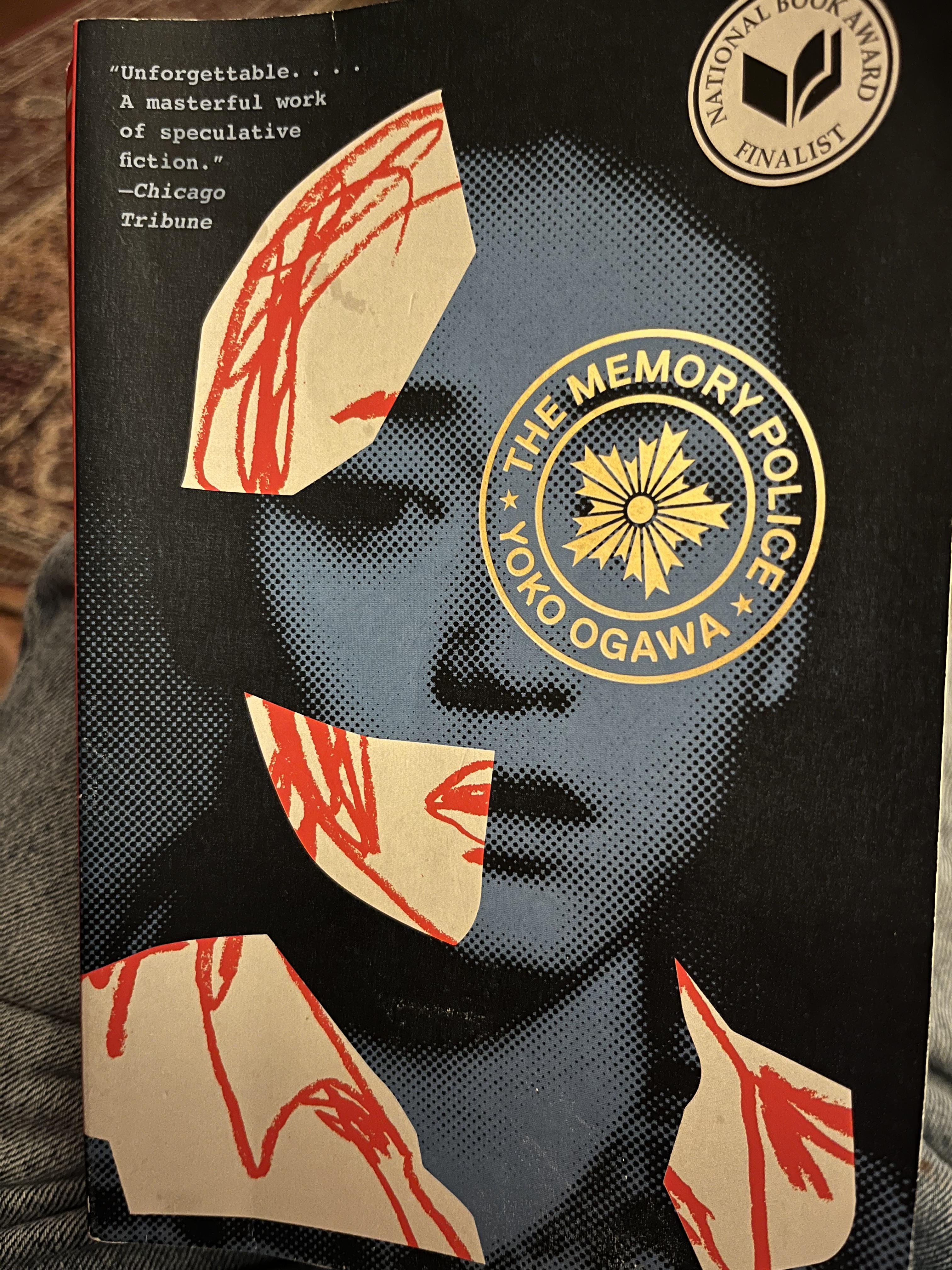
I finished the Memory Police last night, but couldn’t summon enough energy to write a response. It was curious. It was interesting. It was ART!! Were there great lines and thoughts? Yes. Did it make sense? Not at first glance, which this response is. The novel (as the blurb on the back states) takes place on an unknown island where objects keep disappearing. Disappearing completely, even from the memory of most of the people on the island. Those who can still remember are taken away to some unknown place, for some unknown fate by the Gestapo-like Memory Police. The last sentence of the blurb says “The Memory Police is a stunning novel about the trauma of loss.” I guess that is true, but only on one level. I would say it is more about the control of a community’s narrative; How history can be erased, and how we all just go along. How writing extends and saves individual memory for the next generations, who lose and save and create their own memories. How small seemingly unimportant objects can embody massive recollections.
Random Thoughts/Questions: None of the characters have names. There is a narrator, the novelist; the old man, who used to be the ferryman before the ferry disappeared, and R, who does not forget. The novelist is writing a novel, which sporadically we (the reader) get to read.Is the old man an allusion to Charon? Are the people who forget dead? The narrator is writing a novel, but loses her voice and can’t remember how to write. R, who used to proofread the narrator’s novels, keeps encouraging her to write, almost like editors who finish novelists books posthumously. Does “R” stand for reader? which is us, as we try to create meaning out of other’s incomplete memories?
Quotes:
“When I was a child, the whole place seemed… a lot fuller, a lot more real. But as things got thinner, more full of holes, our hearts got thinner, too, diluted somehow, I suppose that kept things in balance… And even when the balance begins to collapse, something remains.”
“I have the feeling my voice may come back one day if I study the letters imprinted on the used ribbon.”
“I’d imagine you’d be uncomfortable, with your heart full of so many forgotten things.”
“Memories don’t just pile up—- they also change over time. And sometimes they fade of their own accord.”
“Each one of us hides them away in secret. So, since out adversary is invisible, we are forced to use out intuition. It is extremely delicate work. In order to unmask these invisible secrets, to analyze and sort and dispose of them, we must work in secret, to protect ourselves.”
“Memories are a lot tougher than you might think. Just like the hearts that hold them”
“When you lost your voice, you lost the ability to make sense of yourself.”
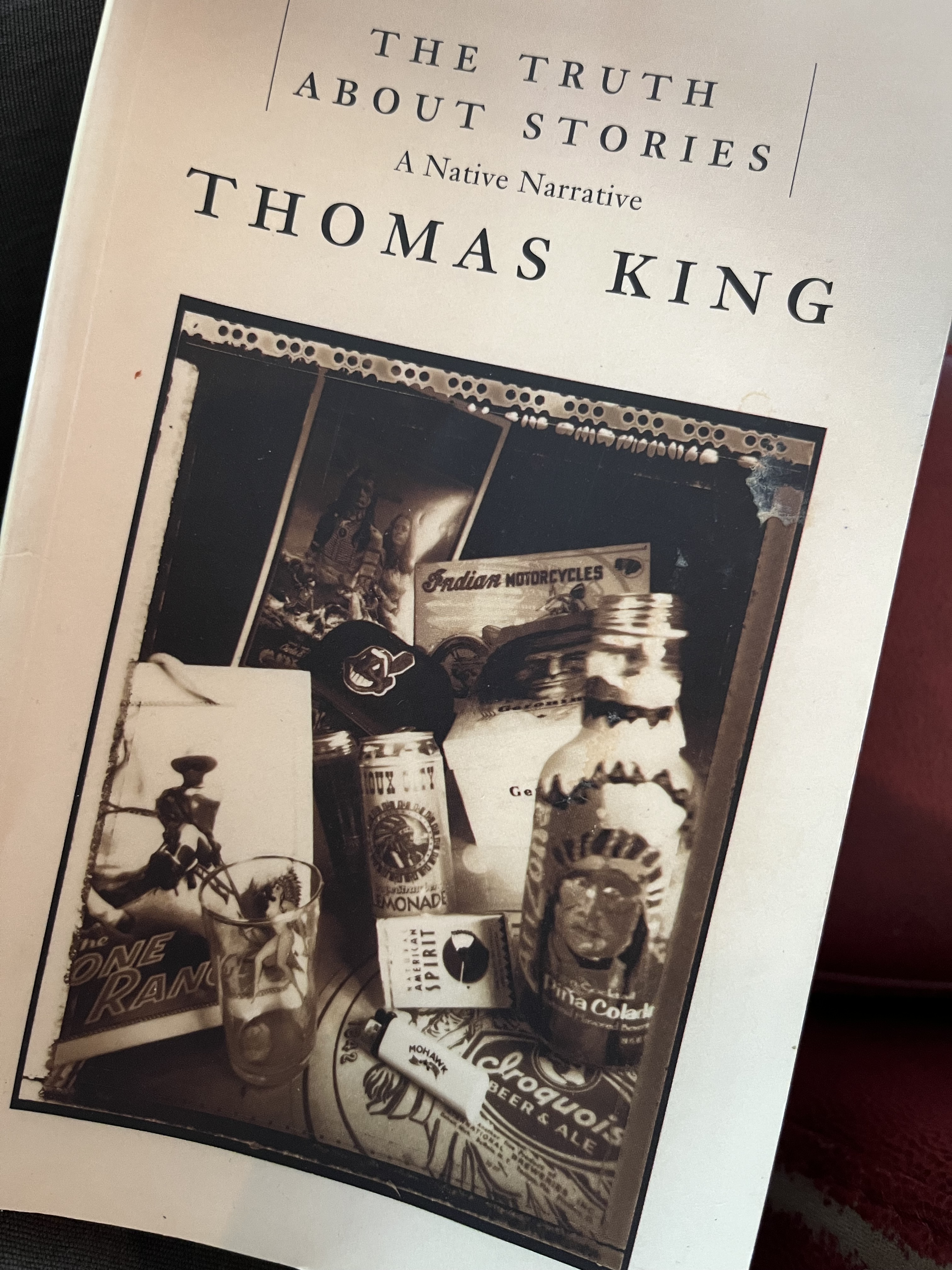
This is the second, maybe third, time I have read this book. It is that good. Oscar Wilde wrote that a book that isn’t worth reading twice is not worth reading once. The Truth about stories is worth reading once, maybe even three times. “The truth about stories is that is all that we are.” King repeats throughout the book as he tells stories within stories, mixing personal narrative with native “myth” and historical facts to illustrate, expand and deepen each section/chapter of his book. His themes are identity, how we become who we think we are, how we can change who we think we are; How others come to define us through the stories they tell about ourselves and themselves; and that we can change our world by changing the stories we tell each other. King is an indigenous Canadian. He focuses early on in the book about how one is an Indian, and how a large part of that definition is provided by the non-indigenous, from how one is supposed to dress to be seen as authentic, to convoluted arcane laws developed by the government in their attempts to control and eventually eliminate the Indian. He has a wonderful light touch in his writing style that makes an otherwise grim tale less horrific without sounding paternalistic. King begins each chapter with the story of the world carried on the back of a turtle, which is carried on another turtle ad infinitum. I assume to point out that there is never a sole basis for the story we live within. He ends each chapter in a similar way connecting the end to one of the stories from that chapter. Here is one of them: “Take it. It’s yours. Do with it what you will. Tell it to your children. Turn it into a play. Forget it. But don’t say in the years to come that you would have lived your life differently if only you had heard this story. You’ve heard it now.”
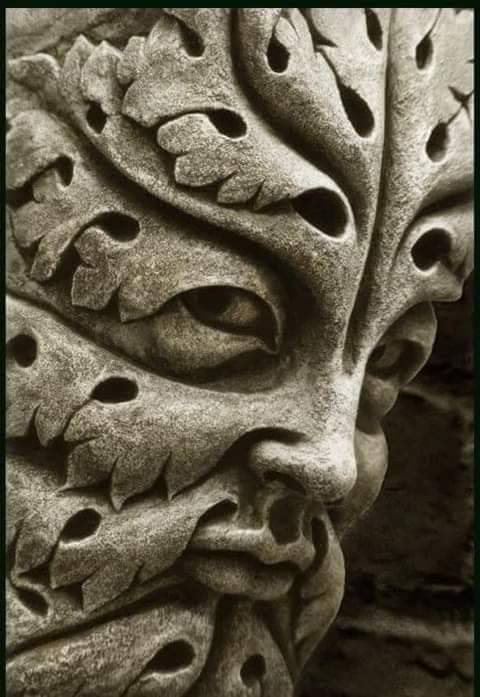
Ghosts move through the house, sitting on the kitchen table, on the arms of overstuffed chairs, looking at the blurbs on the backs of books left casually on side tables as if they still knew how to read. They have something more to say, but they have lost their ability to speak. I loan them my mouth. Their words almost fit what I say. They speak in the footnotes as unacknowledged experts to cite variations and caveats. Although no one has time to read their comments, their soft attention to others’ details reshape the shadows until memory begins to cling to their faces like stone veils, or muscles to bone. They no longer belong to the story they once were, anymore than I know the end of mine.





 subtext